Fight of the century. 1954 style.

Steve_Zoranich

Dodgy Perth spent Sunday morning in the pub watching one man hit another man in the head.

Because it was the Inglewood Hotel, this was happening on TV. Unlike our usual local, the Civic, where these kind of events happen in the car park out the back.

Anyway, we digress.

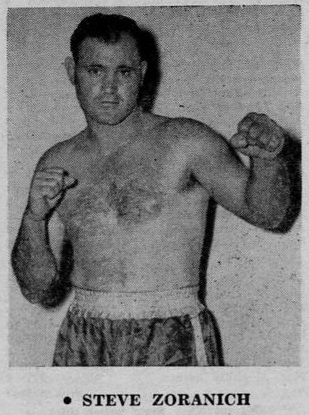
In 1954, the Empire Games (now called the Commonwealth Games) were being held in Vancouver. One of Perth’s star entries was Australian amateur heavyweight boxing champion, Steve Zoranich.

Steve was 25 at the time, having arrived in WA from Croatia at the age of eleven.

The Australian team was to fly to Canada via Hawaii, but for unexplained reasons, at the very last minute Steve was refused a USA visa, required to change planes.

Steve was bewildered: “My opinions have never affected anybody. I have never spoken from a platform, nor stood as a candidate for any Party. I have never appeared in court, nor even been cautioned for political reasons. I can’t understand it.”

He appealed to the American authorities but they refused to change their minds.

The only other way to Canada was via England, but this would have to be entirely at Steve’s own expense.

Fortunately his friends and family immediately started crowdsourcing the necessary money, which was raised amazingly quickly.

Even so, it took Steve nine days and 32,000 km to get to Vancouver, by way of Singapore, Calcutta, Cairo, Rome, London, and Iceland.

He also had no trouble with the Canadian immigration officials, the Americans still having failed to provide a reason for refusing a visa.

We wish that this story ended well, but it doesn’t.

In the first round his English opponent, Brian Harper, floored Zoranich with a solid right cross. Zoranich quickly got up, but before anyone knew what had happened, the referee claimed he had finished the count and the Englishman was declared the winner.

The manager of the Australian boxing team immediately protested, but his objections were waved away by the referee.

If there is a moral to this, it is that not all stories have happy endings. Bring on the next Mayweather-Pacquiao fight, so the right man can win at least once.
An unreliable history of Perth

Foundation_of_Perth

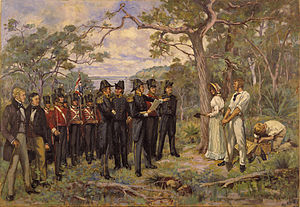
Commemorating the centenary of the founding of Perth, you might imagine people were serious in 1929. You would be wrong:

Forsooth on the 12th day of August in the year of grace one thousand eight hundred and one less than thirty, many good citizens gathered together unto themselves and said, “We must have a city.”

Forthwith they repaired to Governor Stirling, whom they found on his back on the floor of his coach-house endeavouring to repair the differential of his coach and pair.

“We good citizens and true wish to have a city,” they told him.

“The devil you do,” spluttered Stirling as he rose to his feet and adjusted his knee breeches. “Then a city you shall have.”

For the next few days there was great to-do in the new colony. Several good ladies immediately commenced making clothes for the natives in case they desired to attend and drink the King’s health and beer.

At last the great day dawned. The settlers cleaned up their huts and photographers adjusted their easels and paint pots. They came from far and near and further than that and flags flapped and skirts trailed in the dust as the colonists assembled round the Union Jack.

There was a rousing cheer for Governor Stirling as he began to speak: “This city we are founding today,” he said, “is destined to be the capital of a State of great potentialities and possibilities.” (Cheers from the bystanders and groans of “We’ve heard that one before” in the language of the blacks). “Here we will build a city that will one day be great. Along the track where Mrs Jones’ goat goes to call for the paper every morning we will make a street and call it Hay Street.

“Down here we will make Murray Street. From here Harry Boan will sell his third floor specials. Down further we will have Wellington Street, called after the Great Duke. The railway will be right next door. An ideal site this, ladies and gentlemen, for an advertising sign or a fruit barrow, think you not? And let’s have a market here! And a hotel or two.

“Come with me in imagination up this hill to the West. One day people will be able to travel there in trams or Government cars where we now ride in imagination. Here I beg you to tread quietly lest you waken those who will one day sleep there. Here will ambition be born and die, characters be made and lost; this will be Parliament—not the cemetery.

“Out yonder far beyond Harry Boan’s duckpond and Perry’s lane and Ginger’s hansom cab stand we will have a place for the dead. And on festival days and sundry Saturday afternoons the crowds will foregather. And behold their lamentations will be loud and their tears many when they see the dead. This my friends our children and grandchildren will call Ascot.

And forthwith the guests had afternoon tea while the settlers who had not been invited sat on one side and snarled and the natives threw boomerangs at the big sign that had just been erected on the site of the new city: “Eat Bullpup’s biscuits to prevent ingrowing toenails.”

Two men who were unemployed attempted to secure afternoon tea but the police—both of them—turned them away.

Correcting naughty children

Chamberlains

Do you have mischievous children? We at Dodgy Perth have the solution.

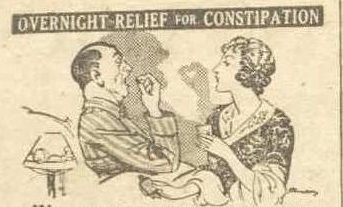
Adverts in the press in 1907 informed you that naughtiness is usually caused by a “disordered stomach”. The good parent will automatically dose the kid up with loads of Chamberlain’s Tablets.

That is to say, a good parent plies their misbehaving child with laxatives. Laxatives.

Apparently you will be delighted with the results.

Should you require any laxatives to make your child into a little angel, just ask your local chemist for the appropriate dose.

Is there a worse city than this?

Edmund Barton Building, Canberra. For unknown reasons, Heritage Listed.

Edmund Barton Building, Canberra. Heritage Listed. Seriously.

We at Dodgy Perth have used not a little ink in the past criticising WA architecture. So, for once, we turn our attention to a different city.

Colin Ednie-Brown, one of Perth’s most famous architects, had the misfortune to visit Australia’s new capital in 1927. ‘Designed’ by Walter Burley Griffin and Marion Mahony Griffin, Canberra has been described as many things, but good is not one of them.

Ednie-Brown certainly did not mince has words:

From an architectural standpoint the place disgusted me.

Everything has come out of the same mould, whether it be a residence or a hotel. The money wasted and thrown away on such a type of buildings is appalling.

Most of the buildings are jerry-built, and of a poor quality of workmanship. The thing that struck me most was the obvious lack of expert supervision throughout the whole of the work.

It is hardly believable that such a scandal should ever have been allowed.

Okay, so Canberra was not exactly to Colin’s taste. Surely he liked something?

Just one building, really. The GG’s residence. But that was only because it was an adaptation of an old homestead.

Just in case you suspect that this is just one WA architect’s opinion. It wasn’t. Famously, Robert Menzies despised Canberra and was embarrassed to be seen there.

So whenever you need cheering up, just remember there are worse places you could live. Like Canberra.

“Commercialised patriotism and commercialised sentiment”

Anzac Day on the Esplanade, 1928

Anzac Day on the Esplanade, 1928

Dodgy Perth missed Anzac Day this year, by virtue of being abroad. However we did discover a bar in Manchester which served Little Creatures Pale Ale, and so a glass was appropriately raised last Saturday.

So, to make up for our failure to attend a service, we offer the thoughts of someone from 1930, who did manage to get to such an event on the Esplanade.

Our writer first notes that the setting is perfect. The Swan River with its white yachts at anchor and the wooded slopes of Mt Eliza extending to the water’s edge making a beautiful and peaceful background to the scene.

As ever, there was a raised platform on the Esplanade for politicians, clergy, businessmen, leading citizens and military officers. In front of the platform were a sorrowful and subdued crowd.

The celebrations claimed to be in remembrance of “gallant fellows whose bones now repose on many of the battlefields of Europe”. But our observer is not so sure that it was.

He had a nagging feeling that the day was nothing more than sneaky way of instilling war propaganda into the receptive minds of young children.

The speeches, he scoffed, were nothing more than “commercialised patriotism, commercialised sentiment, commercialized reverence and commercialised Christianity”.

All he heard was humbug and cant about the glories of war, and nothing of its horror, its resultant sorrow, misery, poverty, and hardships.

Taking a sudden turn to the Left, the writer remembers the huge profits to be made from international disputes.

“Let those who make wars fight them,” he declares.

Complaints about the capitalist adoption of Anzac Day? Criticism of politicians’ motives for engaging in war? At least this could never happen nowadays.

An architectural monstrosity

004004d

People dressed in Western Australia’s traditional costume

If asked to list Perth’s ten worst buildings, this office would definitely include London Court. A cut-price Disneyland Tudor street scene, it was erected in 1937 by shady miner, Claude de Bernales.

How bad does a building have to be to get condemned from the pulpit? Rev Iona Williams described it as so ugly, London Court was an offence against God Himself. Preaching at Trinity Congregational Church, the good reverend said the arcade was a admission that architects had no original ideas. Architecture should be about the now, not a repetition of the past.

But what would a theologian know? Let’s get the opinion of an architect. A poor imitation of Tudor architecture, the architect spluttered, before lashing out at the ridiculous Punch and Judy clock. When archaeologists of the future excavate the arcade, he said, they will be baffled as to why it was erected in the first place. In any case, a good archaeologist would immediately rebury the monstrosity.

Warming to his theme, the architect demanded to know where it would all end? A Leaning Tower of Pisa outside the GPO? Stonehenge on the Esplanade?

In a blistering conclusion, he said the only thing that should be doing impressions is a monkey. And a monkey would probably have made a better job of the London Court anyway.

As you can see, London Court has been much loved ever since it was erected.

Drop-in prophets

I foresee you liking the following snapshot of Perth history

I foresee you liking the following snapshot of Perth history

Madams Zona, Mora and Carlotta were fortune-tellers working in the CBD in 1907. Unfortunately for them, back then being a psychic was illegal. So when a young undercover policeman, Constable Smith, was sent to visit, it was never going to end well.

Constable Smith first entered Madam Mora’s premises in Wellington Street. The plain-clothed bachelor pretended to have a wife who had abandoned him at Coolgardie. He asked the psychic if she could locate this imaginary woman. Mora picked up her cards and told Smith to divide it into three piles.

Using her ‘psychic’ abilities, she read the cards, announcing “You will find your wife shortly.” The cards also revealed a dark man who was connected with Smith’s troubles, and this stranger would try to kill the copper.

Smith paid Zora half-a-crown, and she warned him to say nothing about his visit. Strangely, her clairvoyance did not extend to noticing he was an undercover law enforcement official.

Madam Carlotta was a palmist. In exchange for Smith’s money she also revealed the non-existent wife would soon show up. Not only that, but he would have four children. Even more excitingly, Smith was soon to become an engineer, who would gain fame through an amazing invention.

The final visit to Madam Zona also promised a happy reunion for the policeman. And still the psychics didn’t discover their immediate destiny was to be a trip to court. There, they were spared jail on condition they agreed to cease telling fortunes.

Dodgy Perth does not know what happened to Zona, but Madam Carlotta—known to her friends as Ethel Daley—was unable to give up her trade, and was prosecuted again a few years after.

Mora’s future, though, turned her card skills in a surprising direction. She became an illusionist, regularly appearing at the Melrose Theatre in Murray Street. She also became renowned as a debunker, exposing spiritualist scams and teaching people about gambling tricks.

Now who would have seen that coming?

In the land of the Pharaohs

28th Battalion parades along Barrack Street

28th Battalion parades along Barrack Street

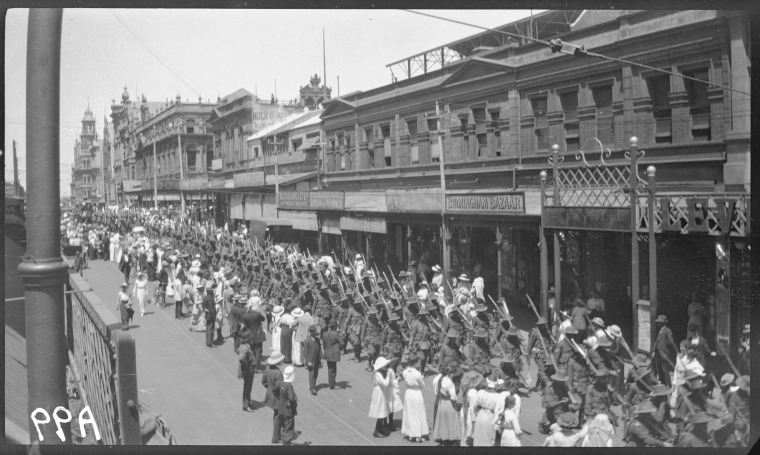
William Granger was a young journalist working for the Great Southern Leader in Pingelly. When WWI broke out, like many others in this State he joined the 28th Battalion to serve the Empire.

On arrival in the Middle East he penned a brief account of everyday life. In his memory, Dodgy Perth invites you to sample the sights and sounds of Egypt while war raged across Europe.

The reader should be aware the following uses language no longer acceptable, but which was normal among white Australians at the time.

Well to say the very least, the train journey was a remarkable eye-opener. I have been always led to believe that the Suez to Cairo journey was through an endless tract of arid desert, but I found that just the opposite was the case. For miles upon mile there was stretched as far as the eye could see, vast green fields in. which profusely growing were tobacco, cotton, dates, grapes, melons, rice, grain, and numerous other articles.

Stations are very numerous and at any of the larger ones a small army of natives besiege us with melons and fruit which they endeavoured to palm off on us at ridiculous prices. However, one can barter with them and often the price is reduced 75 per cent.

The nigs are the laziest and most cunning beggars ever known, they won’t do a tap of work unless the boss stands over them all the time. If the work extends over an hour or so they plead hungry and complain of divers pains—an Australian native is bad enough but they are kings compared with these heathens. They too are abominably dirty, and you can see them covered in sores and flies wandering around eating out of slop buckets. Ugh! they make one sick.

We are at Abbassich, seven miles from Cairo and a mile from Heliopolis. This latter place is an achievement of modern masonry and architecture and is wonder fully clean compared with other towns here. The buildings are large, airy, and the thoroughfares spacy and there is not the appearance of slummery that is so frightfully prevalent in Cairo. Picture shows and salons are run in conjunction with bars and the musical and pictorial portion is free to all.

There are a tremendous lot of wounded here and many large buildings have been commandeered by the military authorities for hospitals. One of the largest and finest buildings in the world containing 700 rooms and a picture of modern science—the Palace—has been taken over for this purpose. This magnificent building was built for a casino, but the license was not granted, hence its being utilised thus, which methinks is for a much better cause.

In passing, beer is obtainable from 1 piastre (2½d) to 2 piastres per pint. English beer can be obtained that is alright, but the local stuff, which is obtainable at every cafe in the street, is abominable stuff and is more deadly than “Mallet Bark”.

A decent feed costs from 6 to 12 piastres, but the mode of dishing up a meal is most peculiar and takes some getting used to.

I have been in Cairo several times but don’t care much for the place. It is of big dimension, and holds a large population and almost every country is represented amongst its cosmopolitan numbers. There is no design about the lay-out of the place, and a street just goes where it will, very often ending abruptly at the wall of some building and back you go to try another way. There are numerous alley-ways and these beggar description, being absolutely indescribable. Filth and immorality prevail and every building seems to be a place of ill-fame and it is not safe to go through these parts singly.

Everybody from mites about two years old to old men somewhere in the vicinity of a century seems to be a business man and spends his time annoying pedestrians trying to palm off his wares. They sell anything and everything. As you walk through the streets you are almost continually followed about by a horde of these pests and they won’t leave till they are forcibly driven off.

I think I have written about all for this time so I will bring this short description of the place to a close.

Corporal William Granger fell in action at the Battle of Polygon Wood on 1 November 1917, aged 25.

The Inglewood scanties

panties

We imagine they looked something like this

As the Dodgy Perth team desperately tries to delete their names from the Ashley Madison database (we had no idea what the site was, we thought it was a garden equipment retailer), we look back to a time when more direct evidence of infidelity was left behind. In the laundry at an Inglewood home.

The date was 13 December 1947. The time, 11.30pm. Laura came back from her friend’s house, and opened her front door. In the living room she discovered an unknown dishevelled couple, while her beloved carpets were covered in beer and cigarette ash. There was no sign of hubby, James.

Screaming abuse, Laura ordered the strangers to get out. This brought James running into the room. Slurring and barely able to stand upright, he too was told to get out the house.

Muttering curses, Laura set about with a mop and brush to restore some order. After that, she stepped into the garden for fresh air.

There were scuffling noises from the outside laundry, and then a woman scampered out and fled. James poked his head around the laundry door.

Naturally, Laura accused him of less than honourable behaviour, but he denied it. By now she was in no mood to argue, and went to bed. Where James slept that night is not recorded.

The next day she went back to the laundry and in the middle of the floor were a pair of scanties. They definitely weren’t hers.

Taking the panties in her hand, she again confronted hubby. This time, with a sore head, facing the irrefutable evidence, he agreed he had not been completely honest the night before. He didn’t even know the woman’s name, having picked her up at the local pub (probably the Inglewood Hotel) for a quickie after he’d been thrown out earlier.

Laura moved out to Fourth Avenue in Mt Lawley, and got her divorce the following year.

The moral, dear reader, is to always clean up after you. And that includes email addresses.