Keeping it in the family

J. W. R. Linton, Perth from South Perth, c.1900

J. W. R. Linton, Perth from South Perth, c.1900

In 1905 the Sunday Times detected the whiff of gross mismanagement at Perth Museum.

There was, however, a little bit of self-interest in its accusation. The founder of the Sunday Times, Frederick Vosper, spent his spare time collecting minerals (and denouncing all non-white races, but that’s another story).

After Vosper’s death, his collection had been donated to the Museum. Which consequently stored it in a broom cupboard.

So when a Sunday Times journalist visited and noticed the minerals weren’t on display it was open season on the Museum’s management committee.

In those days the Museum and Art Gallery were one and the same place. And it was on the art collection that the newspaper turned its fire.

It was alleged that the majority of the collection was purchased from England not because of its quality, but because of family connections between artists and the Museum’s Board.

As a consequence, public money was being wasted on inferior paintings, just to ‘keep it in the family’.

But particular scorn was reserved for the Linton family. Sir James Dromgole Linton was a British artist who advised the Museum on its English purchases.

His son, James Linton, taught art in Perth. And simply because he was the offspring of a very minor English artist, the Museum went out of its way to buy everything James did.

And when they needed a backdrop for the stuffed birds, guess who was engaged to undertake it?

One of Linton’s canvases, purporting to be a representation of Fremantle Harbour, was a particularly bad example of his talentless watercolour daubs.

The Sunday Times described it as something you might paint “after a week on raw lobster.”

Nonetheless, his paintings took pride of place in every room, overshadowing art by painters who could actually paint.

In addition, James Linton’s name appeared all over the Museum. In all the guides, handbooks and reports, and on the financial statements.

The whole place, it was said, felt like Linton’s personal gallery, rather than a building owned by the people of Western Australia.

Of course, we at Dodgy Perth take no stand on the quality of Linton’s art. Except to note that the Sunday Times had it exactly right.

The Museum continued to collect Linton, and the work of offspring of Linton, including some teaspoons. And the work of anyone who took one of Linton’s courses, such as Herbert ‘Kitch’ Currie.

And, most likely, if you look hard enough, the work of Linton’s cat is on display somewhere in the Art Gallery. Probably.

Wake up and smell the coffee

Drunk-man

Starting in the 1890s advertisements appeared in WA newspapers extolling the benefits of a wonder drug called Eucrasy.

Unlike most medicines, though, the main benefit was not for the person who was taking it. Mainly because they didn’t know they were taking it.

It is, of course, very unfortunate if your husband is an alcoholic. Living with a drunkard is not anyone’s idea of fun.

One solution is to send hubbie off to an institute where they will inject him with bichloride of gold four times a day. This is the expensive option, and not within reach for most.

So we enter the crazy world of Eucrasy. A world where women were expected to administer drugs to their partner without his knowledge or consent.

By mail order, a month’s supply of the medication would arrive at your doorstep and it would then be secretly added to the drunkard’s tea, coffee, or slipped into his soup.

Colourless and tasteless, it had no side effects other than curing the man of his drinking problem.

The ingredients in Eucrasy were a secret, but it appears to have been some kind of vegetable extract and contained no minerals, and certainly none of the fashionable morphine, opium, or cocaine.

Instantly, the wife would have noticed her husband’s appetite return, and a loss of desire for alcohol in a mere one to two days

Complete cures could be effected in a week or two.

And we can’t just chalk this one up to Victorian-era weirdness. The medicine was still being marketed in the mid-1950s as something you should secretly slip into hubbie’s coffee.

So men, when you next see your partner slipping drugs into your morning cuppa, don’t assume she’s doing anything bad. It’s just an attempt to keep you away from the pub this evening.

Love is in the air

trap1

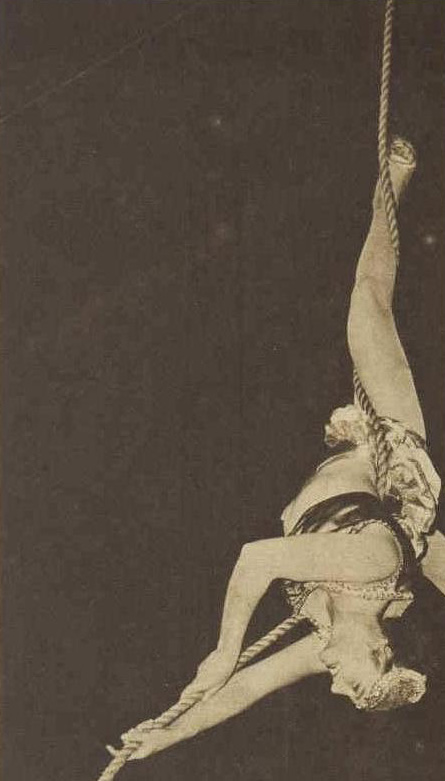
Marlene Dennis, 1959

Did you hear the one about the lion tamer who fell in love with a trapeze artist?

It’s not a joke. Just a story of everyday life in Cannington in 1938.

Mavis Bullen was a trapeze artist from the famous Bullen’s Circus. Professionally working as ‘Miss Jeanette’, she would swing near the tent top, high over the heads of the audience in a seeming death-defying act.

A trapeze artist’s life depends on a good relationship with the man who worked the ropes. In Mavis’ case, this was Bob Dennis, who also doubled up as the lion tamer.

Now, a man who has no problems wrestling a lion isn’t likely to be backwards at coming forwards.

Even so, it was some time before Bob could bring himself to propose to Mavis. And when he did, she refused him point-blank.

The lion-tamer was not going to let a little thing like a refusal worry him. He waited until next time they were rehearsing, and when Mavis was sitting on the trapeze he asked again. Once more she shook her head.

Bob said nothing, but simply tied the rope to a post and left her in the swing until she changed her mind.

In the middle of winter it’s pretty cold sitting on a swing wearing only a trapeze costume, but she stuck to her decision.

After that, every rehearsal, Bob stuck to his strategy—only each time he kept Mavis aloft a bit longer.

When she complained to her mother about this treatment, she got little sympathy. “Serves you right,” said Mrs Perce Bullen. “You’re both in love, and the sooner you make up your minds the better.”

The following day at the end of practice Bob refused to lower Mavis to the ground.

“Will you marry me?” he shouted from the ring. She half smiled, but shook her head.

“All right, then. You’ll stay up there this time till you change your mind,” he said. And she did stay. For an hour and a half.

As Mavis shivered high in the air, Bob stayed below casually smoking a cigarette.

Eventually she called: “Let me down, Bob. I’ve changed my mind.”

Mrs Bullen, who had watched the whole proceedings from a distance, broke their embrace to give them her blessing.

The marriage does seem to have been a success, and one of their daughters, Marlene, went on to perform as a trapeze artist and to work with animals.

Did you hear the one about the lion tamer who fell in love with a trapeze artist?

They lived happily ever after. And that’s not a joke.

Murder on the dancefloor

Audrey Jacob, 1925

Audrey Jacob, 1925

Hundreds set out to have a good time at Government House Ballroom on the night of 23 August 1925. Young men and women dressed to the nines to party in aid of St John of God Hospital.

At half past one in the morning, few dancers observed a tall, slim girl with short dark hair, dressed in a blue silk evening frock. She crossed to an attractive young couple in the centre of the floor and spoke with the tall well-built young man, handsome and smartly dressed in evening suit. He turned and said something to her as the orchestra started up.

Suddenly above the wail of the saxophone and the drums came a loud noise. The music and dancing ceased and all eyes turned on the man as he staggered and fell to the floor with a heavy thump.

Cyril Gidley was arrogant, cruel and violent. Dodgy Perth will spend no time mourning his loss. Instead we turn our attention to the attractive 20-year-old art student whose life was never to be the same again. Audrey Jacob.

Audrey had been engaged to a naval officer, Claude Arundel, when Gidley had come on the scene around twelve months before his death. After much persuasion, she broke off her engagement and agreed to marry the new man in her life.

But one night, on the way to Gidley’s lodgings, they quarrelled because she had received a letter from her former fiancé. Gidley became enraged.

He picked her up and carried her to his room.

“I struggled, and tried to get away,” sobbed Audrey. “Sometimes he would let me get as far as the door, and then pull me back. He seemed to be enjoying the joke. He was very cruel by nature.”

When she was exhausted he grabbed the art student by the throat and hissed the single word “Yes” at her.

The next day Audrey’s mother found her crying, and noticing the bruises on her neck, guessed what had happened.

On the fateful night in August 1925, a girlfriend persuaded Audrey to attend the ball at Government House. They went dressed as Pierrot and Pierrette.

It was then that she noticed Gidley dancing with another girl. She approached him, questioned what he was doing, but he told her to mind her own business and leave him alone.

Audrey ran from the ballroom and returned to her lodgings on the corner of St George’s Terrace and Howard Street. Sobbing for half an hour, she started to undress, before noticing a loaded revolver in her drawer.

Deciding to end it all, she put on her blue evening dress, and walked to the foreshore. But here she began to consider what would happen to her immortal soul if she used the gun on herself. Instead, she went to the Roman Catholic Cathedral, and there, at midnight, knelt in the grass and recited the Rosary.

A strange calm came over her, and she decided to return home. But passing the ballroom, she noticed that the party was still going on. She made the decision to make a final effort to speak to the man she loved.

Making her way through the dancers, with the revolver still wrapped in her handkerchief, she touched him on the shoulder. He turned, and simply said “Excuse me, I am dancing with my fiancée.”

The room span and something snapped. In this dazed condition, Audrey raised her hand to her head—and then she heard a shot and saw Gidley fall.

After deliberating for an hour and a quarter the jury returned a verdict of not guilty. Audrey rose from her seat, and her mother rushed into the dock. No attempt was made to stop an outburst of applause from the crowded gallery.

It was always going to be impossible to resume life in Perth, and Audrey married an American industrialist, Roger Sinclair, and left for New York early in 1926.

For Perth, though, this was not the end of their fascination and for several years rumours continued to fly that Audrey was stranded penniless in South Africa, or that her husband had turned out to be a bigamist.

None of these stories were true, of course, and the last we know of Audrey Campbell Jacob is that she arrived in Boston on 2 May 1926 on board the Celtic. After that, Perth never heard from her again.

White Australia, I could be one of your kids

Frederick_Vosper

Frederick Vosper, looking bohemian and not at all like a bigot

We in the Dodgy Perth office are in favour of people using their democratic right to protest against mosques. It makes organising dinner parties much easier when the bigots have outed themselves.

But before we get too smug and believe only the Victorians have a racism problem, a quick look back at the Anti-Asiatic League which was formed at Coolgardie in 1894 to ensure only white folk worked the goldfields.

All-round racist, and founder of the Sunday Times, Frederick Vosper explained to a public rally that the average Afghan had first come to Coolgardie as a mere camel driver. By working hard he had gradually become a storeman, then a member of the police force. Eventually, some Afghans had obtained work with the council.

Naturally such an evil could not be allowed to go unchecked, Vosper explained, so whites had been forced to found the Anti-Asiatic League to stop hard-working Muslims getting jobs.

Being a clever chap, Vosper had noted whites and Afghans had different religions. Therefore, he said, the two races could never be on friendly terms. Not only that, the buggers were so dirty they polluted the water supply just by using it.

Warming to his theme, Frederick explained that since dogs were quarantined to stop rabies, Muslims should be quarantined to prevent leprosy. And just like he would today, Vosper read a few out-of-context lines from the Qur’an to prove Muslims hated Christians.

Either the white man or the Afghan must go, he declared. The miners, at any rate, were determined that it should be the Afghan.

The Anti-Asiatic League roared its approval and this tolerant nation took one more step on the road to White Australia.

Pistol packing Coral

coral

Bang bang, she shot me down. Coral Honter in 1956

In 1956, there was indignation when a Bicton dance hall presented Coral Honter doing the daring Dance of the Seven Veils. The stunning 18-year-old entertainer, originally from Colombo, raised more than just eyebrows with her strip teases.

Now living in South Perth, the young beauty had developed a fan base among the local ‘jazz sophisticates’. So when Coral announced she would perform the songs of American singer-songwriter Ruth Wallis, it was always going to be controversial.

The songs of Ruth Wallis were banned in Australia, her records confiscated by the authorities, and even possession of them was illegal.

Wallis’ lyrics were pure double entendre from start to finish. A typical verse would run:

Johnny’s got a yo-yo
It really is a wow
Teacher keeps him after school
So he can show her how.
It’s shiny and he says it is brand new
And he can do more tricks with it than his dad can do.
You can’t learn to play with it just by wishin’,
You gotta know how to hold it in the right position
By intuition…

Apart from Johnny Had a Yo-Yo, Coral announced she would also be singing Tonight For Sure, The Pistol Song, Sweater Girl, The Admiral’s Daughter, Down In Montevideo and The Psycho Mambo.

Setting out to provoke Perth’s conservative elements, Coral sweetly said: “I couldn’t care less if a few prudes make a fuss about my singing these songs. Most people, I am sure, will enjoy their sexy sizzle—that’s if they’re sophisticated.”

Coral’s charms had not gone unnoticed by wannabe sugar daddies, especially as she developed a reputation for liberal distribution of kisses during her numbers. “I’ve got one weakness,” she slyly admitted. “Bald heads.”

Sugar daddies had better watch out. This is one smart cookie.

Who ya gonna call?

ghostbusters

And they say the media doesn’t turn kids into criminals.

In 1938 one of the most popular radio shows was a serial about haunted houses.

In the Bicton area, every young boy aged between nine and twelve would sit glued to the wireless to hear the latest episode.

So, when a rumour spread that an empty house on Canning Highway in Palmyra was haunted, it was going to be impossible to keep them away. Especially when the boys were told that there was a reward of £5 for the first person to capture the spirit.

haunted

The haunted house on Canning Highway

Around 25 of the little horrors got together, determined to become WA’s first ghostbusters.

And that many eager boys, all determined to ensnare a phantom, found the house was locked. This minor detail was not going to stand in their way.

Windows were broken, and the front door was forced open.

One poor unfortunate found himself pushed right through the French windows by the surging kids behind.

Of course, that’s not exactly what they said to the investigating police officer.

In fact, they said that they had just touched the door and it had fallen off its hinges. And when one lad had merely laid a finger on a window it had broken all by itself.

Kids, eh?

Once inside, they discovered… the ghost.

No really, they did.

Okay, it turned out to be one of their gang with a white sheet over his head, and who presumably had been the ringleader in stirring up the whole escapade in the first place.

But it was a bit like a spectre.

All the ghostbusters were too young to charge with criminal damage, but they still cost their parents a pretty penny to put the damage right.

We blame the media.

You know what gets my goat?

goat

Who are you calling a hillbilly?

Animal rights activists, look away now. Dodgy Perth presents a horrible tale of goat cruelty from 1905. The scene is Hare Street, Kalgoorlie, around 5 o’clock in the afternoon.

An elderly man, Owen O’Neill, drives his cart up to Edward Chidlow’s house and screams out that the occupant is “a EXPLETIVE DELETED murderer” and “a EXPLETIVE DELETED convict”. The old gentleman dares Edward to come out and settle this like a real man.

Receiving no response, Owen slowly pulls away, continuing to yell abuse.

What could have caused such drama? As it turns out, the death of Owen’s beloved goat.

He had owned a milch goat which much appreciated in Kal. One small girl had been so sick she could consume nothing but a little goat’s milk. Now the goat was dead, and the little girl cried all the time.

Did we forget to mention how the goat died? Edward had lured it from Owen’s premises, shot it, and cut its throat.

The heartbroken Owen walked up to the murderer and asked: “Did you kill this goat?” Edward calmly, and somewhat harshly, replied with a simple “Yes.”

After that, every time he encountered the old man, Edward put his fingers to his nose and baa-a-aa at him like his poor deceased goat.

Of course the whole thing ended up in court. Owen was found guilty of using abusive language in a public place and heavily fined, with the threat of one month’s hard labour if he failed to pay.

The goat murderer, of course, walked free. Justice? It ain’t what it used to be.