Where the streets have no name

map_perth

They appear to have accidentally built Perth on a load of lakes

Well, they do have names. And stories behind them. As we start to get things together for the Dictionary of Perth website, it’s fairly evident that one thing that fascinates people is the origin of street names. Having a story to go with your road makes it just a little bit more magical.

The first complete record of street names in the city was made on 12 February 1838, when an official map was issued. Perth was less than ten years old and there were very few decent roads in existence.

So, without further ado, we’ll get the ball rolling with the people behind some of the larger streets in Perth.

Aberdeen Street

Received its name in honour of George Hamilton Gordon, Earl of Aberdeen and Prime Minister of England in 1831.

Newcastle Street

The Duke of Newcastle, Secretary of State for the Colonies from 1852 to 1854. An old street named Ellen Street after Lady Ellen Stirling, wife of the Governor, extended from Lake Street to Stirling Street is now part of Newcastle Street. In the early days, the road east of Stirling Street was called Mangles Street, after Ellen’s maiden name.

Beaufort Street

Named after Irishman Rear-Admiral Sir Francis Beaufort, who in 1829 was the Admiralty’s chief map-maker.

One of his groupies was John Septimus Roe, who first planned Perth, and who not only named Beaufort Street after him but also Francis Street in Northbridge.

In an earlier version of this post we claimed it was named after Lord Charles Henry Somerset, second son of Henry, 5th Duke of Beaufort. This turns out to be a 19th century urban myth.

Goderich Street

Originally extended towards town as far as Barrack Street. It was named after Viscount Goderich, Prime Minister of England in 1827-28 and Secretary of State for the Colonies in 1830-1833.

Murray Street

Named after Sir George Murray, Secretary of State for the Colonies from 1828 to 1830.

James Street

Honours the Christian name of Sir James Stirling

Mount’s Bay Road

Shown on the 1838 map as Morgan Street, it took its name from J. Morgan, Resident Magistrate of Perth in 1832, and who was tasked with making this road.

Pier Street

Originally extended from Perth’s first landing stage northwards through the present grounds of Government House.

Stirling Street

The surname of the State’s first Governor

St. George’s Terrace

In honour of the patron saint of England.

William Street

Originally King William-street, after William IV. During the years the ‘King’ was dropped and when this was done, King Street came into being.

Hay Street

Named after Robert William Hay, Permanent Under-Secretary for Colonies when Perth started. East of Barrack Street, Hay Street was once known as Howick Street, after Lord Howick, an official in the Colonial Office.

Lord Street

Lord Howick, Lord Wellington and Lord Goderich having given their names to three parallel streets, Lord Street probably received its name from its close connection with the three thoroughfares.

Adelaide Terrace

Named after Queen Adelaide, wife of William IV.

Barrack Street

The first barracks in the State were erected near the corner of Barrack Street and St. George’s Terrace.

Wellington Street

With the victories of Nelson and Wellington still fresh memories, many street names show how patriotic the early settlers were. Nelson Crescent, Horatio Street, Nile Street (after a famous campaign), Waterloo Crescent, and Trafalgar Road. Bronte Street is so called because Lord Nelson was Duke of Bronte.

West Perth streets

In 1877-78, Col. R. T. Goldsworthy, Colonial Secretary of the State, who served during the First War of Independence in India (then called the Indian Mutiny) fixed the names of several Perth streets after this event. Colin Street after Sir Colin Campbell, Delhi Street, Havelock Street after General Sir Henry Havelock and Outram Street after General Sir James Outram.

Bad seating and the flirt

DSCN0024

We recommend you bring your own cushion

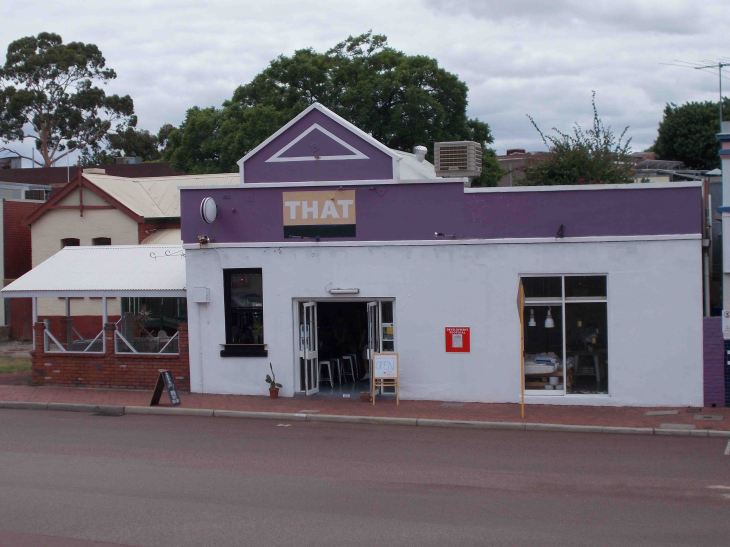
Apparently everyone but us knew the above building on Eighth Avenue Maylands used to be a cinema. We should have guessed from the shape of the rear of the place, but we didn’t. In any case, welcome to the Lyric Theatre.

Opening on 31 August 1923, there was a small hiccup because the circle had not yet been inspected for safety regulations, so only the ground floor was available. This didn’t stop the owners, though, who weren’t going to put off showing their opening flick, ‘The Flirt’.

This pre-Hays Code movie was based on the best-selling novel by Booth Tarkington. Unfortunately, we have been unable to find out much about it (many films of this era are now lost, and this may be one of them). But it was remade in 1931 as ‘The Bad Sister’ which marked the screen debut of Bette Davis, who apparently had eyes. If you have a spare hour, enjoy it here:

It wasn’t always smooth sailing for the Lyric, and in 1949 patrons complained that management had raised ticket prices despite torn seats with springs protruding through the covers. The theatre was unmoved, claiming customers should be grateful the seating was upholstered at all.

The Lyric closed in June 1961, after which it became an electrical goods showroom, then a growers’ market, a Red Shield Op-shop, a BWS, and now hosts a coffee shop, which makes a great skinny flat white as we found out this morning.

As Maylands continues to bloom perhaps it’s time for a micro cinema in memory of the Lyric. But with better seating.

The case of the missing hubby

king_will_dp

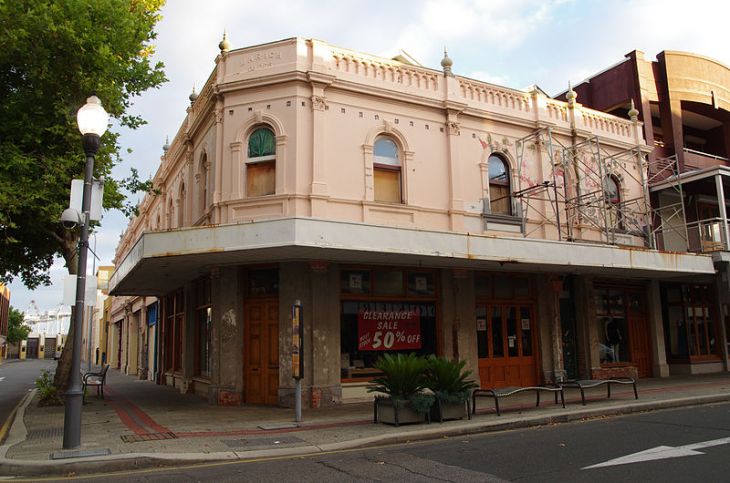
If these walls could speak, they would say bad things about James McLeish

When you lose a building you lose an opportunity to tell the stories about the people who lived there. Sure, the stories still exist but they are so much more real when connected to a place.

The above building, 11 King William Street in Bayswater, probably doesn’t have long for this world. Bits of the façade might be saved, but that will be all. Currently occupied by a number of businesses, the best of these is a small coffee shop run by two brothers who are evidently trying to out-do each other in the who-looks-most-hipster game. But they are only the most recent part of the story.

The left hand side of the building was built, probably in 1905, as a general store for Robert and Mary McLeish. The right hand side of the store and the façade are probably 1920s, when Bayswater’s main shopping district expanded with all the new people moving to the area.

The couple had come over from Adelaide in 1902 to set up business in Bayswater. They were evidently a good match, since they eventually celebrated their diamond wedding anniversary.

This story isn’t about them, but son James. He married a Melbourne lass, Ethel, in 1920 and came to WA three years later. Dad, Robert, helped set James up in business, and eventually (four kids later), the younger pair took over the running of the King William Street store.

But in February 1940, James declared he needed to go on holiday to the South West for a weekend. However, as Ethel explained four years later:

First he said for a weekend, then a week, and finally changed his mind and said he’d take a month. I’ve neither heard from him nor seen him since.

She took over the running of the shop and quickly realised he’d never meant to return, having taken all the cash with him, leaving her only with unpaid bills.

Fortunately, Robert McLeish stepped in and settled the debts, and let Ethel and one of his daughters run the store.

You won’t be surprised to discover she got her divorce when she asked the courts for it.

Water, water, everywhere

salisbury

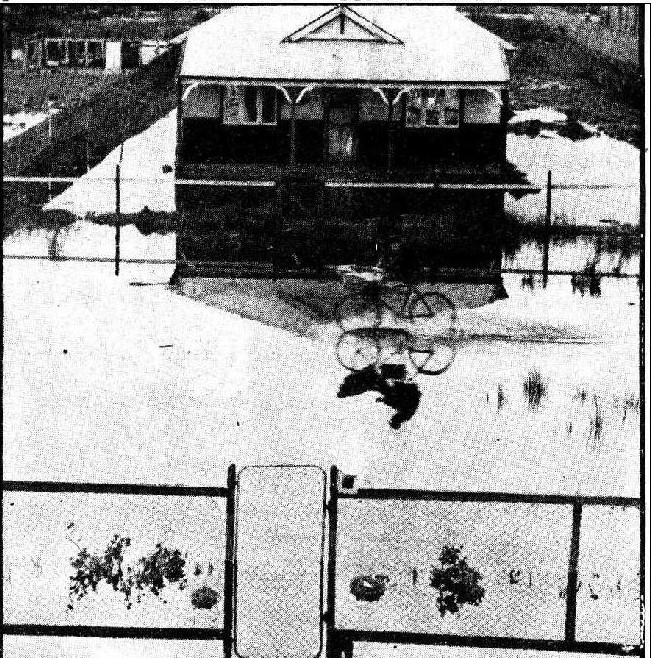
We’re not certain, but we think this is 43 Salisbury Street, Bayswater. And is still there.

It’s raining outside, so this seems as good a moment as any to discuss the Great Bayswater Flood of 1939. How do you feel like spending two months with your house underwater?

In July, floods forced several families to evacuate from their houses in Salisbury Street. A depression in the road had filled with water and it turned into a 40-metre-long lake. It was there so long, thousands of tadpoles swam in it and frogs kept up an incessant croaking.

One residence became an island and it was impossible to access the front door. But Mrs McBarron refused to leave her house, even though she could only get her family in and out through a gap in the side fence and then through their neighbour’s house.

Bayswater council made noises about dealing with the problem, but they had known about the issue for years and done nothing. Eventually, the council begged the government for help, but were (correctly) told small drains were Bayswater’s responsibility.

By August things were even worse. For three weeks Mrs McBarron had been walking along precariously balanced boards and boxes to get to the back fence. Her small daughter paddled around the backyard in a tin canoe, which allowed her to get to three houses either side. She might have thought this was fun, but her mother didn’t.

After seven weeks of living in the middle of a lake, things looked no better. Cars attempting to plough through the water stopped in the middle of the road and had to be pulled out. It was only when parts of Beaufort Street went underwater that the council and government finally got their act together.

Eventually, after August came and went, the water dropped. Bayswater finally decided to pull their finger out and do some drainage work the following year. All too little, all too late.

A jolly good Post Office

DSCN0008

From stamps to tikka masala

*Update* We have now been informed that the Post Office was located in the (now) Beauty & ‘Massage’ parlour, not the restaurant. Same story. Same building. Wrong door.

Continuing our quest to make our local neighbourhood more historical, we turn to the building on the corner of Beaufort and Salisbury Streets in Inglewood. Now the best Indian restaurant in Perth (no argument accepted), we knew this was once a Post Office. But that was not enough. More research was required.

The building screams Art Deco at you. Admittedly a very cheap version of Art Deco. But still, Art Deco. Its date is certainly mid-1930s and so it proved. Approval was given for three brick shops and a residence (at a cost of £2,000, should you care) in late 1935. So they were probably erected in 1936.

The area was then known as Bedford Park and, boy, was it growing. Growing like a plant that grows a lot. A serious amount of plant growth.

In an age before Facebook Messenger there were apparently something called ‘letters’. The Dodgy Perth team does not claim to be familiar with this method of communication, but it turns out to be a real thing. And you had to ‘post’ them. At something called a ‘Post Office’.

Trouble was, the expanding community of Bedford Park didn’t have anywhere convenient to ‘post’ their ‘letters’ in 1938. (We hope we have the language right here.) But the Postmaster General’s Office—the feds who ran the show—weren’t willing to pay for more staff. Imagine that: a government department trying to save money.

The outcome was a compromise called an ‘unofficial post office’. As far as we can tell (and it’s difficult to get accurate information on this one), this meant a deli that sold stamps, collected the letters and parcels, but didn’t get an income from head office. They just made money from selling stamps.

So the shop on the corner of Beaufort and Salisbury Streets got the job of being the local unofficial post office from 1 August 1938, run by John Ramley. But the story doesn’t end here.

Diagonally opposite is a small park, where a war memorial is now located. Bayswater Council offered the site for a permanent Post Office, but this was rejected by the Postmaster General’s Office. The reasons are technical, but basically an A-class reserve cannot be built on without State Government legislation. And this was all too difficult for the Post Office to figure out.

So, our local Indian restaurant leads us to a story about cost-cutting exercises by a federal government department, and their inability to deal with a state government. We guess nothing ever changes.

No one cares about ‘Straya Day

sydney

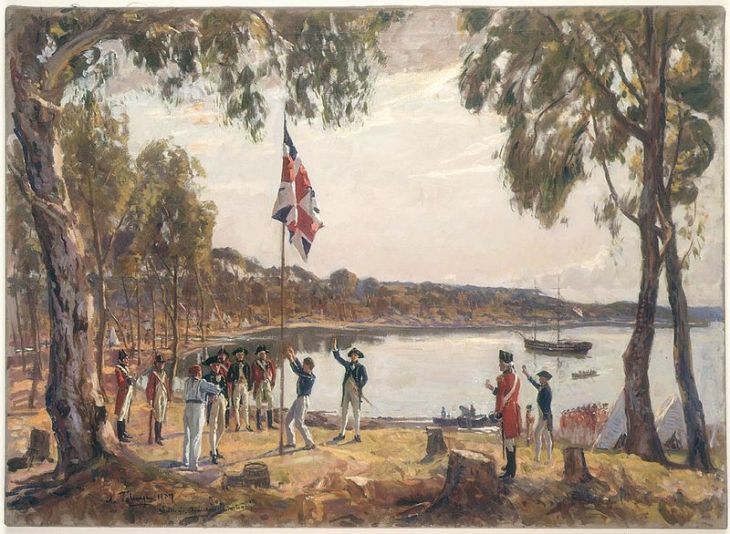
Captain Phillips somewhere on the other side of the country

On TV this year, cricket legend Adam Gilchrist encouraged everyone to celebrate Australia Day in their own way. And so he might. After all, it’s never been clear to anyone what the 26th January is actually for.

Sure we all know it represents the founding of New South Wales. But what are we, on the other side of the country, meant to do in response to that?

Some young ladies like to put on small and cheap patriotic bikinis from Red Dot [no objections here from the Dodgy Perth offices], some young men like to drape themselves in the flag, get pissed, and shout “Aussie, Aussie, Aussie! Oi, Oi, Oi!” [many objections]. Most people have a BBQ and listen to JJJ.

What we learn from the past is that they had no idea how to celebrate it either. For starters, they couldn’t even agree on a name. Some states called it Australia Day, others used the term Foundation Day or Anniversary Day. It was only in 1936 the Commonwealth Government ordered everyone to use the words Australia Day. But even this didn’t make it any clearer.

In the 1910s it was a day for kids and the place to be was South Beach. There were pony rides, fruit, swings, toys, swimming and running races, and a greasy pole in the pool. But by the 1930s no one was organising anything except a rowing regatta on the Swan. Which didn’t seem very patriotic to anyone, really.

Enter the Australian Natives Association (ANA). While they might sound as if they had something to do with Aboriginal rights, they couldn’t be further away. The ANA were the leading jingoistic mob, always demanding more be done to keep Australia white and British. There is still an ANA rowing club at Bayswater, but we imagine they’ve dropped their appalling racism by now.

It was pressure from the ANA and a bucket-load of nationalistic speeches from them about celebrating White Australia that forced the government’s hand in 1936 to make the day ‘Australia Day’ for everyone.

But no one cared. Each year the Perth newspapers tried really hard to educate the public about the arrival of Captain Phillip on Sydney Cove and why they should be celebrating this historic event. But no one cared. Even during World War II, when patriotic sentiment was at its height, the City of Perth forgot to put out the national flags on 26th January until the ANA shouted at them.

Australia Day has long been a holiday for Western Australians. And that’s all its ever been. Our only tradition has been to take the day off and enjoy it. We’re not particularly interested in Captain Phillip, just JJJ. And there are no objections here from the Dodgy Perth offices.

History and tragedy

butchers

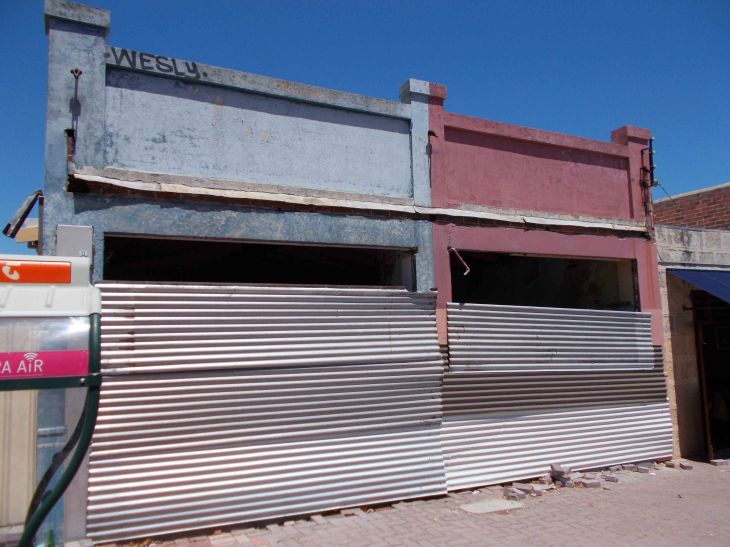
1002 Beaufort Street, next to Mille Café

This is a story about a double tragedy. When we started the research we had no idea it would lead to such a gloomy tale. But that’s the thing about doing history, you simply have to go where the records take you.

Just round the corner from the Dodgy Perth offices is a pair of shops on Beaufort Street. They have been empty for years, but renovations have recently started. Wanting to know more about them, and eager to try out the new office camera, we started with the above photograph.

First port of call is always the Post Office Directories, where we found that in 1946 1002A Beaufort Street was a deli run by Archibald Stubbs and 1002B was the Colreavy Bros butchers. Having got this far we turn to the newspaper archives in Trove to see who these Colreavy brothers were.

And this is where it turns heartbreaking.

Leo and James Colreavy ran two shops, one in the city and the other on Beaufort Street. In March 1947 they went swimming up at Trigg Island. There was a single sign on the beach near the infamous Blue Hole, a permanent rip, which read “Warning. Bathing 50 yards either side of this sign dangerous”. Unfortunately, the brothers misunderstood. They thought it meant it would be dangerous if you went more than 50 yards either side of the sign.

Leo, aged 29 and married with two children, and his single older brother James, aged 31, left their clothes on a rock and dived into the water in their bathers.

Before long two men holidaying in a shed on the beach heard a woman call out “Save them!”

Andrew Aitken and Arthur Samuels launched their 14-foot dinghy, but were driven back by the surf breaking over the rocks. They could see the two swimmers all the time, but they were being carried out beyond the line of surf.

Forced back to the beach, Aitken and Samuels ran along the beach following the helpless swimmers. Using a rope Samuels made an attempt to wade out but failed. An ex-member of the Scarborough Surf Life Saving Club, Keith Mouritz, then took the rope and tied it around his waist. A strong swimmer, he managed to grasp one of the unconscious men, who started to sink just as he reached him. In the meantime, a fisherman in a small boat dragged the second man from the water.

Ambulances were called and artificial resuscitation applied but it was all too late. Both men died at the scene.

The only good outcome of the tragedy was that the coroner ruled more and better signs needed to go up near Blue Hole to prevent more deaths.

And this is just one of the many stories such a building has to offer. Why not pick a place near you and see what turns up?

When journos go bad

weight

Three homely ladies

Here in the Dodgy Perth offices we do not believe the fashionable theory all journalists are lazy bottom-feeding scum. Statistically speaking, at least one of them has to be an acceptable human being.

Sometimes, however, they don’t do themselves any favours. We’ve all seen the ACA piece, or read something in The West, and asked ourselves “How is that news? Did you have five minutes to go and realise you’d spent the day in the pub and so just knocked out some sensational rubbish through your beer goggles?”

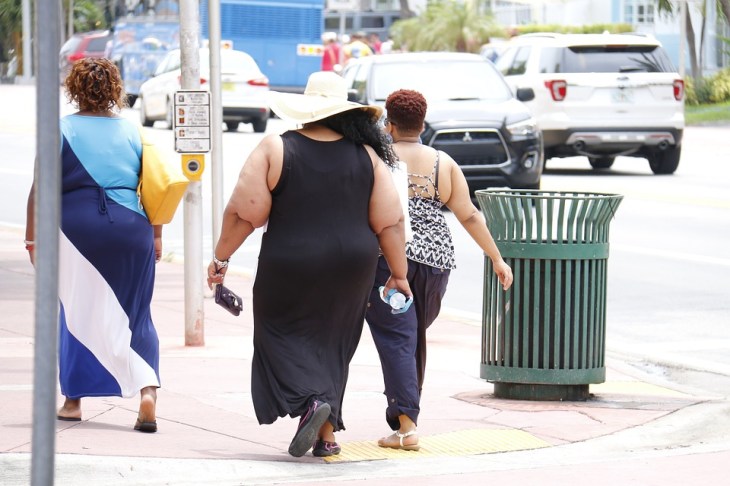
Well yes. They did. And so did a journo from The Mirror in 1935. They managed to fill many, many column inches sneering at overweight women, and throwing in some casual racism on the side.

And what had provoked this? Just a contact ad in the West Australian:

Miner (47), would like to meet homely lady, prefer fat woman, child not objected, view to above [matrimony]. Genuine.

After noting “fat women have had a sorry time through the ages”, our drunk hack observes that while the Turkish are an exception, the “average civilised man” doesn’t like plump chicks.

The newspapers are full of adverts for diets and slimming pills, and there is good reason for this.

Could you ask a fat girl to sit on your knee? Could you rely on her to have the agility to hop off it in time if someone came along?

Could you hold her in your arms in the back seat of someone’s car without feeling that you had the weight of the world on your shoulders or a ton of spuds on your chest?

People glare at her resentfully in crowded trams because she takes up a whole seat while others stand.

Bathers leave the water for fear of a tidal wave as she cavorts down the beach like a dyspeptic balloon and rumbles into the sea with the concentrated grace of a generation of elephants. Surfers crash into her broad back and, before they get the water out of their eyes, object to the P. and O. Company leaving a liner in a swimming area.

Just a tiny hint of fat-shaming, we’d say.

Anyway, now onto his twelfth gin, our lazy scribbler signs off with a pun: “A miner might like ‘a good crushing,’ but the average smart young man doesn’t.”

Hilarious.

An unwanted bed warmer

marich

Not just bed and breakfast

It can be hard on our country cousins when they don’t understand city ways. Take for example, Charles Sonesson who came down to Fremantle from Narrogin in 1917. Needing somewhere to sleep for the night he booked his bed at the Alhambra Café in Henry Street.

This café had opened in 1900 in the Marich Buildings, with a dining room decorated with mirrors and wall paintings. The upstairs bedrooms were described as considerably large and clean. Which is nice.

In accordance with the sign displayed outside the Alhambra, Charles paid one shilling for his room. It being early, our young Narrogin hero went for a walk, but was disgusted by how Fremantle girls were wearing their skirts way too short.

Disappointed in modern women he went back to the Alhambra, where the night porter said, “Oh, yes, this is your room, sir, but it’s another four shillings, please.”

“Nonsense!” said Charles, “I’ve paid for my bed.”

“That’s all right, old chap,” said the porter, “but you don’t know what’s in it yet. Step this way.”

After stepping that way and duly minding the step, Charles was shown into a bedroom where Miss Lily Smith, or, as her name was entered in the book—Miss Cherrynose—was lying on Charles’ bed.

The young man from Narrogin tried to explain he hadn’t requested any extras, but the night porter was having none of it.

“Come on, come on,” he said, “gimme the other four bob, she’s all right.”

It was not until he called the police that Charles could get his possessions and flee the Alhambra Café to find accommodation elsewhere in the delightful city.

Can anyone recommend accommodation in Fremantle now that provides additional services?

Our first gold fever

miner

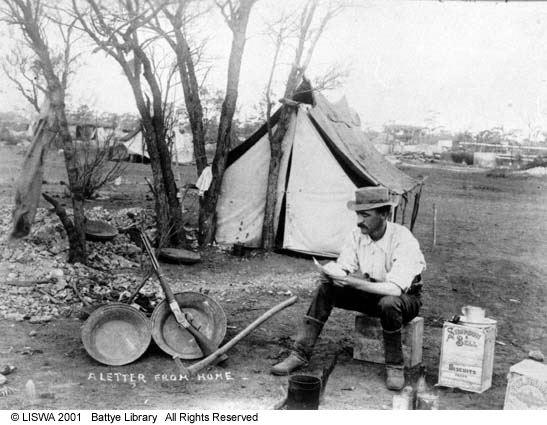
All the home comforts you could want…

Where was the first gold rush in Western Australia? If you believe the history books (and you shouldn’t) they’ll say it was at Halls Creek in 1885. Not even close. The first gold rush was more than 30 years earlier.

Just off the South Western Highway, a bit south of Byford, lies the sleepy townsite of Cardup. It was here in 1854 that the newspapers breathlessly announced the first gold to be discovered in this State. Allegedly hundreds of men had camped there and were toiling away finding it easy to produce small mountains of gold. One group of prospectors had picked up more than nine kilograms without any difficulty at all.

This was great news for the people of Western Australia. The failing colony had been forced to take on convicts as cheap labour, and everyone was looking jealously at Victoria which was on the verge of becoming one of the wealthiest places on Earth thanks to its gold mines.

Many people were looking for gold here, especially since the government had announced a £500 reward for the first verified finds. The Cardup prospectors, however, were never to receive this money.

Unfortunately for our wannabe gold mine owners, Harry Hughes, then secretary of the Mechanics’ Institute, decided to take a trip to Cardup to investigate the rumours. Rather than hundreds of men, he found about twenty.

Rather than gold piled up everywhere, the best he could be shown was some quartz with tiny specks of something shiny on it, which might or might not be gold.

In any case, most of the miners were on the verge of giving up and going back to their usual careers which they had hastily abandoned for the chance of instant riches.

The moral of the story is clear. Don’t believe the history books but, even more importantly, don’t believe the newspapers. And don’t give up your day job.