Fight of the century. 1954 style.

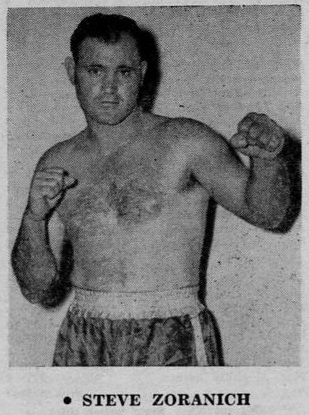
Steve_Zoranich

Dodgy Perth spent Sunday morning in the pub watching one man hit another man in the head.

Because it was the Inglewood Hotel, this was happening on TV. Unlike our usual local, the Civic, where these kind of events happen in the car park out the back.

Anyway, we digress.

In 1954, the Empire Games (now called the Commonwealth Games) were being held in Vancouver. One of Perth’s star entries was Australian amateur heavyweight boxing champion, Steve Zoranich.

Steve was 25 at the time, having arrived in WA from Croatia at the age of eleven.

The Australian team was to fly to Canada via Hawaii, but for unexplained reasons, at the very last minute Steve was refused a USA visa, required to change planes.

Steve was bewildered: “My opinions have never affected anybody. I have never spoken from a platform, nor stood as a candidate for any Party. I have never appeared in court, nor even been cautioned for political reasons. I can’t understand it.”

He appealed to the American authorities but they refused to change their minds.

The only other way to Canada was via England, but this would have to be entirely at Steve’s own expense.

Fortunately his friends and family immediately started crowdsourcing the necessary money, which was raised amazingly quickly.

Even so, it took Steve nine days and 32,000 km to get to Vancouver, by way of Singapore, Calcutta, Cairo, Rome, London, and Iceland.

He also had no trouble with the Canadian immigration officials, the Americans still having failed to provide a reason for refusing a visa.

We wish that this story ended well, but it doesn’t.

In the first round his English opponent, Brian Harper, floored Zoranich with a solid right cross. Zoranich quickly got up, but before anyone knew what had happened, the referee claimed he had finished the count and the Englishman was declared the winner.

The manager of the Australian boxing team immediately protested, but his objections were waved away by the referee.

If there is a moral to this, it is that not all stories have happy endings. Bring on the next Mayweather-Pacquiao fight, so the right man can win at least once.
An unreliable history of Perth

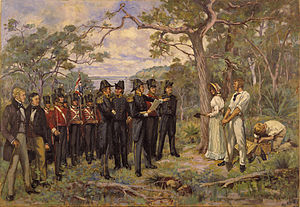
Foundation_of_Perth

Commemorating the centenary of the founding of Perth, you might imagine people were serious in 1929. You would be wrong:

Forsooth on the 12th day of August in the year of grace one thousand eight hundred and one less than thirty, many good citizens gathered together unto themselves and said, “We must have a city.”

Forthwith they repaired to Governor Stirling, whom they found on his back on the floor of his coach-house endeavouring to repair the differential of his coach and pair.

“We good citizens and true wish to have a city,” they told him.

“The devil you do,” spluttered Stirling as he rose to his feet and adjusted his knee breeches. “Then a city you shall have.”

For the next few days there was great to-do in the new colony. Several good ladies immediately commenced making clothes for the natives in case they desired to attend and drink the King’s health and beer.

At last the great day dawned. The settlers cleaned up their huts and photographers adjusted their easels and paint pots. They came from far and near and further than that and flags flapped and skirts trailed in the dust as the colonists assembled round the Union Jack.

There was a rousing cheer for Governor Stirling as he began to speak: “This city we are founding today,” he said, “is destined to be the capital of a State of great potentialities and possibilities.” (Cheers from the bystanders and groans of “We’ve heard that one before” in the language of the blacks). “Here we will build a city that will one day be great. Along the track where Mrs Jones’ goat goes to call for the paper every morning we will make a street and call it Hay Street.

“Down here we will make Murray Street. From here Harry Boan will sell his third floor specials. Down further we will have Wellington Street, called after the Great Duke. The railway will be right next door. An ideal site this, ladies and gentlemen, for an advertising sign or a fruit barrow, think you not? And let’s have a market here! And a hotel or two.

“Come with me in imagination up this hill to the West. One day people will be able to travel there in trams or Government cars where we now ride in imagination. Here I beg you to tread quietly lest you waken those who will one day sleep there. Here will ambition be born and die, characters be made and lost; this will be Parliament—not the cemetery.

“Out yonder far beyond Harry Boan’s duckpond and Perry’s lane and Ginger’s hansom cab stand we will have a place for the dead. And on festival days and sundry Saturday afternoons the crowds will foregather. And behold their lamentations will be loud and their tears many when they see the dead. This my friends our children and grandchildren will call Ascot.

And forthwith the guests had afternoon tea while the settlers who had not been invited sat on one side and snarled and the natives threw boomerangs at the big sign that had just been erected on the site of the new city: “Eat Bullpup’s biscuits to prevent ingrowing toenails.”

Two men who were unemployed attempted to secure afternoon tea but the police—both of them—turned them away.

“Commercialised patriotism and commercialised sentiment”

Anzac Day on the Esplanade, 1928

Anzac Day on the Esplanade, 1928

Dodgy Perth missed Anzac Day this year, by virtue of being abroad. However we did discover a bar in Manchester which served Little Creatures Pale Ale, and so a glass was appropriately raised last Saturday.

So, to make up for our failure to attend a service, we offer the thoughts of someone from 1930, who did manage to get to such an event on the Esplanade.

Our writer first notes that the setting is perfect. The Swan River with its white yachts at anchor and the wooded slopes of Mt Eliza extending to the water’s edge making a beautiful and peaceful background to the scene.

As ever, there was a raised platform on the Esplanade for politicians, clergy, businessmen, leading citizens and military officers. In front of the platform were a sorrowful and subdued crowd.

The celebrations claimed to be in remembrance of “gallant fellows whose bones now repose on many of the battlefields of Europe”. But our observer is not so sure that it was.

He had a nagging feeling that the day was nothing more than sneaky way of instilling war propaganda into the receptive minds of young children.

The speeches, he scoffed, were nothing more than “commercialised patriotism, commercialised sentiment, commercialized reverence and commercialised Christianity”.

All he heard was humbug and cant about the glories of war, and nothing of its horror, its resultant sorrow, misery, poverty, and hardships.

Taking a sudden turn to the Left, the writer remembers the huge profits to be made from international disputes.

“Let those who make wars fight them,” he declares.

Complaints about the capitalist adoption of Anzac Day? Criticism of politicians’ motives for engaging in war? At least this could never happen nowadays.

Drop-in prophets

I foresee you liking the following snapshot of Perth history

I foresee you liking the following snapshot of Perth history

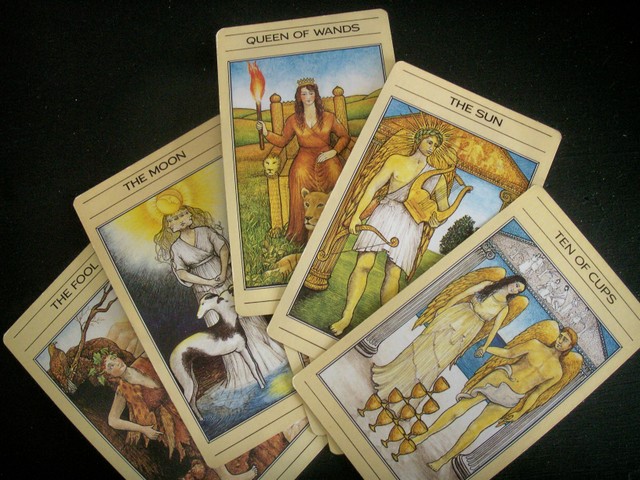
Madams Zona, Mora and Carlotta were fortune-tellers working in the CBD in 1907. Unfortunately for them, back then being a psychic was illegal. So when a young undercover policeman, Constable Smith, was sent to visit, it was never going to end well.

Constable Smith first entered Madam Mora’s premises in Wellington Street. The plain-clothed bachelor pretended to have a wife who had abandoned him at Coolgardie. He asked the psychic if she could locate this imaginary woman. Mora picked up her cards and told Smith to divide it into three piles.

Using her ‘psychic’ abilities, she read the cards, announcing “You will find your wife shortly.” The cards also revealed a dark man who was connected with Smith’s troubles, and this stranger would try to kill the copper.

Smith paid Zora half-a-crown, and she warned him to say nothing about his visit. Strangely, her clairvoyance did not extend to noticing he was an undercover law enforcement official.

Madam Carlotta was a palmist. In exchange for Smith’s money she also revealed the non-existent wife would soon show up. Not only that, but he would have four children. Even more excitingly, Smith was soon to become an engineer, who would gain fame through an amazing invention.

The final visit to Madam Zona also promised a happy reunion for the policeman. And still the psychics didn’t discover their immediate destiny was to be a trip to court. There, they were spared jail on condition they agreed to cease telling fortunes.

Dodgy Perth does not know what happened to Zona, but Madam Carlotta—known to her friends as Ethel Daley—was unable to give up her trade, and was prosecuted again a few years after.

Mora’s future, though, turned her card skills in a surprising direction. She became an illusionist, regularly appearing at the Melrose Theatre in Murray Street. She also became renowned as a debunker, exposing spiritualist scams and teaching people about gambling tricks.

Now who would have seen that coming?

The Inglewood scanties

panties

We imagine they looked something like this

As the Dodgy Perth team desperately tries to delete their names from the Ashley Madison database (we had no idea what the site was, we thought it was a garden equipment retailer), we look back to a time when more direct evidence of infidelity was left behind. In the laundry at an Inglewood home.

The date was 13 December 1947. The time, 11.30pm. Laura came back from her friend’s house, and opened her front door. In the living room she discovered an unknown dishevelled couple, while her beloved carpets were covered in beer and cigarette ash. There was no sign of hubby, James.

Screaming abuse, Laura ordered the strangers to get out. This brought James running into the room. Slurring and barely able to stand upright, he too was told to get out the house.

Muttering curses, Laura set about with a mop and brush to restore some order. After that, she stepped into the garden for fresh air.

There were scuffling noises from the outside laundry, and then a woman scampered out and fled. James poked his head around the laundry door.

Naturally, Laura accused him of less than honourable behaviour, but he denied it. By now she was in no mood to argue, and went to bed. Where James slept that night is not recorded.

The next day she went back to the laundry and in the middle of the floor were a pair of scanties. They definitely weren’t hers.

Taking the panties in her hand, she again confronted hubby. This time, with a sore head, facing the irrefutable evidence, he agreed he had not been completely honest the night before. He didn’t even know the woman’s name, having picked her up at the local pub (probably the Inglewood Hotel) for a quickie after he’d been thrown out earlier.

Laura moved out to Fourth Avenue in Mt Lawley, and got her divorce the following year.

The moral, dear reader, is to always clean up after you. And that includes email addresses.

Our glorified saloon

165x215mm

You probably know that to get a building heritage listed, the Heritage Council (aka the Style Council) has to give reasons why it should go on the list. You can find these on the Style Council’s website.

So, let’s take a look at why Parliament House deserves heritage protection:

The 1904 section of the building expresses the sense of grandeur and pride associated with the establishment of Parliament House & Grounds, through both the external and internal design, finishes and furnishings and by the use of Western Australian building materials.

To summarise: According to the Style Council, when it opened people loved Parliament House.

But did they really?

Well, the bare-armed worker who had helped construct the place certainly didn’t love it. In his opinion it was a waste of money and he looked forward to the day when a Labour Government would dispense with “this tommy-rot, and spend all that good brass feeding the poor.”

Mr J. M. Kelly wasn’t too concerned about the poor. He was just concerned about the poor design, which he called a “blot on the landscape”.

I have come to the conclusion that the new Parliament Houses being erected are mean, paltry, and but a sorry housing for the legislators of Western Australia.

Ouch. But do go on Mr Kelly:

On its western side, past which a fine broad road leads you, it has an almost despicable appearance, reminding one of a railway goods shed, with its squat, stuccoed walls.

Okay, but somebody must have liked the design. Perhaps legendary architect George Temple Poole?

It is fair to deduce that the State is on the eve of expending £210,000 for a building of the class of construction and work generally which cannot be considered sufficient for the monumental character of a State Parliament House.

As a skilled architect, maybe Mr Temple Poole has too high expectation. Perhaps we should just ask a civil engineer what they think:

The proposed building has no pretensions whatever to architectural effect in any sense of the term. Judging from the plans and elevations offered for inspection the ‘tout ensemble’ discloses a lop-sided pile of buildings of the most incongruous nondescript order of the cheap and nasty type.

Ouch and ouch again.

But dear reader, you’ve probably noticed that we’ve been unfair. All of these criticisms were made before Parliament House opened. Once it was open, surely the “sense of grandeur and pride” (as the Style Council puts it) will become clear to the people of Perth.

So let’s ask the people on opening day what they thought:

The visitors had time to criticise the extraordinary colour scheme of the Assembly Chamber, count the hundreds of black swans swimming the blue sea of carpet, comment on the dizzy height of the galleries, and draw comparisons—born of the wearying display of stained glass and coloured wood—between the general appearance of the Chamber and that of a glorified saloon.

A ‘glorified saloon’ is more generous than ‘cheap and nasty’ pile of buildings. But not much. And certainly not what you might expect from the Style Council’s glowing description of the external and internal design.

Just because it’s on the State Register doesn’t mean anyone liked it at the time.

Proposed Parliament House. Not built.

Proposed Parliament House. Not built.

Drinking in the men’s room

Women listening as men discuss manly things

Women listening as men discuss manly things, like hair-dos

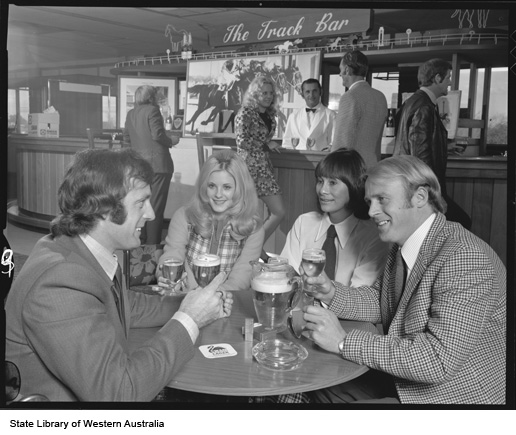
Is it acceptable for women to down a schooner in a public bar? Or should the fair sex be confined to the lounge bar? In Brisbane fifty years ago, activists Rosalie Bogner and Merle Thornton had to chain themselves to a foot rail just to get served.

We were a bit more progressive that that in the 1950s and ’60s. Unlike Brisbane, it was not illegal for a woman to have a beer in a saloon. But most publicans did not approve. Men needed their own space, somewhere men could be men.

In 1953 the Sunday Times asked if lasses should enter such a testosterone-rich environment. The journalist noted that most women did not want to prop up a bar, even though drinks were more expensive in the lounge. (When did this practice of different pricing stop?)

In the summer, one Cottesloe hotel usually had representatives of the fair sex drinking in the saloon bar. But this was the exception, rather than the rule for most hotels. Unless you lived in Armadale. Nobody had the nerve to tell Armadale women where they should drink.

For most Perth hotels, though, publicans said they would object if a lady invaded the men’s space, and she would be directed to the special place set aside for women to drink in.

We’d like to see some landlord try that one with Mrs Dodgy Perth.

When heritage kills

095,505PD

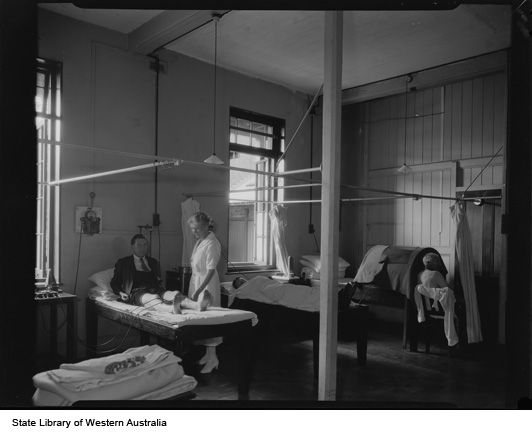
Perth Hospital, 1932

As stories continue to grow about the troubled Fiona Stanley Hospital, Dodgy Perth looks back to a time when medical things were much, much worse. We refer, of course, to what is now called Royal Perth Hospital, but was then simply Perth Hospital.

In 1937, Melbourne architect Arthur Stephenson was asked to report on the conditions at Perth Hospital. His report was damning. The place did not have one redeeming feature. It was “insanitary” and “indecent”.

This was certainly the worst hospital in Australia, and probably one of the worst in the world. Medical care had been better in the fifteenth century. Stephenson was baffled why Perth was not up in arms. The place attracted swarms of flies feasting on partially decomposed corpses piling up in the so-called mortuary.

It was only because doctors and nurses were trying to do their best, he said, that the hospital could even be called a medical establishment at all.

However, reforms were being held up because of the heritage lobby. Improvement required a decision as to whether the hospital should be developed on the present site or a new complex built elsewhere. But the old Colonial Hospital (still there in RPH to this day) and its attendant buildings were much loved. Patient care be damned when there is heritage to save.

Stephenson saw the “ingrained dislike for destroying old buildings” in Perth, but still said it was a simple choice. If the hospital was not to move, existing buildings would have to be replaced. They could have heritage or health care, but not both.

It took nearly ten years to complete the transformation from Perth Public Hospital to Royal Perth Hospital. It is still unclear whether keeping the Colonial Hospital was sentiment or cost-saving. And disputes about the location of hospitals and their heritage value have not stopped yet.

In praise of Forrest Chase

padburys

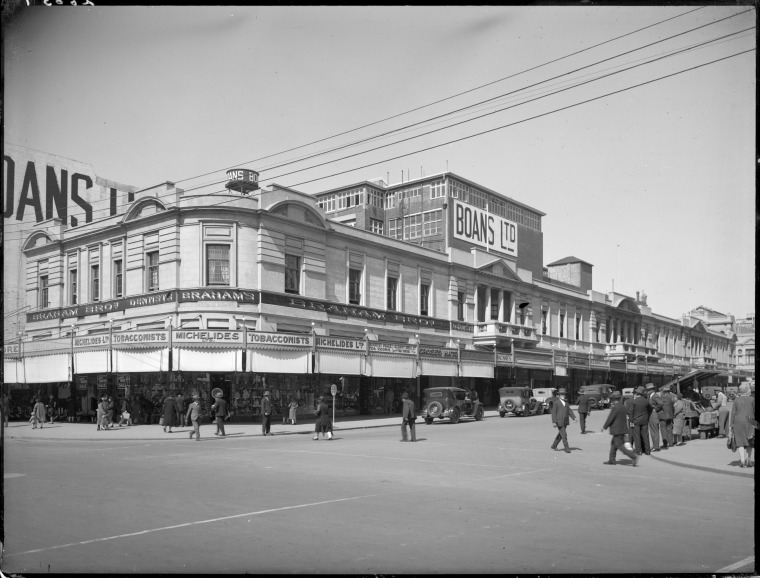
Before Forrest Chase, the ugly Boans building dominated the streetscape

Today we tell a familiar Perth story. How a potentially great space became a disaster. We’re not talking about the delightful Forrest Chase, complete with detailed precast lattice work. Good lord, no. We mean the vile Padbury and Boans buildings which were there before it.

After the General Post Office was finished in 1923, it was assumed that the Federal Government would turn Forrest Place into a park for local residents. This would link the Railway Station to Murray Street for the benefit of all. A petition went to Parliament, requesting that Forrest Place be reserved only for public purposes.

Instead, the Feds, determined to claw back as much money as they could after the GPO project, gave a fifty year lease to William Padbury to build a shopping centre opposite. Naturally, there was outrage that the “people’s heritage” was to be converted to “brick and stone” simply for the purpose of making a quick buck.

That’s right. To build Padbury’s involved a loss of our heritage. William Padbury was already a rich man, it was pointed out. Could he not work for the public interest and build his hideous shops somewhere else?

Padbury did not see it that way and commenced construction.

padbury

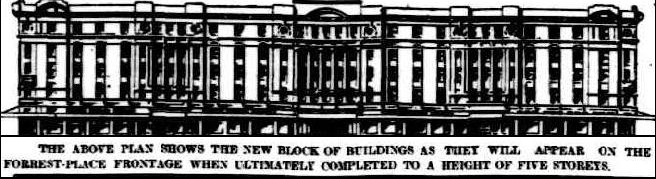
This is what William Padbury promised to build.

In a story headed ‘Beauty and the Beast, or How Not to Build a City’, it was noted that Padbury’s would make Forrest Place too narrow. In any case, there were already too many “tawdry structures”, such as the Central Hotel next to the GPO. Padbury’s would just be one more.

But there was a way of saving the situation. One problem with Forrest Place was Boan’s unsightly wall. If Padbury’s had to go ahead, a five-storey building could work in this space, and justify the loss of public space.

However, William Padbury, like any good capitalist, was not going to spend more money than necessary. Since the Feds were in control of the land, not the City of Perth, a cheap two-storey building was erected. Padbury vaguely promised to put up another three storeys in the future, but no one really believed him.

padbury3

The disaster some predicted

Any two-storey building must be in proportion to its street frontage. Padbury’s, at several hundred feet, was far too wide to have any aesthetic balance. In any case, Boan’s dominated above the low parapets, ruining both Forrest Place and any pretence to architecture Padbury’s might have claimed.

Forrest Place was a tragedy because the Feds simply wanted money. Padbury simply wanted money. And Boan’s was a hideous piece of architecture to begin.

Now tell us you still hate Forrest Chase.

Peace, love and barbies

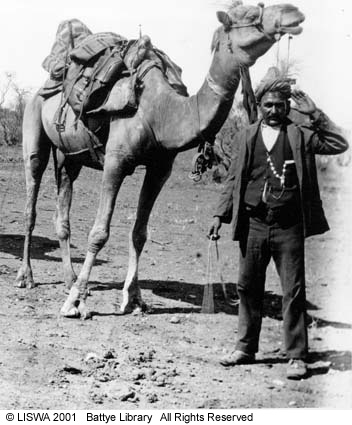
Fazal Din and camel, 1904

Smoked camel anyone?

As every Australian knows, all it takes is a barbeque to shatter cultural barriers. Usually.

For what may have been the earliest multicultural festival in Perth, in May 1897 adverts in the local rags announced the ‘Mohammedan Christmas’, Bakreed.*

A camel would be sacrificed at the home of Ahmed Khan, on Vincent Street, Highgate. A camel selected from Ahmed’s personal herd as being the very best.

To make it tempting for the non-Muslims, free camel burgers were on offer for anyone who showed up.

Some fifty members of Perth’s Muslim community arrived, together with the media and a number of interested onlookers.

At 10 o’clock in the morning, Ahmed and his comrades started to pray in Arabic. After the traditional prayers, Mr Khan exclaimed Bismillah, followed by Allahu Akbar as he drew the knife across the hapless camel’s neck. Then the knife was ritually inserted into the beast in three places.

With the formal proceedings out of the way, an experienced butcher cut up the carcase so the barbeque could get going.

Unfortunately for Mr Khan, the westerners turned up their noses at the free barbie, preferring just to watch their Muslim neighbours tuck in. Was it the lack of beer? Or the lack of tomato sauce? Either way, not one unbeliever was willing to try something new.

One journalist was repeatedly pressed to give the burgers a go, but he announced he was “sufficiently bigoted in his tastes” and would not eat anything but the traditional cow. Rudely, after the ceremony, the hack went straight to a restaurant to get a steak.

Despite this clash of tastes, multiculturalism was alive and well 120 years ago, and no one was holding government inquiries into halal labelling.

*Bakri-Id (Eid-al-Adha), to be celebrated in September this year.