Don’t look back in anger

coat_of_arms

What you looking at?

Dodgy Perth promises this is the last time we will ever deal with this controversial issue. Especially since we are going to put it bed for once and all time.

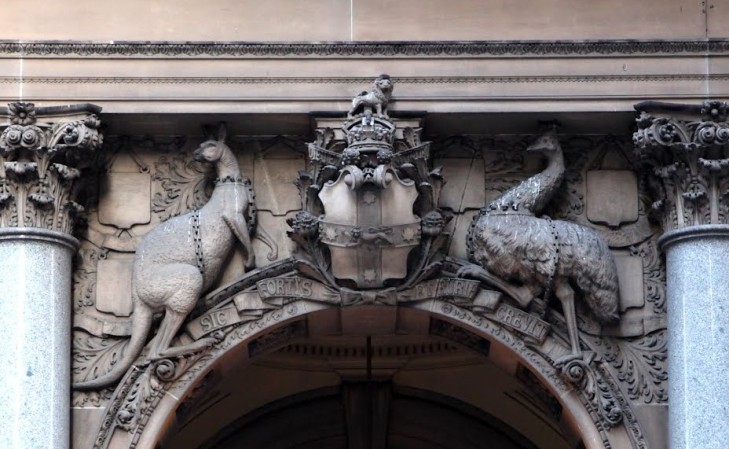
Take a look above at the Australian coat of arms on Perth’s GPO, freshly installed when this photo was taken, with the kangaroo looking the wrong way. As is well known, the sculptor didn’t get paid so the roo is looking in an accusing fashion towards the treasury building.

Wait, did we say this was Perth GPO? Our mistake.

This is actually a picture of the coat of arms installed on the new parliament building in Canberra in 1926. So, evidently this sculptor didn’t get paid either. What is it about sculptors not getting paid in the 1920s?

1-gpo-george-facade

Oi, look at me when I’m talking to you!

But sculptors haven’t been getting paid for a long time before the 1920s. Oh yes. This is the old Sydney GPO, which predates the Commonwealth, and the roo is looking in an accusing way towards… well, towards something presumably.

Every time this story gets a mention on local radio, someone rings up and claims their father (or grandfather, or uncle) made the GPO coat of arms, and the legend is completely true.

Well, we’re sorry to say folks, that this is just how some fancy shield things were done in the past. Just is. Nothing more interesting than that.

Is the Hartog Plate a hoax?

hartog

Close-up of the Hartog Plate

The Dodgy Perth team loves a good conspiracy. So we were delighted to find one about the upcoming 400th anniversary of Dirk Hartog’s trip to Western Australia, and the famous Hartog Plate which will be on show at the Maritime Museum.

This is the mother of all conspiracy theories: the Hartog Plate is fraudulent. Before you accuse us of having gone loopy, versions of this theory were promoted by an expert on European discoveries, George Collingridge, and by our very own leading historian, James Battye.

According to this version, the Hartog Plate was faked by Willem de Vlamingh in 1697 to ‘prove’ the Dutch had landed in WA first. If Hartog ever landed, there is no evidence of it. The British were sniffing around WA, and de Vlamingh was under orders to find proof of prior Dutch landing, by whatever means necessary.

Is there anything to back this up? It’s important to realise that there are no independent accounts of Hartog’s explorations other than the mysterious plate and a 1627 Dutch map labelling us as ‘Eendracht Land’ after Hartog’s ship.

When de Vlamingh visited Hartog Island in 1697, he said he removed the old plate, fixing another in its place. The Vlamingh Plate copies Hartog’s on the top with a new addition by de Vlamingh below. In the ship’s journal, published in Amsterdam in 1704, the key entries read:

On the 1st of February, early in the morning, our little boat went to the coast to fish… Our chief pilot, with De Vlamingh’s boat, again went into the gulf, and our skipper went on shore to fix up a commemorative tablet.

On the 3rd de Vlamingh’s chief pilot returned on board. He reported that he had explored 18 leagues, and that it was an island. He brought with him a tin plate, which in the lapse of time had fallen from a post to which it had been attached, and on which was cut the name of the captain, Dirck Hartog… who arrived here in 1616, on the 25th October…

How could the first commemoration, fixed up on 1st February, contain words only discovered two days later? They can’t have been added after, because they would be below de Vlamingh’s message. Did he rip the first draft down and put up a new one? Or did he have a copy of Hartog’s inscription before he arrived in WA? If so, where could he have got it from, since it was never published?

Or did de Vlamingh just make the whole thing up to prove prior claim over the Brits? All very mysterious. As is the subsequent history of the Hartog Plate, which only arrived in the Rijksmuseum in Amsterdam in 1875, where it now resides.

Dodgy Perth is sure all of this can be cleared up by someone answering the following questions:

  1. Is Hartog’s Plate capable of being dated as to whether it is early or late 17th century?
  2. Other than taking de Vlamingh’s word for it, what other evidence is there that Hartog ever landed in WA?
  3. How can Hartog’s words on the Vlamingh Plate be explained, if the original wasn’t found until two days later?

We look forward to hearing some answers when the 400th anniversary of Hartog’s voyage is celebrated next month.

Cars not trains, said the Minister for Railways

meltham

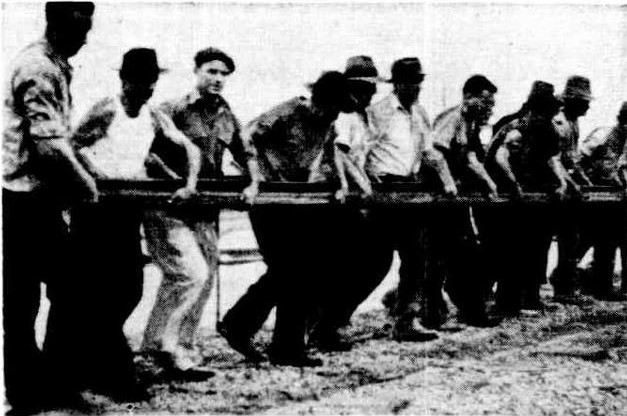
Lifting the old track at Meltham Station (1947)

The PTA suggests closing ‘underperforming’ stations on the Midland Line, and Dodgy Perth is very cranky. We’ll start with a declaration of interest: Meltham is our local station, and we hate the long trek from Maylands, especially when it’s raining. Or hot. Or any form of weather at all.

Dear PTA, your predecessors first promised us a railway station at Meltham in 1898, and the Meltham Estate was only built and sold with that pledge in mind. There wouldn’t have been development if people thought they’d have to walk to Bayswater or Maylands. But they did have to. A generation later, in 1923, the Commissioner of Railways turned down Bayswater Council’s repeated pleas for station at Meltham.

Another ten years went by and the council was getting desperate. The government suggested the council should subsidise a new station, so Bayswater guaranteed to cover losses up to £50 a year. At the moment, they said, “people were compelled to walk great distances…, and it was felt that the lack of any reasonably close travelling facilities was retarding the development of the district”.

Even so, the Minister for Railways said no. This made the council quite cross, so they resolved to keep demanding a station until the government gave in. And they engaged engineers to design reasonable solutions. Didn’t make the government budge one inch.

By 1937, the council was offering even more money and a private developer offered to chip in as well. The local MLC said, very reasonably, “if the Government wanted people to use trains in the metropolitan area it must provide facilities”. Nope, said the Minister for Railways, who was in favour of more roads!

We’ll skip over the war years, but in 1947, half a century after first proposed, it was announced Meltham would get its station. Work began in April and then immediately stopped due to a shortage of labour and materials. In fact, it was so delayed that when opened on 14 May 1948, only a tiny part of the platform had been constructed and it was essential to be in the last two coaches if you wanted to alight.

It might have surprised the Minister for Railways, but it came as no shock to anyone else that the station was an immediate success, even if only part of the platform was open. Fifty years of pleading, offers to subsidise, and proof that a station was essential had finally paid off.

And now the PTA wants to close it. Just. Don’t. Even.