A bridge too far

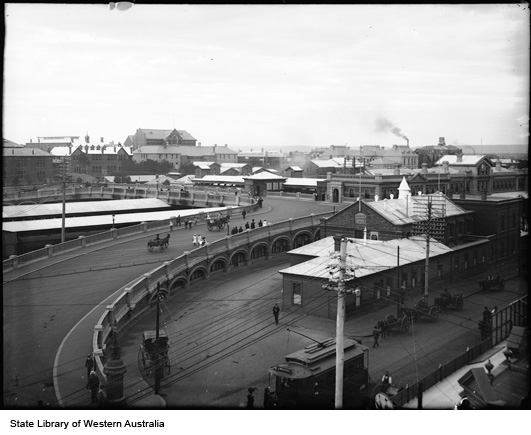
Anyone who has lived in Perth for more than a week knows the story of the Horseshoe Bridge. How the Railways Department came up with a brilliant solution to the problem of restricted space, making it (according to the Heritage ‘Style’ Council) an “outstanding example of a major urban railway overbridge of its time”.

Well, this is Dodgy Perth, so prepare to have all your illusions shattered. Our comments on the above story are no, no, and God no.

Firstly, it is not innovative. Nor did anyone claim it to be at the time. It was not called The Horseshoe Bridge in 1904, just described as a horseshoe bridge.

Why this particular design? Because wherever they were going to put a bridge, the tight-arse Railway Department didn’t want to hand over cash to landowners on Wellington or Roe Streets. They wanted a bridge that would only use land the Government already owned.

There never was restricted space. Just an attempt to save money.

Speaking of hard cash. Robert Howard, a draughtsman working for the Public Works Department knocked up plans for a horseshoe bridge and then offered to sell them to the Government for £1,000. They told him to bugger off, since he was an employee. So Robert quit the PWD and then sold the plans to the Government for £1,000 anyway. (The cheeky sod actually went to court later to obtain even more money from them!)

The estimated cost of the bridge was £25,000. It was delayed for a couple of years because no one could build it for that amount. When finished, the thing cost £40,000. It would have been much, much cheaper to buy some land from private owners and put up a regular bridge.

Everyone hated the new crossing. And we mean everyone. A footbridge over the railway was pulled down, forcing people to walk the long way round over the new erection. The newspapers were full of outrage. The City of Perth kept complaining to the Government that 22,000 people had to walk over the bridge every day, meaning an 3,600 extra miles daily, or 1,140,000 miles a year.

So, all up… the Railways Department created their own restriction, bought their plan off an employee who drew it on Government time, failed to budget the project correctly, and seriously annoyed everyone who worked in the CBD.

And that, friends, is what the Style Council likes to call an ‘innovate design solution’. Dodgy Perth has a different opinion.

A wagyl’s revenge

Matt Benson-Parry, Wagyl & Dewi (2007)

Matt Benson-Parry, Wagyl & Dewi (2007)

The last time Dodgy Perth was in Claremont was to see a band at the Claremont Hotel. But next time we’ll be making a short pilgrimage to see a verified home of a wagyl.

Some white folk have an impression that wagyls (there were many of them—not to be confused with The Wagyl) were well-meaning creative spirits who just happened to look like big snakes. Not even close.

Wagyls were extremely dangerous and their presence alone at a place could make it winnaitch (taboo). And such was the case at Karbomunup Hill in Claremont, roughly where Osborne and Bindaring Parades meet.

Once on this hill, according to legend, some children broke an important food law, and the wagyl living there became so boogur (angry) it came out of the hill and swallowed all the men, women and children of the place. All except one woman, who was gobbelguttuk (pregnant).

A peculiar shaped stone on or near the shore at Claremont was supposed to have actually been the gobbelguttuk woman. The stone and the hill were ever after winnaitch. Just to go there was to risk death.

In 1894, when the Osborne Hotel was built on Karbomunup Hill, the owner announced a corroboree as one of the opening-day attractions. Naturally, no local Aborigine would take part, so some North West folk were recruited instead.

A much retold story says that two of the North Westerners fell down while dancing, and although taken to the white man’s hospital they soon died. Locals said that had been wagyl bom—wagyl struck.

Definitely worth a trip out to Claremont to see if the wagyl is still active.

Racist gets whats coming

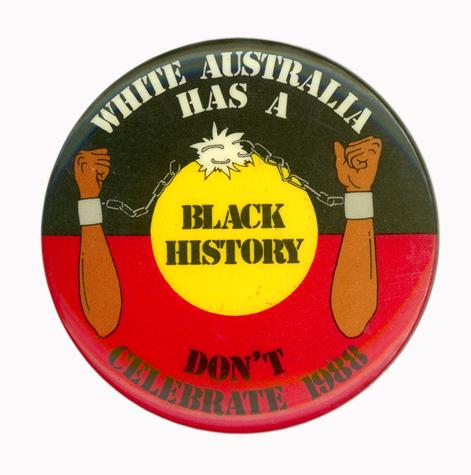
1988 badgeWhen ‘J. T.’ of East Perth wrote a pro-segregation letter to the newspaper in 1943, they probably expected to get some support for their position.

After all, J. T. had noticed the waiting seat for trolley bus passengers in Wellington Street was frequently occupied by “natives or half-castes” and bus passengers had to stand.

“What right,” fumed J. T., “have these natives to occupy a seat that should be reserved for white people?”

Given how generally racist Perth sometimes looks in the past, Dodgy Perth found it refreshing to read the next edition of the Mirror.

K. R. Whitby of Geraldton kicked off by noting that the country belongs to Aboriginal people, not white folk, and demanded “fair play” for everyone.

A Darlington resident told J. T. that he was the trespasser on Wellington Street, since white people stole the country from the Aborigines. So no one could complain about where the rightful owners chose to sit.

And W. Pearce of Fremantle stuck the knife in by pointing out that J. T. would have refused a seat to Christ, since he would have been a “coloured man” in J. T.’s eyes.

Sometimes it’s too easy to judge the past from the point of view of the present. We need to remember that some people in the past were racist bigots, and some as PC as you can get.

A modest proposal to deal with the deficit

EQJust over a century ago Western Australia’s deficit meant the State was building up huge debts.

Sound familiar?

The blame, as it turned out, was to be laid squarely at the door of a government committed to large-scale projects without actually costing them properly or having the money to pay for them in cash.

Sound familiar?

There was a huge waste of money down by the waterfront. Not Elizabeth Quay this time, but formal gardens with beautiful grass and flowers. Just where it was likely that a quay or a wharf would be needed.

Even though faced with a budget shortage, the Government still went ahead with major building projects like a new stadium at Burswood. No, sorry, our mistake. Not a stadium, but an Art Gallery, so the leisured few could stroll around it on a Sunday afternoon.

No one could deny that investing in a public library or a technical school were essential. And given the mining industry, perhaps even a geological museum could be justified.

But not an art gallery, not a zoo, and certainly not an observatory. None of these could be defended until Western Australia had a population much larger than it had in 1909.

It was simple. Western Australia’s financial troubles were wholly of its own creation.

Sound familiar?

How to keep your man

lose man

Wants to know why dinner isn’t ready yet

As part of our ongoing quest to explain to Mrs Dodgy Perth how she can become a better wife, we have started leaving clippings from old newspapers around the house.

Newspapers in the past regularly contained advice to wives, to new brides, and to women in general. Unlike a modern Cosmo article (1000 Ways to Drive Him Wild Tonight), the historic hints and tips were a little more focused on the domestic.

So, let’s find out how to keep your man, courtesy of 1933.

Firstly, learn from the sad tale of a young man who broke off the engagement because she kept asking “Do you love me? Are you sure?”

Girls, don’t do this!

It is wrong to quiz a man, or to find out why he loves you. Men, you see, are secretive by nature. The best you’ll get is “I love you because of the colour of your eyes”, or “The twist of your smile.” That’s the kind of cryptic answer you’ll get. Just live with it and stop asking.

Speaking of interrogation, another way to lose a man’s love is to ask him anything at all. There is nothing a husband hates so much as either of these fatal questions: “Why are you home late?” and “What have you been doing all day?”

No man should ever be required to give an account of his activity. In any case, even if he answers honestly, chances are the suspicious wife won’t believe him anyway.

Also, ladies, never mention any of your past love affairs. Men are simple creatures, and once they have decided on a life partner they never want to hear anything about how she once had a choice of lovers.

Girls, he will never bore you with his emotional past, so do not, under any circumstances, mention yours.

Speaking of things that annoy men, you know that thing you do when you tidy up? Of course it is only right that the little woman should keep the house in order, but do not touch a man’s things.

If we leave our slippers by the coal scuttle, that is where we expect to find them. If we leave our pipe on the mantelpiece, for heaven’s sake do not return it to the pipe rack.

Just leave all of the male things alone!

Finally, don’t ever mention another woman in a positive light. If you say “So and so cooks better than me” or “I wish I had her figure” your husband will agree and run off with the better woman.

So, don’t ask if you’re loved. In fact, don’t ask any questions at all. Do not speak of emotions or the past. Do not move a man’s possessions. Do not like other woman.

Obey these few simple rules and we’ll get along just fine.

The naughty racist elephant

Jumboroo in 1922

Jumboroo in 1922

Hello children. Are you sitting comfortably? Today we will tell the story of Jumboroo the racist elephant.

Mr Le Souef was sad. He owned a zoo. But he did not own an elephant. “What use was a zoo without an elephant?” thought Mr Le Souef.

Mr Le Souef had a Government friend called Happy Jack Scaddan. In 1922 Happy Jack was visiting Kuala Lumpur. He saw they had lots of elephants. So he asked if Perth Zoo could have one.

The nice people in Kuala Lumpur said yes. They promised to send an elephant to Happy Jack as soon as possible. So little Jumboroo was caught and placed on-board a ship bound for Fremantle.

On they way, Jumboroo fell through a hatch on the deck and tumbled six metres into the cargo below. What a naughty elephant. After that he was held in tight chains for the rest of the journey. Don’t you think he deserved it, children?

When he arrived at Robb’s Jetty, Jumboroo was scared of the big crowd there. He tried to get away. The people said he was a very naughty elephant indeed.

Jumboroo was even more frightened when they used a crane to lift him onto a small ferry to take him to South Perth. He made lots of noise. The people said the elephant must be very wicked to be so noisy.

When they finally dragged Jumboroo into the zoo, he did not want to go. The naughty little elephant was terrified of the roaring tigers. So Mr Le Souef said he would keep the mischievous elephant in chains since he was not behaving himself.

All the children came to see Jumboroo at Mr Le Souef’s lovely zoo. But the naughty elephant did not like it at the zoo, and he would not play with the lovely children.

The zoo people decided Jumboroo was racist, and only liked black people from his home country.* And you can’t have a racist animal in Perth Zoo. Can you, children?

So Mr Le Souef sold Jumboroo to Perry’s Circus for fifty pounds.

And the naughty racist elephant went off to start his new life in the Eastern States as part of the circus entertainment. We are sure he must have been very happy in the circus. Everyone loves circuses, don’t they?

Goodbye, Jumboroo the racist elephant.

* Actually they did not say “black people”. They said another word Dodgy Perth cannot use, even if Kanye West can.

Why WA’s museum loved cats

Noolbengers looking unbearably cute

Noolbengers looking unbearably cute

Colin Barnett may not like cats. He even passed a ridiculous piece of legislation forcing cats to be on some kind of sex offender register.

But we’ll tell you who does like cats. The West Australian Museum. That’s who.

Why? we hear you ask. Because they added to the Museum’s collection of native wildlife, and that institution had no money to spend on assembling one.

In 1939, a cat belonging to Mr W. Skeet, of Forrestdale caught a live noolbenger. (Don’t worry, we had to look it up on Wikipedia too. Turns out it’s a honey possum, which is half the size of a mouse.)

Mr Skeet did what any good citizen would do, and posted it to the WA Museum. The cute little critter was put in a cage with another noolbenger, which had been caught by a Shenton Park cat a couple of weeks earlier.

The Museum’s curator, Ludwig Glauert, loved cats. He encouraged people to send in anything they caught. Other than mice. Apparently mice were boring.

You see, cats are “instinctive collectors”, who don’t (so we are told) eat West Australian native marsupials, they just like bringing them home to play with.

The top unpaid animal collector in WA was an unnamed black and white cat owned by Miss May Tree, of Newlands near Donnybrook. (Dodgy Perth can’t help thinking that Miss May Tree sounds like a great name for a black and white cat.)

For years, in the course of its “unscientific researches,” Miss Tree’s cat donated ring-tailed possums, wambengers, dunnarts, noolbengers, quendas, and even bats.

Without this hard work, the WA Museum wouldn’t have had much of a collection said Ludwig.

Especially since many of these animals were nocturnal. And curators can’t go out at night. Apparently.

So let’s hear it for WA’s unsung hero of scientific research. The humble pussy.

h/t Christen Bell

A level playing field

foy&gibson

Foy & Gibson ladies football team, 1917

This morning, Dodgy Perth watched the USA v Australia game from the women’s world cup. Unfortunately the septics won. But sometimes bad things happen to good people.

It got us wondering when the first women’s football happened in Western Australia.

According to soccer historian Richard Kreider, after WWII there were a few ladies social matches, particularly among the Italian community.

However, the first organised women’s soccer game was not until 1971 when the Vel-Belles played the Beauts as a curtain raiser to WA v Moscow Dynamo.

To find women’s football older than this, we need to turn to the Australian version.

In the late 19th century, when women in other countries were beginning to play games seriously, most men found the idea either ridiculous, or at the very least unladylike.

The West Australian even found space to mock the idea of women’s sport in a lengthy song, of which this verse is typically misogynistic:

The goal-keeper looked at the ball—quite amazed at it!
Now, the next time it neared her she’d turned to a friend
To examine the cut of her blouse, and to chat on it,
Said the captain, “Miss Bodgers, I wish you’d attend!”
So she turned to see where the ball was, and she sat on it.

With attitudes like this, it’s easy to see why women’s sport was slow to develop in WA.

But with so many young men away fighting in Europe during WWI, the women got a chance to play Australian Rules.

Taking place at Subiaco Oval on 29 September 1917, the event was organised as a charity fund raiser by Miss Gell Howlett.

A team in maroon played a team in gold. The former won three goals to two.

Even so, this ground-breaking moment in WA sporting history was scorned by the media, who mocked it as women in ‘fancy dress’ who showed little talent. Although there some amusement value, it was said to be a total failure as a game of football.

Seems the women didn’t quite see it that way, since leagues were quickly established both in the metropolitan area and in the Goldfields, and grand finals were keenly fought.

There’s a really good exhibition of the history of the women’s game on at the State Library right now. Get to see it if you can.

How WA honours one rapist

Looking every inch like a rapist

Looking every inch the rapist

When the Boy from Bassendean was convicted of historical sex crimes, people were quick to react. Perth Modern removed paintings from the wall, while Perth and Bassendean councils ripped up their memorial plaques. So what to do about a city named after a sadistic rapist?

In April 1826 Charles Howe Fremantle was arrested and charged with raping a 15-year-old servant. This had taken place in front of a woman and two children at Charlie’s lodgings in Portsmouth. A charge of ‘aggravated rape’ carried the automatic death penalty. Fortunately for him, daddy was a politician.

William Fremantle immediately called on his mentor, the much-hated Marquess of Buckingham. He told Charlie’s dad he would help get the young man out of this “sad scrape”, and would pay “bail to any amount”. Further, William was advised to “buy off the evidence” in order to keep the scandal out of the press.

Thanks to Buckingham’s dirty money, bail was granted and the marquess even advised on which dubious lawyer would best “get rid of the evidence”.

And so thanks to a corrupt aristocrat, daddy’s connections and a bent lawyer, a brutal rape was covered up and Charles was bundled out of the country to go and claim Western Australia. (The ungrateful sod had the nerve to complain about this mission!)

And, in due course, the evil bastard became an admiral.

Every now and again, someone claims Fremantle was only ‘charged’ with rape, never convicted. But simply read the correspondence between Buckingham and William Fremantle. There is no question about his guilt.

So, if we rip up plaques mentioning sex offenders, what do we do about an entire city?