Where was Perth’s first gym?

Feel the burn

Feel the burn

There is, apparently, anger at the news ECU is thinking of privatising its gyms. All the users will get in exchange is better opening hours and increased investment in the equipment. Outrageous!

But this does lead to the historical question: where was WA’s first gym? It’s not an easy question to answer, since it depends on what you mean by gymnasium. The school at Fremantle had the first equipment, but it wasn’t open to the public.

In which case, we nominate Stirling Square at Guildford. Some wooden gear, painted white, was erected there around 1885. This was organised by future MLC and local businessman, James Morrison, who was worried about the local larrikins and wanted to give them something energetic to do.

stirling_square

Named after James ‘Young Brides’ Stirling

The following year, Wellington Square got Perth’s first outdoor fitness centre. There was a trapeze, a horizontal bar—one for adults and one for kids— rings and a climbing pole. While it was popular, residents complained the unpainted wood made it look half finished.

Wellington_Square

Then known as the Recreation Ground

A commercial gym was established in 1887 by William Rosevear at the back of his ironmongers in William Street, right where the entrance to the Bankwest Tower now sits. The club taught self-defence, and had a horizontal bar, free weights and other equipment.

The 1880s saw an obsession with gyms because of the rotten kids. Boys were standing on street corners, smoking and swearing, while the girls were walking the streets looking for a quickie. The solution, known as Muscular Christianity, believed that anaerobic exercise resulted in more spiritual souls.

As the Dodgy Perth staff can testify. After a good gym session we are in no state to smoke, swear or seek one night stands. Muscular Christianity works.

How to keep the Guildford Hotel open

Back in the day before it met with an unfortunate accident

Back in the day before it met with an unfortunate accident

As the Guildford Hotel controversy still rumbles on in the background, Dodgy Perth looks back to a time when the scandal took place inside the building. And it was all revealed by accident.

In 1927, Bassendean residents were clamouring for a hotel of their own, since the suburb still didn’t have one. A few locals opposed the idea. They had only moved to Bassendean, they said, so they could keep their daughters away from the evil drinking types.

In the licensing court, James Wilkinson was giving evidence about why Bassendean needed a hotel. The accommodation would benefit his FIFOs, he said, and sporting groups needed somewhere to meet. The bench was sceptical. How useful would a hotel be for sporting groups, when it would have to close at 9pm each night? Surely that would be a little early for committee meetings?

Don’t worry about that, blurted out James. All we have to do is pay the landlord £1 each for a special license and we can keep drinking until 11pm. We do it all the time at the Guildford Hotel. Suddenly, the proceedings fell silent.

“The police will be interested,” quietly observed one official. At this point, James probably realised he’d dropped the hotel’s landlord right in it.

So remember, when the Guildford reopens, £1 buys you a two-hour extension to closing time, otherwise they’re not being true to their heritage.

U can’t touch this

Boys being boys

Boys being boys

Today’s topic is a sensitive one we have touched on before. How can we stop young men from self-abuse? By which we mean spanking the monkey. This was one of the great panics of the 1910s and, perhaps surprisingly, the Scout movement was called to be at the forefront of the war on self-pleasure. But first, a little background.

If you’ve seen Dr Strangelove, you may recall General Ripper ranting about the importance of “precious bodily fluids”. This is a reference to the theory that unused semen has to be reabsorbed back into the body in order to build a manly man.

Any boy who wastes this precious bodily fluid will be giving away his future manhood, and will at best be effeminate, and at worst a homosexual. This was all proved by science. Apparently.

Most importantly, the future of the white race depended on having sufficient masculine men to build empires, fight wars, and the rest. So it was down to the scouting movement to conserve as much semen as possible.

Each Scoutmaster was commanded to tell their charges that under no circumstances whatever must they play or meddle with their sexual organs. Besides being sinful, it was contrary to common sense and the boys’ future interests.

The best instructions to Scoutmasters was to

push prudery on one side, and to take their boys in hand…

That’s actually what it said.

Further advice involved regularly bathing the relevant organs in cold water, not eating heavy food at night, and refusing all stimulants.

If the Scouting movement could succeed in imparting this vital information it will have saved the country and secured the future of the white race.

Who knew it could be so easy?

Bringing a touch of the exotic to Rockingham

How Rockingham imagines itself, allegedly

How Rockingham imagines itself, allegedly

The naming of beaches along the west coast has always been a bit haphazard. Sometimes it was a wrecked ship (Kwinana), or just boringly obvious (City Beach).

But two of the most inexplicable names are from Rockingham: Palm Beach and Waikiki Beach. Although we have to admit the latter now goes by a different designation.

Palm Beach got its name around 1929, and at that time it was just a barren part of Rockingham, a couple of kilometres past the township. There wasn’t a palm in sight, although there were a few bush shacks built by country folk for their holiday homes. And, more importantly, a grove of olive-green cypress pines.

Most of the local roads were badly maintained and full of pot-holes, and only a few roads were actually passable to get to the beach. A local legend says a council workman was instructed to put up a sign for motorists who didn’t want to get bogged down to follow the track to ‘Pine Beach’.

However, he misheard the order and neatly painted a sign with the words ‘To Palm Beach’, along with an arrow directing people to the cypress grove. Hence the beach (allegedly) received its new name. We at Dodgy Perth make no claims as to the truth of this legend, but it is entirely plausible.

But what excuse could be offered for calling a barren windswept part of the coastline past Safety Bay, Waikiki Beach? This was named in 1949 by the developer of a new subdivision, in order to attract buyers to an otherwise bleak landscape. It didn’t last long. Although the developer’s more imaginative name lives on in the suburb they started, by 1952 the government had decided that Waikiki Beach was far too silly and it became the far more prosaic Warnbro Beach.

What’s in a name? Well, a mishearing and a sales opportunity, apparently.

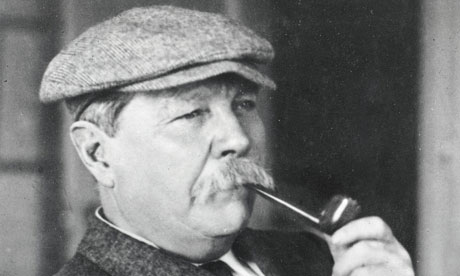
A late visit from Conan Doyle

Conan Doyle pretending to be Sherlock Holmes

Conan Doyle pretending to be Sherlock Holmes

Following on from our recent story about Sherlock Holmes’ creator visiting Perth, we should mention that Arthur Conan Doyle came back to WA in August 1930. That might not seem unusual, until you realise that he had been dead for more than a month.

A Sydney psychic (Psydney psychic?) claimed to be the first to have had a vision of the great man, but this was instantly rubbished by west coast mediums. If Conan Doyle was going to appear anywhere in Australia, it would definitely be in Perth. After all, hadn’t he visited here in 1921, and didn’t he donate £85 to the Spiritualist Church? And wasn’t WA the only place in Australia to actually have a spiritualist church at all?

So, a local apparition of the famous author was needed quickly, and fortunately one came to herbalist and clairvoyant, Maud McDonough. He had no particular message for her on this occasion, but she did see him quite plainly.

However when Conan Doyle returned three years later he had a very clear message for Maud. She was to take charge of all the various smaller spiritualist groups in Perth and Fremantle and unite them under own command. This was to be the grand Spiritualist Church of Western Australia (Inc).

Unsurprisingly, this did not go down well with the other leaders in the movement, who rejected Maud’s unambiguous mission from Conan Doyle. A series of bitter meetings took place, where Maud was roundly condemned and attempts made to expel her from the club.

The church administration fragmented, while numerous lawyers’ letters failed to resolve the situation. In the end, the secretary and treasurer resigned, taking the association’s cash with them.

Apparently the spirit of Arthur Conan Doyle didn’t see that coming.

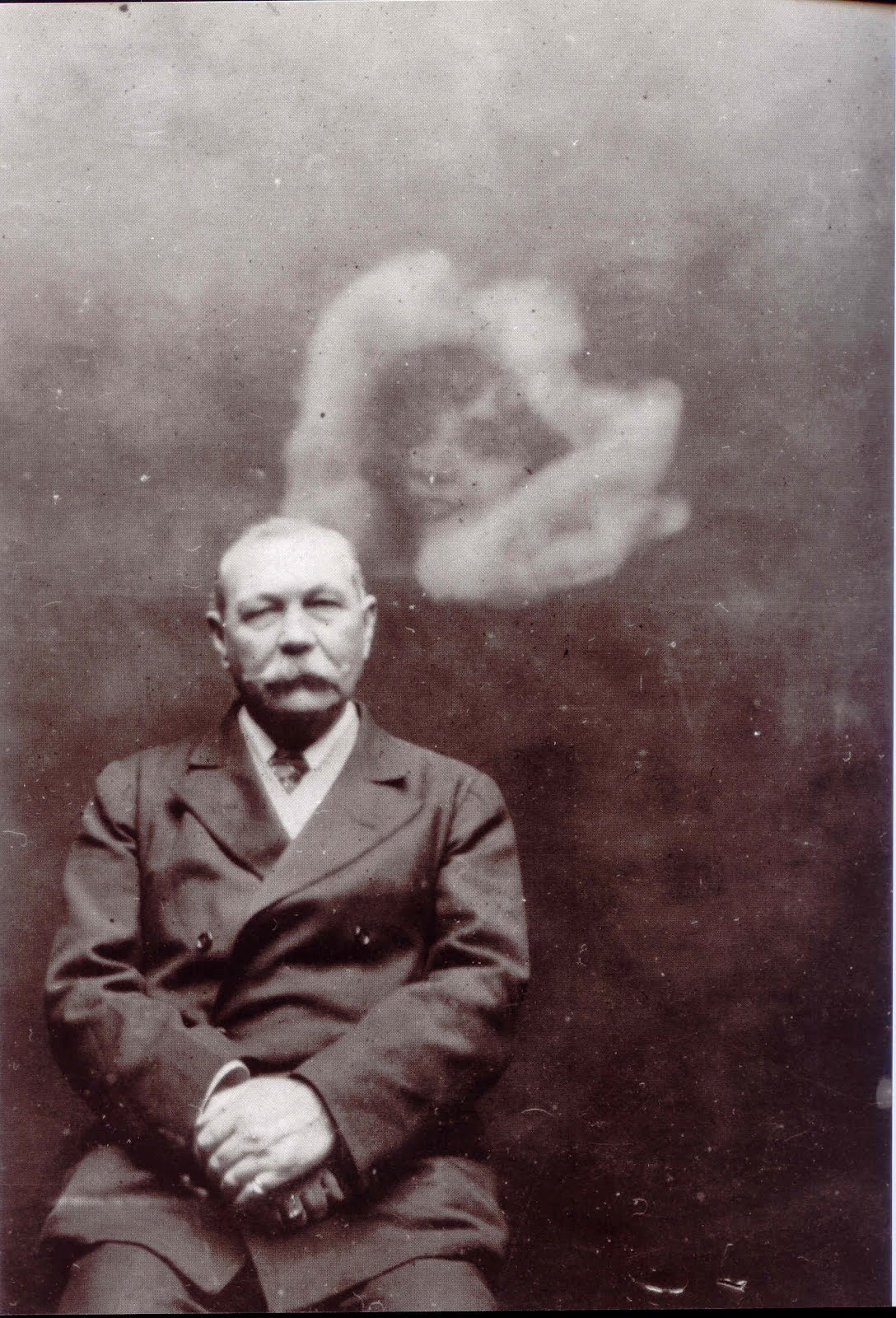
Speaking to the war dead

Arthur Conan Doyle and friend

Arthur Conan Doyle and friend

What do Sherlock Holmes and speaking to the dead have in common? The answer is, of course, Arthur Conan Doyle, who visited Perth in 1921 as part of a world tour.

But he wasn’t here to plug his books. Instead, Conan Doyle wanted to talk about his latest obsession, spiritualism. And His Majesty’s was packed out for the lunchtime event, with almost everyone in the audience being female. But we’ll come back to that.

Conan Doyle briefly sketched out the history of contacting the deceased, announcing that anyone who denied the existence of life after death was “either ignorant or a moral coward”. Certainly, the audience were receptive to the idea.

Especially when the speaker mentioned that his good friend, the brilliant scientist Oliver Lodge, had talked with the boys who had been killed in World War I. Every person in the audience had either lost a son or a husband in that conflict, or knew someone who had. Their bodies might not have been brought home, but now someone was offering a chance to say farewell.

“That,” said Sir Arthur from the stage, “is the message we have tried to give Australian mothers.” Mothers. Conan Doyle clearly knew who his audience was.

He had even spoken to his own dead son, Kingsley, who died in 1918 from the flu epidemic which raged across the world. A medium had relayed the words to Conan Doyle, who discovered that Kingsley was happy in the afterlife, and he even felt the touch of his son on his forehead.

How much excitement would that have created in an audience of mothers? An undoubtable, serious writer was proclaiming the very real possibility of once again speaking with lost children. How many tried and failed after this, we will never know.

There is no doubting Conan Doyle’s sincerity. He was no con artist, and was prepared to face ridicule for promoting his beliefs. Many of his friends tried to discourage him, not least Harry Houdini, the famous escapologist. But for Sir Arthur, this would mean giving up the belief he had finally said goodbye to his own son.

Speaking to the WWI dead is not usually thought of as part of Anzac history, but it fully deserves a small place in the tales to be told about 1914 to 1918.

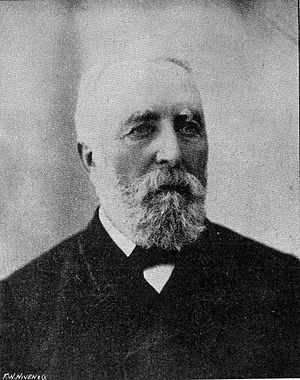
Ladies and gentlemen, raise your glass

What a beard!

What a beard!

How many people can claim to have saved a Western Australian icon? And what would WA be without Swan Draught? Ladies and gentlemen, we present Mr Thomas Wall Hardwick.

In 1887 a company bought both the Swan Brewery and the Lion Brewery, and together they (unimaginatively) called themselves the Swan Brewery Company. The outcome was a disaster. For the next two years the business bled money and was on the point of bankruptcy.

Enter Thomas, who spent decades in England running breweries before being enticed to take over the operations at Castlemaine in Victoria. Castlemaine? As if that’s even a beer.

After a couple of other jobs, Thomas was invited to Perth to save the Swan Brewery, which was distinctly on its last legs. He was horrified by the industry he found here, but promised he could work out a more efficient management system which might make it pay.

The directors offered him a very substantial salary if his vision could come true. And it did. His new beers were first sampled in 1891, and they were so popular that the turnover of the company went through the roof.

And now the grand house Thomas built in West Perth is due to face the wrecking ball, so some luxury apartments can be built in its place.

Horrible modern front, but could probably be restored

Horrible modern front, but could probably be restored

There is a function room at the redeveloped Old Brewery named after Thomas, but that is about all the commemoration he gets. While we at Dodgy Perth reserve judgement on the price of progress, it does seem a shame that his house will be lost without raising at least one tinnie of Swan Draft at 37 Mount Street before it is finally lost forever.

Who wants to join us?

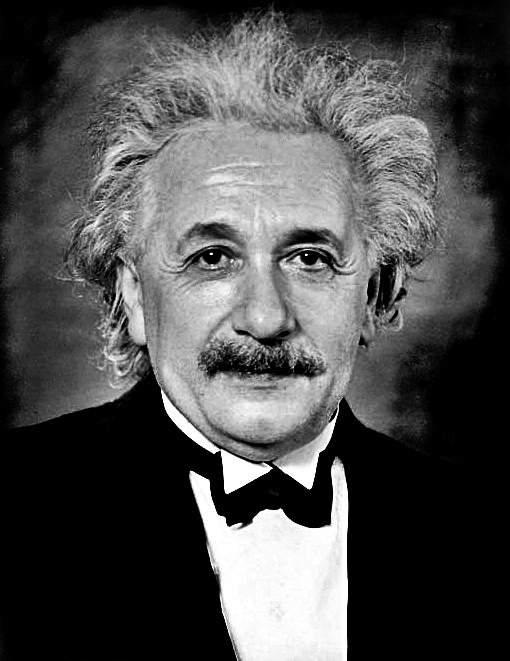
Relatively speaking

Not such a genius as to find a decent barber

Not such a genius as to find a decent barber

If you are the sort of person who likes to wear a white lab coat with pens sticking out the pocket, Western Australia was the only place to be in 1922. It was here one of Einstein’s most controversial theories was proved.

The closest we at Dodgy Perth ever get to science is watching reruns of Ghostbusters, but bear with us while we stumble through the technical bit.

Einstein said that light didn’t just travel in straight lines but was affected by gravity. So the light from a star passing near the heavy mass of the sun would make the star appear in a different place than if there was no sun. Smart bloke this Einstein fellow.

Anyway, scientists from all over the world gathered at Eighty Mile Beach between Broome and Port Hedland. Although the beach was called Ninety Mile Beach at the time, and is in fact 140 miles long. Go figure.

Here was the best place on Earth to see the total eclipse of the heart—sorry, sun—and check out the stars on either side of it. But the isolated Eighty Mile Beach was not easily reached by a large group of nerds, along with all their astronomicky gadgets. It is worth noting that five of the geeks were lady scientists.

The group left Freo on-board the Charon, along with a film crew to make a documentary of the trip. Eventually they reached Broome, and unloaded some 60 tons of instruments into the lugger Gwendoline.

Because of the tides, they had to anchor 3km offshore, and the heavy equipment put into whaleboats to take to land. Here, local Aborigines were waiting, and it was they who did all the hard work packing the boxes onto donkeys to travel to the camp sight. This process took more than two days.

Trenches were dug for concrete foundations for the astro-sciencey stuff, and eventually telescopes and cameras were in place, along with aerials so the team could stay in communication with Europe and America. Also included were darkrooms, so the photos could be developed on the spot.

Finally, on 21 September 1922, the observations were made and Herr Einstein was proved—unsurprisingly—to be completely right. The sun did indeed make stars move about. Light was odder than we’d thought.

And that was WA’s role in proving the 20th century’s most important scientific theory.

Dances with trees

It's not the size of your chopper...

It’s not the size of your chopper…

On this day, 12 August, Helena Barbara Dance swung an axe at a tree. And for the most part, that is all most people know about her. First, let’s look at the account as given, very woodenly (see what we did there?), by Charles ‘Rapist’ Fremantle:

The Lieutenant Governor made up his mind to establish a town up the Swan River to be called Perth and to lay the first stone of it on the King’s birthday the 12 August 1829. There being no stone contiguous for our purpose to celebrate the commencement of the new town, Mrs Dance cut down a tree, fired volleys, made speeches and gave several cheers, naming the town Perth according to the wishes of Sir George Murray.

Although Fremantle says Helena cut down the tree herself, Alexander Collie downplayed her role saying she only “gave the first blow”.

And George Pitt Morison didn’t like a woman doing too much manly work either. So in 1929 he paints a bloke waiting to the side ready to finish the job after Helena has tapped the tree with her tiny axe.

We know she was intrepid. It is often claimed Helena was only present because all the other women were giving birth. But that’s not what was said at the time. Hubby William said she was the only female brave enough to leave Garden Island and venture into a ‘savage land’. By which he meant it was full of savages.

The pregnancy excuse was invented by later generations who didn’t want to think their great-great grandmothers were anything other than bold explorers.

And now it gets odd. William Dance has a different description of the foundation of Perth:

By the bye, the laying of the first stone of this town, which took place on August 12, and on which occasion we made as much noise and rejoicing as our limited means would allow, was done by Mrs. Dance.

So Fremantle and Dance disagree on whether or not there were any stones. Perhaps Helena’s husband was being metaphorical. Or had a really bad memory.

The Dances were forced to leave Perth in 1832 when they had to escort James ‘Young Brides’ Stirling back to England so he could desperately try to salvage his failing colony, and the couple never returned.

After living in England and France, Helena died in 1863, never knowing how much her brief moment of fame would later be celebrated.

Incidentally, Dodgy Perth is sceptical about the alleged box made from Mrs Dance’s tree which was miraculously found by the Queen of England herself in a junk shop and gifted back to WA in the 1930s. When a story is too good to be true, it’s always too good to be true. One day we hope the real story about this box will be uncovered.

When electric disco sticks were all the rage

Just feel the power

Just feel the power

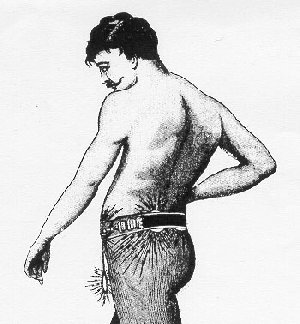
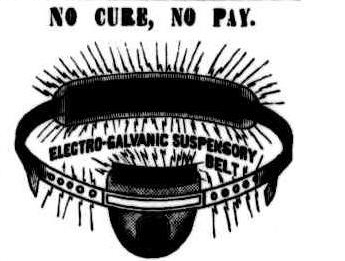
In the late 19th century, strange adverts started appearing in Perth newspapers. ‘Electro-galvanic suspensory belts’ were on sale, guaranteed to cure all ‘nervous weaknesses’.

To understand this oddity in the history of quack medicine, it is first necessary to know what causes nervous weaknesses in men. And by nervous weaknesses is meant a whole range of symptoms, but especially impotence.

The cause, you may be surprised to hear, was spermatorrhea, an excessive discharge of semen. Usually brought about through too much playing with yourself when a teenager.

In the 1800s, this imaginary disease caused such a panic that there were reported cases of suicide among men who suffered from it. Spermatorrhea could also damage your internal organs in a variety of horrible ways.

Fortunately, the solution was to wear a patented electric belt. This went round the patient’s waist, and a series of metal pieces would miraculously provide a continuous current of electricity, infusing ‘manly vigour’ into the generative organs.

This makes our eyes water just thinking about it

This makes our eyes water just thinking about it

Seriously. People bought shed loads of these things. And if the belt wasn’t for you, there were plenty of other products advertised to restore the vital forces of manhood.

Naturally, some doctors sneered at the sheer quackery of it all, but men were convinced that applying electricity to their manhood was the only possible solution to their problems.

Now, where can the Dodgy Perth team get one of these wonders?