
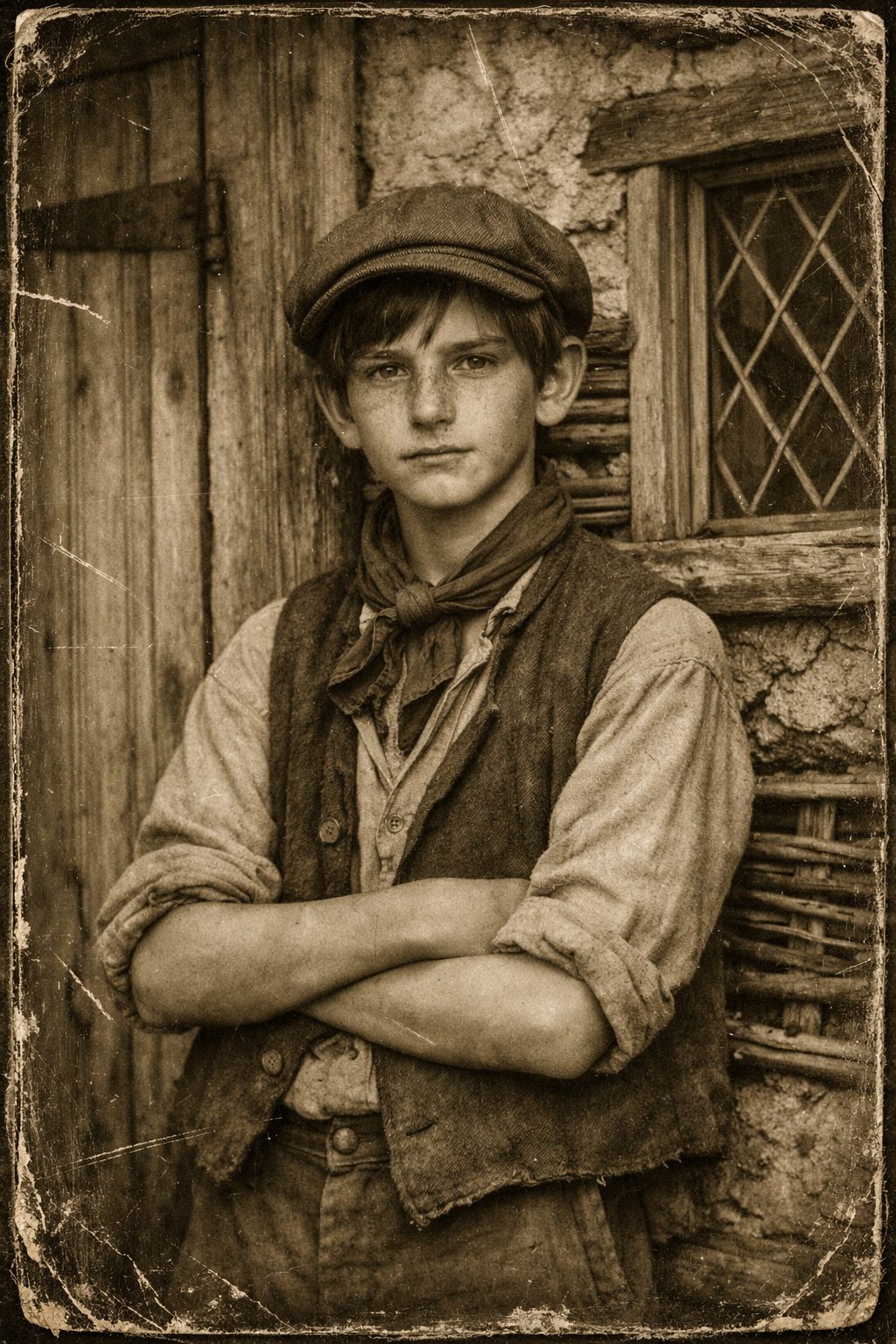
When fifteen-year-old John Gavin was hanged for murder at the Fremantle Roundhouse in 1844, the newspapers mentioned that a death mask and cast had been taken ‘for the purpose of furthering the ends of science.’ That brief remark hints at the intellectual world into which Gavin’s body was delivered, a world in which the human head was believed to reveal the secrets of the soul. Gavin’s skull showed ‘extraordinary formation.’ The front of the head, they said, was strangely narrow, the back bulged with ominous force. To modern eyes this sounds like the language of pathology, and some recent historians have mistakenly treated it as such. To the colonists of the 1840s, it was something more potent: a moral diagnosis.
Phrenology, that curious nineteenth‑century blend of measurement, speculation and prejudice, divided the skull into four regions: the anterior (intellect), the coronal (moral sentiments), the lateral (aggression), and the basilar (animal impulses). A well‑balanced character, phrenologists insisted, required harmony between these compartments. Too little intellect, too much passion, and a person was destined for trouble.
A decade after Gavin’s death, the colony would see this logic displayed in its most dramatic form. In 1853, after the bushrangers Patrick O’Connor and Henry Bradley were hanged outside Melbourne Gaol before a vast crowd, their heads were immediately measured and compared to the supposed ‘average British skull.’ The results were printed with breathless authority. O’Connor’s lateral region, the seat of destructiveness and combativeness, was said to bulge to ‘perfect deformity.’ Bradley’s anterior region, the home of intellect, was declared so small that he possessed the ‘passions of a full‑grown man and the intellect of a child.’
The conclusion was irresistible to colonial readers. Bradley, at least, was not so much wicked as incapable, a man whose malformed brain made crime irresistible. In the colonial imagination, he was not bad, just mad. And the implication was clear: if skulls could reveal such dangerous deficiencies, then the system ought to be identifying these people before they committed crimes, incarcerating them not as offenders but as biological risks. Phrenology promised a future in which criminality could be detected in advance, written on the body like a warning label.
This was the intellectual climate in which Gavin’s skull was interpreted. He was only fifteen, an apprentice in a household a world away from his home, but phrenology had no category for adolescence. Nor did it recognise the brutal shaping forces of the Parkhurst system through which he had already passed: a regime of silence, drill, and moral correction designed to break and remake juvenile offenders. Gavin had endured that discipline, stripped of identity and choice, before being transported without consent to Western Australia. There, he was assigned as an apprentice to a remote farm, isolated from anyone he knew, expected to reform through labour and obedience. In such a setting, far from the world he knew, his youth and vulnerability were invisible to those who later examined his skull. They saw only the contours of supposed criminality, not the marks of a harsh short life and an institutional cruelty that had already shaped him.
The claim that his ‘anterior organs’ were ‘very deficiently developed’ was not read as the ordinary physiology of a boy whose frontal lobes were still maturing. It was taken as evidence of weak intellect. The ‘enormous’ posterior region was read as proof of overpowering animal impulses. In the phrenological worldview, Gavin’s head did not belong to a frightened teenager, it belonged to a type, a body whose shape foretold his fate.
And this typology was already deeply entangled with the racial thinking of the colony. Phrenology was not only a theory of criminality; it was a tool of scientific racism, used to rank peoples and justify colonial rule. In Western Australia, settlers and officials routinely applied the same four‑region framework to Aboriginal people. Writers like Henry Landor claimed that the ‘narrowness’ of the Aboriginal forehead showed a lack of intellect, while the breadth of the base revealed an excess of passion. Missionaries, protectors and amateur scientists repeated these ideas, using phrenological charts to argue that Aboriginal people were naturally impulsive, childlike or incapable of civilisation.
These ideas were not confined to drawing rooms or lecture halls. They shaped policing, punishment and policy. Aboriginal suffering was dismissed as the inevitable outcome of ‘inferior’ cerebral development. Phrenology provided a scientific‑sounding justification for dispossession, surveillance and violence. The same measurements that condemned Bradley and O’Connor as ‘criminal idiots’ were used to deny Aboriginal people full humanity.
In this context, the reading of Gavin’s skull becomes more revealing than the skull itself. It shows how colonists understood crime, race and youth through the same distorting lens. It shows how easily a boy could be stripped of individuality and folded into a hierarchy of ‘types’ (the criminal, the Aboriginal) all imagined as governed by passion rather than reason. It shows how the colony naturalised guilt by locating it in the body, making execution or displacement from land seem not only just but inevitable.
Gavin’s skull was probably not abnormal. The framework used to interpret it was. But that framework mattered. It helped erase his youth. It made his conviction appear the product of biology rather than circumstance. It allowed colonists to imagine that the boy on the gallows had been destined for this end from birth. To understand Gavin’s world, we must look not at the cast of his head but at the cast of mind that surrounded him. A world in which pseudo‑science and racial hierarchy combined to turn a fifteen‑year‑old into a specimen, and a tragedy into a lesson about the supposed shape of criminality.

