The right sort of pervert

Bathing beach, 1920s

You know how it is. Down at Como Beach in South Perth and the only place to change into your swimming togs is in the back of the car.

Well, in 1938 young women were doing so with only the benefit of a towel or two covering the car window.

The Mirror was suitably shocked. Well, sort of shocked. But more a little bit creepy.

Noting that young girls were often undressed on the beach, our journalist made the astounding observation that perhaps young ladies had not grown out of this habit of appearing nude in front of young men.

But while young men would be embarrassed to stare at a naked child, they would not be so coy about a fully developed female body.

And this is where our journalist becomes a little odd. He declares that it is not his intention to be a spoilsport, or to restrict the liberty of girls to change where they like.

After all, those males who get a “spicy delight” from walking up and down past the cars hoping to catch the female form should not be denied their right to do so.

But unfortunately, every now and again someone ruins the party by committing sexual assault.

So, it is up to the girls to make sure that they are not seen by perverts. Only the decent sort of peeping tom is allowed that privilege.

This article is a rewrite of an earlier Dodgy Perth post. You could go and find the older piece, but you shouldn’t really be looking between the towels.

Keeping it in the family

J. W. R. Linton, Perth from South Perth, c.1900

J. W. R. Linton, Perth from South Perth, c.1900

In 1905 the Sunday Times detected the whiff of gross mismanagement at Perth Museum.

There was, however, a little bit of self-interest in its accusation. The founder of the Sunday Times, Frederick Vosper, spent his spare time collecting minerals (and denouncing all non-white races, but that’s another story).

After Vosper’s death, his collection had been donated to the Museum. Which consequently stored it in a broom cupboard.

So when a Sunday Times journalist visited and noticed the minerals weren’t on display it was open season on the Museum’s management committee.

In those days the Museum and Art Gallery were one and the same place. And it was on the art collection that the newspaper turned its fire.

It was alleged that the majority of the collection was purchased from England not because of its quality, but because of family connections between artists and the Museum’s Board.

As a consequence, public money was being wasted on inferior paintings, just to ‘keep it in the family’.

But particular scorn was reserved for the Linton family. Sir James Dromgole Linton was a British artist who advised the Museum on its English purchases.

His son, James Linton, taught art in Perth. And simply because he was the offspring of a very minor English artist, the Museum went out of its way to buy everything James did.

And when they needed a backdrop for the stuffed birds, guess who was engaged to undertake it?

One of Linton’s canvases, purporting to be a representation of Fremantle Harbour, was a particularly bad example of his talentless watercolour daubs.

The Sunday Times described it as something you might paint “after a week on raw lobster.”

Nonetheless, his paintings took pride of place in every room, overshadowing art by painters who could actually paint.

In addition, James Linton’s name appeared all over the Museum. In all the guides, handbooks and reports, and on the financial statements.

The whole place, it was said, felt like Linton’s personal gallery, rather than a building owned by the people of Western Australia.

Of course, we at Dodgy Perth take no stand on the quality of Linton’s art. Except to note that the Sunday Times had it exactly right.

The Museum continued to collect Linton, and the work of offspring of Linton, including some teaspoons. And the work of anyone who took one of Linton’s courses, such as Herbert ‘Kitch’ Currie.

And, most likely, if you look hard enough, the work of Linton’s cat is on display somewhere in the Art Gallery. Probably.

Pistol packing Coral

coral

Bang bang, she shot me down. Coral Honter in 1956

In 1956, there was indignation when a Bicton dance hall presented Coral Honter doing the daring Dance of the Seven Veils. The stunning 18-year-old entertainer, originally from Colombo, raised more than just eyebrows with her strip teases.

Now living in South Perth, the young beauty had developed a fan base among the local ‘jazz sophisticates’. So when Coral announced she would perform the songs of American singer-songwriter Ruth Wallis, it was always going to be controversial.

The songs of Ruth Wallis were banned in Australia, her records confiscated by the authorities, and even possession of them was illegal.

Wallis’ lyrics were pure double entendre from start to finish. A typical verse would run:

Johnny’s got a yo-yo
It really is a wow
Teacher keeps him after school
So he can show her how.
It’s shiny and he says it is brand new
And he can do more tricks with it than his dad can do.
You can’t learn to play with it just by wishin’,
You gotta know how to hold it in the right position
By intuition…

Apart from Johnny Had a Yo-Yo, Coral announced she would also be singing Tonight For Sure, The Pistol Song, Sweater Girl, The Admiral’s Daughter, Down In Montevideo and The Psycho Mambo.

Setting out to provoke Perth’s conservative elements, Coral sweetly said: “I couldn’t care less if a few prudes make a fuss about my singing these songs. Most people, I am sure, will enjoy their sexy sizzle—that’s if they’re sophisticated.”

Coral’s charms had not gone unnoticed by wannabe sugar daddies, especially as she developed a reputation for liberal distribution of kisses during her numbers. “I’ve got one weakness,” she slyly admitted. “Bald heads.”

Sugar daddies had better watch out. This is one smart cookie.

Who ya gonna call?

ghostbusters

And they say the media doesn’t turn kids into criminals.

In 1938 one of the most popular radio shows was a serial about haunted houses.

In the Bicton area, every young boy aged between nine and twelve would sit glued to the wireless to hear the latest episode.

So, when a rumour spread that an empty house on Canning Highway in Palmyra was haunted, it was going to be impossible to keep them away. Especially when the boys were told that there was a reward of £5 for the first person to capture the spirit.

haunted

The haunted house on Canning Highway

Around 25 of the little horrors got together, determined to become WA’s first ghostbusters.

And that many eager boys, all determined to ensnare a phantom, found the house was locked. This minor detail was not going to stand in their way.

Windows were broken, and the front door was forced open.

One poor unfortunate found himself pushed right through the French windows by the surging kids behind.

Of course, that’s not exactly what they said to the investigating police officer.

In fact, they said that they had just touched the door and it had fallen off its hinges. And when one lad had merely laid a finger on a window it had broken all by itself.

Kids, eh?

Once inside, they discovered… the ghost.

No really, they did.

Okay, it turned out to be one of their gang with a white sheet over his head, and who presumably had been the ringleader in stirring up the whole escapade in the first place.

But it was a bit like a spectre.

All the ghostbusters were too young to charge with criminal damage, but they still cost their parents a pretty penny to put the damage right.

We blame the media.

Last night a DJ ruined my life

Mrs E. Halliday and her wireless, 1950

Mrs E. Halliday and her wireless, 1950

Everybody has one friend who “can’t bear to listen to commercial radio”, and who praises JJJ.

The same friend will also tell you all modern music is rubbish.

I. Can’t. Even.

Anyway, in Dodgy Perth HQ we are unashamed to have 94.5 FM blaring away as our crack team of researchers finds ever more stories from the past to entertain you.

Today: What did people think of commercial radio in 1949?

Not a lot, if we are to believe the Westralian Worker, who listed seven specific harms of listening to such stations.

Channels such as 94.5 and 92.9 have:

  • Destroyed silence and the ability to create our own amusements.
  • Played music only fitted to an “asylum for cultural perverts”.
  • Bombarded us with adverts which are disgusting and impudent.
  • Ruined family life by removing the need for conversation and let DJs into the family circle, a type of person who would normally never get past the front door.
  • Turned the whole country into noise hungry robots.
  • Lowered standards of music, literature and drama.
  • Hampered education by encouraging mediocrity, inaccuracy and sensation.

Okay. We get it. Back to JJJ for us then.

No dirty dancing at Gilkison’s

001734d

Young Australia League, Murray Street, under construction in 1924

The young couple are clasping their bodies suggestively close. In typical bodgie style, a cigarette dangles from his lip, and their expressions are fashionably bored.

His right hand is on her hip and her left hand rests gently on his bicep. They bend their knees and off they go, repeating the same three dance steps over and over. The boy going backwards all the time.

Welcome to the most shocking dance craze of 1953: The Creep.

For Sam Gilkison, who operated a dance studio from the Young Australia League (above), this was the type of thing only done by “sensation-seeking drug-addicts”:

“I can’t imagine any teachers having anything to do with teaching this type of thing,” he said.

Old time ballroom dancing was as risqué as it should get. Even modern ballroom, if you have to. But never dance crazes like the Creep, he fumed.

Mr Gilkison was not a big fan, we take it.

In any case Gilkison—who should know—declared that the Creep was not a legitimate dance since it had a “suggestive nature” which risked bringing the dancing profession into disrepute.

The “sex dance menace” alarmed those who had responsibility for the moral well-being of Perth’s youngsters.

Dance hall owners feared controversy if the Creep became too popular, as it threatened to do. So these owners got together to discuss banning it altogether from their venues.

Dodgy Perth nostalgically remembers Goth nights at Gilkison’s, sipping an absinthe cocktail, and seeing dancing on the floor of which Sam Gilkison would definitely not have approved.

We remember little more after the second absinthe cocktail, but hope our own moves were not even close to being of the sex dance menace type.

As your attorney…

Ye Olde Englishe Fayre was a fairground which included a freak show where you could see the monkey boy and a two-headed pig. It also had a variety show with the top acts of the day, in between local performers of varying quality.

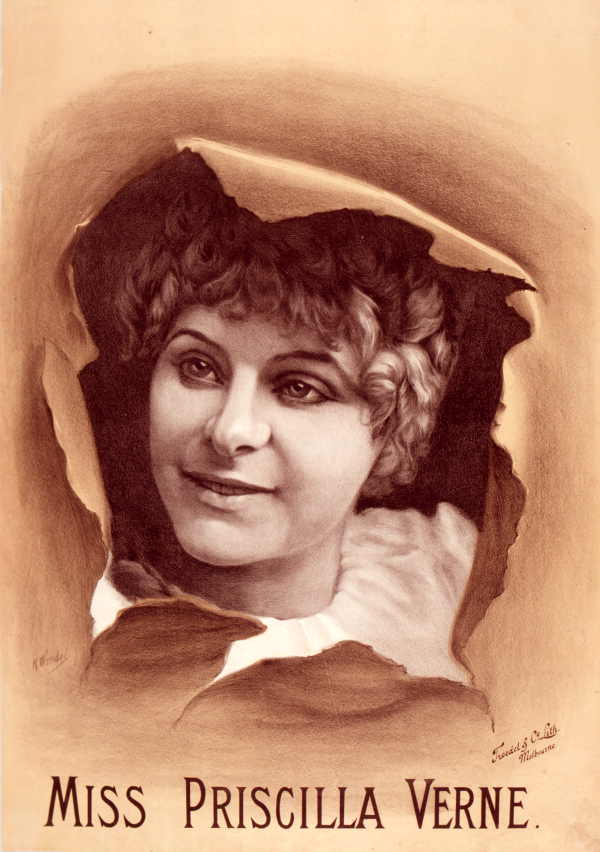
By 1896 the Fayre had relocated to the site now occupied by His Majesty’s Theatre where you could see renowned singer Priscilla Verne do her best known routine, a song called ‘He Sits in the Front Row’:

He sits in the front row; he is blushing like a maid,
I love you, darling; be my hub; now, don’t be afraid.
Don’t turn away in anger, dear; I always will be true,
Accept this kiss, and give me one; for I love you.

At this point she would lean forwards and beckon to a male patron in the front row to act out the final line. This particular Friday, she turned to Gus McBride, who fancied himself a bit of a ladies’ man. Priscilla invited him on stage to kiss her.

For reasons which are not clear, Gussie declined this generous offer and retorted with an insult which made Priscilla’s blood boil. “You contemptible little cad,” she snarled from the stage. The next day she consulted a lawyer, who advised her she should have her abuser horsewhipped in public.

So Priscilla sent a letter, signed ‘Alice Chambers’, claiming she had fallen in love with Gus and would like to meet him outside the Town Hall on Barrack Street that very afternoon. Together with other members of the show, she lay in wait with a cane hidden in her dress.

When Gussie arrived to meet with ‘Alice’ he was shocked to be greeted by the assembled Fayre employees. “Come here! I want to speak to you!” said Priscilla. Gus began to run along Barrack Street, followed by Priscilla who kept lashing out at him with the cane.

“You cad,” she shouted, “I’ll teach you not to insult another woman as you did me.”

By this time a large crowd was enjoying every moment of the scene, and Gus had to plead with two burly police officers to defend him. Soon afterwards he left Perth and we never heard from him again.

There’s probably a moral in all this, but we have no idea what it is.

When the freak show came to Perth

Monkey BoySo you thought the Giants were good last weekend? Baby, you don’t even know what entertainment is.

Through the magic of history, let Dodgy Perth transport you back 120 years to show you a good time.

On Hay Street, right where the Kings Hotel now stands (lovely piece of architecture that it is) was once the site of Ye Olde Englishe Fayre. So on a hot December night in 1895, let’s find out what there was to see.

After passing through an elaborately decorated entrance, you would first see the standard fairground stuff: sideshows, refreshment stalls and a stage for a variety performance.

Persuasive attendants would tempt you to part with your money for swinging boats, shooting-galleries, and the inevitable Aunt Sally. Opportunities to lose money on games were everywhere.

But you want real entertainment, don’t you? Not the ordinary fairground paraphernalia.

Let’s pay (again) and enter the first tent. Here you’ll encounter waxworks, including those of Beach and Searle, renowned Australian scullers. Unfortunately, this wax wasn’t made for the Perth summer heat and is beginning to melt a little. Next!

Mummies. Four-thousand year old mummies. They will hold you for a bit.

And if mummies aren’t your cup of tea, how about the body of conjoined twins. That ought to make you stare. And at the two-legged pig right next to them. There were plenty of other freaks to guarantee value for your money.

But the big draw card of Ye Olde Englishe Fayre was Monkey Boy.

Either “a human monstrosity” or a “hideous freak of nature”, he was substantially under a metre tall, and a mere thirteen years old. He looked like a monkey, acted like a monkey, but (shockingly!) could talk to the crowd.

Everyone rushed forwards to touch and manhandle the weird child.

And the papers all agreed that “monkey-faced boy” was the best thing ever to appear in the colony.

Forget your Giants, Perth. They knew what real entertainment was 120 years ago.

Please note that this is an edited re-post of an earlier article. Dodgy Perth has many new followers lately, and the story is so good it’s worth rereading anyway.

Fremantle sensual stew… and it’s not a recipe

NewportBack at the time of Federation, neither the Court Hotel nor Connections Nightclub were welcoming gay men. Since it was illegal to be homosexual, no one was supposed to be welcoming gay men.

So if you were gay in 1901, where could you meet other people on the scene?

Turns out the answer is a billiard room in a Fremantle hotel. Dodgy Perth strongly suspects that it was the Newport, then known as the Club Hotel. (Check out the Newport’s Thursday music nights. Coming up next week is Boom Bap Pow as the Divinyls. Which Dodgy Perth is definitely not going to miss.)

Some of WA’s finest citizens were known to go to this billiard room. The kind of elite who could afford the finest clothes, diamond rings, gold watches, and “even eye-glasses”.

It seems that the landlord of the Newport simply let out the room, and turned a blind eye to whatever went on. The local policemen were slipped a few pound notes every now and again and, strange to say, never saw a need to investigate the billiard room’s clientele.

It is even suggested that at least one police inspector and a local magistrate liked to play billiards from time to time.

In fact, had you attended before midnight, all you would have seen were some respectable citizens enjoying a game or two, while sipping a few beers.

But, come midnight, if you were a stranger and seemed likely to be gay, you would have been asked to stay on for “a little game on the quiet.”

After this, we cannot say for certain what occurred, but it must have been good because The Sunday Times described it as a “carrion filth heap of depravity”, a “foul Fremantle sensual stew”, and a “den of disgusting depravity”. Which sounds like a great night out.

So, when Dodgy Perth is at the Newport next Thursday, we will raise a glass (or two) to a generation whose love might not be able to speak its name, but could still find time for a game of after-midnight billiards.

When drag came to Perth

ValentinesIn honour of St Valentine, the Court Hotel is holding one of its (in)famous Traffic Light Parties this evening. If you haven’t been to one before, Dodgy Perth can assure you of a great night out.

The event will be hosted by two of the Court’s regular queens, Hannah Conda and Barbie Q.

Which leads to today’s historical problem: When did drag first come to Perth?

It is impossible to know who was the first local man to dress in women’s clothes, since appearing in public meant almost certain arrest. As happened to South Belmont resident Richard Moyes in 1949. Richard was only spared jail by agreeing to see a psychiatrist.

Stewart Hobbs of East Cannington was not so lucky the following year, when he was sentenced to fourteen days for wearing a dress.

But men will be men (or women in this case), and in 1953 The Mirror was shocked to discover that suburban houses were hosting Drag Nights.

Because the innocent readers of The Mirror wouldn’t have a clue about the jargon of “the effeminates”, the newspaper helpfully defined ‘drag’. It meant having an elaborate wig, painted and rouged face, expensive frock and dainty underwear, brassiere with padding, silk stockings and high heeled shoes.

Sounds about right to us.

The paper had been tipped off by a man who ‘accidentally’ (yeah, right) attended one of these drag nights.

All the guests were men, and there was plenty of hard liquor and hot jazz and dancing. Especially dancing.

Most regrettable of all was that the queens were intelligent men, who held respectable jobs during the day.

The Mirror’s informant fled when one of the ‘synthetic sirens’ asked: “Have a dance with me please, darling.” So, unfortunately, the reader is unable to discover exactly what kind of debauchery took place later that evening.

However, the paper suggested that it might have involved a mock religious marriage ceremony. Or it might not, since no one saw anything of the sort.

Jazz. Dancing. Liquor. Drag queens. In Perth? Where was the strong arm of the law to sort things out?

And especially important, where was our invite?