Why WA’s museum loved cats

Noolbengers looking unbearably cute

Noolbengers looking unbearably cute

Colin Barnett may not like cats. He even passed a ridiculous piece of legislation forcing cats to be on some kind of sex offender register.

But we’ll tell you who does like cats. The West Australian Museum. That’s who.

Why? we hear you ask. Because they added to the Museum’s collection of native wildlife, and that institution had no money to spend on assembling one.

In 1939, a cat belonging to Mr W. Skeet, of Forrestdale caught a live noolbenger. (Don’t worry, we had to look it up on Wikipedia too. Turns out it’s a honey possum, which is half the size of a mouse.)

Mr Skeet did what any good citizen would do, and posted it to the WA Museum. The cute little critter was put in a cage with another noolbenger, which had been caught by a Shenton Park cat a couple of weeks earlier.

The Museum’s curator, Ludwig Glauert, loved cats. He encouraged people to send in anything they caught. Other than mice. Apparently mice were boring.

You see, cats are “instinctive collectors”, who don’t (so we are told) eat West Australian native marsupials, they just like bringing them home to play with.

The top unpaid animal collector in WA was an unnamed black and white cat owned by Miss May Tree, of Newlands near Donnybrook. (Dodgy Perth can’t help thinking that Miss May Tree sounds like a great name for a black and white cat.)

For years, in the course of its “unscientific researches,” Miss Tree’s cat donated ring-tailed possums, wambengers, dunnarts, noolbengers, quendas, and even bats.

Without this hard work, the WA Museum wouldn’t have had much of a collection said Ludwig.

Especially since many of these animals were nocturnal. And curators can’t go out at night. Apparently.

So let’s hear it for WA’s unsung hero of scientific research. The humble pussy.

h/t Christen Bell

A level playing field

foy&gibson

Foy & Gibson ladies football team, 1917

This morning, Dodgy Perth watched the USA v Australia game from the women’s world cup. Unfortunately the septics won. But sometimes bad things happen to good people.

It got us wondering when the first women’s football happened in Western Australia.

According to soccer historian Richard Kreider, after WWII there were a few ladies social matches, particularly among the Italian community.

However, the first organised women’s soccer game was not until 1971 when the Vel-Belles played the Beauts as a curtain raiser to WA v Moscow Dynamo.

To find women’s football older than this, we need to turn to the Australian version.

In the late 19th century, when women in other countries were beginning to play games seriously, most men found the idea either ridiculous, or at the very least unladylike.

The West Australian even found space to mock the idea of women’s sport in a lengthy song, of which this verse is typically misogynistic:

The goal-keeper looked at the ball—quite amazed at it!
Now, the next time it neared her she’d turned to a friend
To examine the cut of her blouse, and to chat on it,
Said the captain, “Miss Bodgers, I wish you’d attend!”
So she turned to see where the ball was, and she sat on it.

With attitudes like this, it’s easy to see why women’s sport was slow to develop in WA.

But with so many young men away fighting in Europe during WWI, the women got a chance to play Australian Rules.

Taking place at Subiaco Oval on 29 September 1917, the event was organised as a charity fund raiser by Miss Gell Howlett.

A team in maroon played a team in gold. The former won three goals to two.

Even so, this ground-breaking moment in WA sporting history was scorned by the media, who mocked it as women in ‘fancy dress’ who showed little talent. Although there some amusement value, it was said to be a total failure as a game of football.

Seems the women didn’t quite see it that way, since leagues were quickly established both in the metropolitan area and in the Goldfields, and grand finals were keenly fought.

There’s a really good exhibition of the history of the women’s game on at the State Library right now. Get to see it if you can.

How WA honours one rapist

Looking every inch like a rapist

Looking every inch the rapist

When the Boy from Bassendean was convicted of historical sex crimes, people were quick to react. Perth Modern removed paintings from the wall, while Perth and Bassendean councils ripped up their memorial plaques. So what to do about a city named after a sadistic rapist?

In April 1826 Charles Howe Fremantle was arrested and charged with raping a 15-year-old servant. This had taken place in front of a woman and two children at Charlie’s lodgings in Portsmouth. A charge of ‘aggravated rape’ carried the automatic death penalty. Fortunately for him, daddy was a politician.

William Fremantle immediately called on his mentor, the much-hated Marquess of Buckingham. He told Charlie’s dad he would help get the young man out of this “sad scrape”, and would pay “bail to any amount”. Further, William was advised to “buy off the evidence” in order to keep the scandal out of the press.

Thanks to Buckingham’s dirty money, bail was granted and the marquess even advised on which dubious lawyer would best “get rid of the evidence”.

And so thanks to a corrupt aristocrat, daddy’s connections and a bent lawyer, a brutal rape was covered up and Charles was bundled out of the country to go and claim Western Australia. (The ungrateful sod had the nerve to complain about this mission!)

And, in due course, the evil bastard became an admiral.

Every now and again, someone claims Fremantle was only ‘charged’ with rape, never convicted. But simply read the correspondence between Buckingham and William Fremantle. There is no question about his guilt.

So, if we rip up plaques mentioning sex offenders, what do we do about an entire city?

When the colonists needed Yagan

yaganToday Dodgy Perth takes a slight detour from our usual preoccupation with sex and scandal. Instead we wish to celebrate an Aboriginal hero of the early colony.

On 8 March 1833, with white settlement only a few years old, Josephine Birkett was granted Perth Lot A12 by James ‘I like young brides’ Stirling. This attractive piece of land was on St George’s Terrace, exactly where the hideous London Court now sits.

She had already built herself a bungalow on the site (planning laws were somewhat different then), along with a few neighbours, including Charles Leroux.

All the cottages were constructed with roofs made of reeds and rushes. So it is no surprise that locals fretted about what would happen if they caught fire. And why weren’t the roofs supported properly? You can imagine that the owners dismissed such concerns with a wave of their hand. Nothing will happen, they would have said.

On 13 March 1833, just five days after taking legal ownership of the land, Josephine Birkett’s bungalow caught fire. Josephine had a narrow escape, the flames reaching the bed on which she was sleeping before she was aware of her perilous situation.

She and her daughter were unable to grab their treasured possessions, escaping only with the clothes on their back.

The fire quickly spread to the adjoining cottages, including that of Charles Leroux. A bugle was sounded and people ran to the scene to offer assistance. Among those who attended were Captain Ellis and renowned Aboriginal resistance leader, Yagan.

Yagan was keen to offer assistance, but knew exactly how white men thought under these circumstances. He went up to Ellis and asked him to tell him straight if white folk or black folk were going to be held responsible for the destruction. Ellis replied that as far as he knew it was an accident.

This was all Yagan needed, and he took charge, encouraging the colonists to work harder and bringing bucket after bucket of water himself. His cries of “mocha, mocha” stimulated the townsfolk to do their best.

But, despite these heroic efforts, as the smoke cleared, many of the cottages and all of their contents were completely destroyed.

Despite Captain Ellis’ words to Yagan, immediate suspicion fell on the local Aboriginal population. However, with no evidence the mob decided that it was probably a local boy who had recently been punished for some minor crime. But, again, no proof was forthcoming.

Eventually, Josephine’s servant said that, although it probably had nothing to do with her, she did remember throwing the glowing embers from a grate in the exact spot the fire started.

One happy outcome was that Private Jefferies, of the 63rd Regiment, was poking through the ruins when he discovered Josephine’s moneybox. He immediately returned it to her, earning praise for his honesty.

We wish all the ends to this story were happy, but suspect the reader already knows they are not.

Yagan was murdered by a young settler just a few months later, after the government issued a bounty for his capture ‘dead or alive’.

Captain Ellis was to be killed by an Aboriginal warrior the following year, as he fought at the Pinjarra Massacre.

Life was often bloody and short in the 1830s. Let’s not whitewash it with sentimental views of early colonists and their pretty cottages.

h/t Museum of Perth

Embarrassing bodies

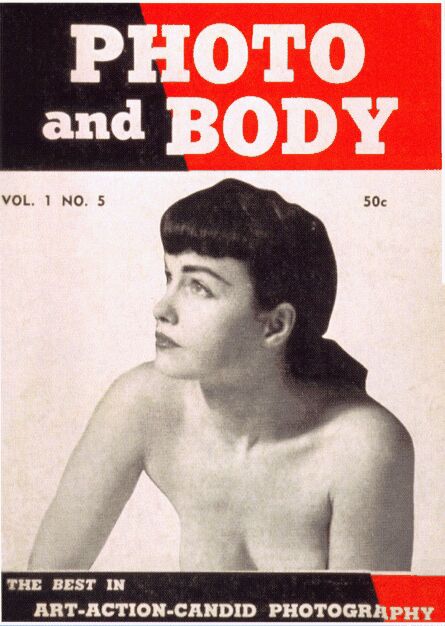
As is well known, only the most recent generation would be so stupid as to allow nude photographs of themselves to circulate outside of their control. Only today’s generation.

Which is why it is impossible their grandparents could have done so in the 1950s. Impossible, we tell you.

Well, except for those young Perth girls who were willing to get their kit off for a photographer and then unexpectedly find themselves in adult publications.

In 1953 it was all the rage to strip off for any photographer, professional or amateur. Sometimes the girl was paid. Sometimes she just did it for fun.

Although a few of the images could be considered artistic, many of them were much less ‘inhibited’. And it was these photos that often found their way to overseas magazines euphemistically known as ‘naturist publications’.

The trouble was magazines get imported. Sometimes back into the same city the original photos came from. Like Perth.

In Australia the law demanded local publications ‘retouch’ the images so certain lady bits were not so prominent. However, no such law applied to many European countries or to America.

So more than one Perth young lady found her suggestive poses purchased by her acquaintances, without any blurring from 1950s Photoshop.

But, like we say. It’s only the modern generation that would be so stupid.

Celebrating sex offenders? Really?

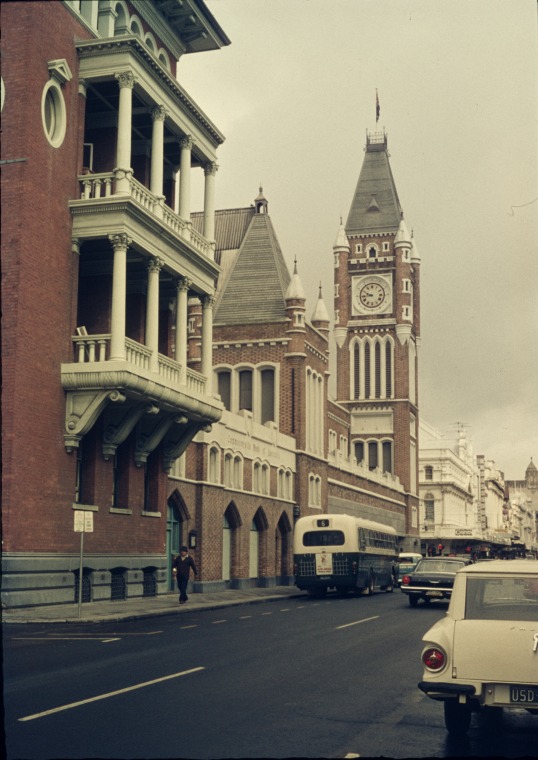
Town HallReader, we are all friends here, are we not? Good. Then Dodgy Perth can reveal the heavy weight hanging on our collective heart.

Dear fellow Perthite, Dodgy Perth proposes that the Town Hall on Barrack Street should be demolished.

We know, we know. You’ll never be able to look us in the eye again. But hang around for a bit, while we justify this outrageous statement.

In 1913, it appeared likely Perth Council would vacate the Town Hall for proposed new premises. The Institute of Architects, big bunch of softies that they were, proposed the tower of the Hall be preserved for historic reasons, and incorporated into any new design.

(If you want a 21st century example of this way of thinking, look no further than the eyesore that is St George’s Hall façade on Hay Street.)

Fortunately, not everyone was as sentimental as the architects. And a few were willing to speak out, noting it was inconceivable that any sane person could desire to have “such an aggressive monstrosity” as the Town Hall handed down to posterity.

Of course, some will point out it was convict built, and we should treasure these memories of the past. Dodgy Perth, and our 1913 modernists, say no.

What are we commemorating? The dreadful crimes committed by some who constructed the Town Hall? Among those arriving on the Hougoumont (who made up most of the workforce) were men guilty of rape, murder, and incest.

Do you want to venerate rapists? Really?

If not the men, then perhaps we should remember the awful system which condemned people to be transported half a world away and used as slave labour, long after it had been abolished everywhere else in the world.

The impact it had on people like Frederick Bicknell, a young carpenter who did the shingle roofing on the Town Hall. And who was transported for arson and insurance fraud. And who died in Old Men’s Home in Perth, well into the 20th century.

Do you want to venerate slavery? Really?

Instead, argued our 1913 anti-heritage consultants, simply let us forget the Town Hall. In any case, its birthstains can never be forgotten when it has four sets of ghastly broad arrows at the corners of the spires. The Town Hall can only recall an exceedingly dark and blotted page in the history of the State.

If antiquarians really care, then measured drawings and a set of photographs could be made. But not one brick should remain of this awful place.

If we wish to perpetuate early architecture, Government House is pretty enough, and in much more picturesque surroundings.

So Dodgy Perth joins in with the dissenting voices of 1913 and says, with all due reverence and respect, let the Town Hall join its builders, and quietly pass away.

Ridin Dirty

Ocean Beach Hotel, 1920s

Ocean Beach Hotel, 1920s

The young women of Perth have continuously been in one moral danger or another. In the 1920s the threat came from men who owned motor cars.

Some suburban hotels were known to be ‘joy-riders pubs’. Allow Dodgy Perth to explore the meaning of this odd phrase with you.

Apparently every generation of Perth girls has a particular ‘pleasure weakness’. Can you remember what yours was?

Around 1900, it was orgies of booze on the beach. But for the feather-headed flappers of the 1920s, their Achilles’ heel was motor cars.

And, boy, did the middle-aged men know how to work that particular vice. At the end of Barrack Street, down by the river, and you’d see a group a girls—aged between seventeen and twenty-one—looking for someone to take them for a ride.

The men, often married, were substantially older than the girls. And some were well-known people, including a politician and a few celebrities.

“It’s just a little spin for a few miles, my dear,” the rake would say to the flapper, although a few could turn into twenty, as he sought out his favourite joy-riders pub.

There, they stop for a little drink. It is an apparently quiet pub. Perhaps it will even have a private sitting room. But to the young woman, it all seems so romantic. She may be a factory girl, a shop girl, or an office employee, but in any case her salary doesn’t usually run to many evenings out.

The poor girl will then be offered—we shudder to say it—a drink. Naturally, being a good girl, she will at first decline.

The middle-aged cad will insist that she take a little wine to warm her up, and finally she will give in.  To the flapper, the drink adds to the romance, like a vamp scene in a play. But the average girl never realised the danger until it was too late.

This, dear reader, is the peril of ending up at a joy-riders pub.

The media demanded that something be done. Firstly, the girls should be incarcerated as neglected children. Next, the hotels should lose their licenses. And, most importantly, it should be made harder for men to get a driver’s license in the first place.

Without immediate action, Perth was in danger of having more and more of these evil pubs around the city, causing the downfall of many more foolish flappers.

Speaking of which. Can anyone recommend Dodgy Perth a good suburban hotel for meeting up with a young lady?