
Back from Bali. Missing the poolside Bintangs already.
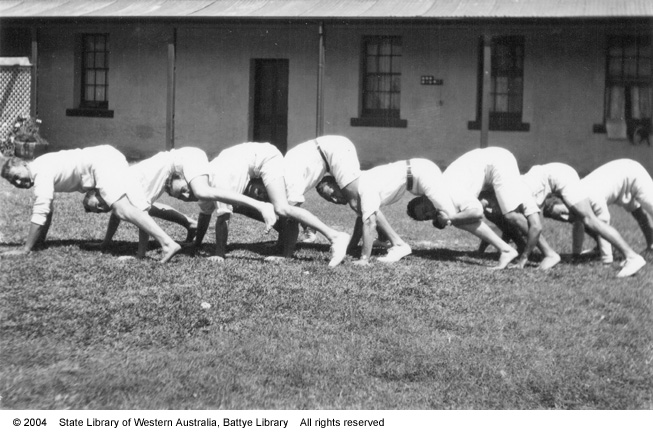
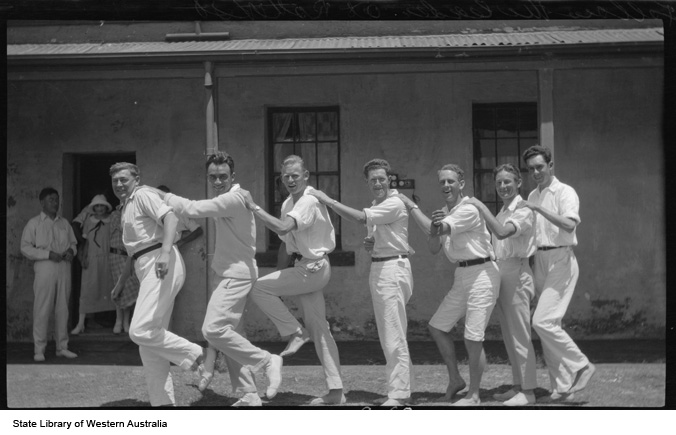
To compensate, Dodgy Perth offers happy images of holiday makers on Rotto in 1924.
If this was 1920s charades, I’m thinking ‘Human Centipede’. No?

Back from Bali. Missing the poolside Bintangs already.
To compensate, Dodgy Perth offers happy images of holiday makers on Rotto in 1924.
If this was 1920s charades, I’m thinking ‘Human Centipede’. No?

Looking as attractively arty as ever
Here at Dodgy Perth we don’t pretend to know much about modern art. Which is okay, because it turns out no one else does either.
In 1953 the first significant exhibition of modern art was held in the Art Gallery, including works by Picasso, Leger, and Le Corbusier.
The public response was predictable. Letters poured into the newspapers decrying the monstrosities hung on the walls, demanding to know why the artists had not been locked up in an asylum. Most visitors regarded the whole show as a bad joke.
Fortunately, the gallery’s Assistant Art Director, David Lawrance, was on hand to explain why modern art was important. So let’s listen to the wise words of Perth’s leading expert on the subject.
No one knows what modern art is about, but it will have an important influence on the average kitchens of tomorrow.
Sorry? I’m not sure I heard you correctly.
“It is difficult to arrive at what exactly is meant by modern art,” he restated, but it has influenced modern kitchen design.
Okay, moving on. David was asked what one painting next to him was all about. He blushed, turned aside and whispered to an aide: “What is its title?”
As the audience began to snigger, the art expert helpfully added “Your guess is as good as mine,” making everything clear.
He ummed and he ummed some more.
As a picture, it is quite good in its balanced shapes and variation in colour. But the meaning… I’m a bit lost!
Ladies and gentlemen, that concludes today’s lesson on modern art. Thank you for attending.

This lady has many more clothes than the star of our story
The scene is Thomas Street, at the Subiaco end. It is midnight on a Wednesday in August 1938. Two young fellows were walking home. We don’t know exactly where they’d been, but is easy to image they’d probably had a pint or two.
This particular Wednesday night was to prove an experience these two lads were never going to forget. They were walking on the right hand side of the road when a bicycle came towards them. So far, not very out of the ordinary.
Although the bike didn’t have any lights, it was, in fact, simply a young lady in a large overcoat pedalling her way home.
Pulling level with our heroes, she suddenly whipped open the fawn-coloured coat and revealed. Well. Everything. Or nothing, take your pick.
She was stark naked underneath and the two fellows could do nothing but stand there, jaws open. Or, in the words of one of them:
You can guess the shock I got when I saw she had nothing under it. We just gaped at her. Well, we couldn’t do anything else. And next minute she was gone. One thing I’m sure of is that she didn’t have anything at all on the front of her body.
She didn’t say a word, or laugh, or even look at the astounded observers. In any case, they don’t think she did. They weren’t paying too much attention to her face, it must be admitted.
After all, if a chap suddenly sees a girl’s nude body in front of him, he can’t remember for sure whether she’s laughing or not.
As she rode off into the distance, they did note her bare legs, but were unable to say for certain if she had shoes on.
By the time our brave Subiaco boys recovered, she was round the corner and lost to sight. Could they describe her? She was a brunette. That’s all they could remember. Definitely a brunette.
The media wondered if this cycling Godiva would encourage more Subiaco men to take midnight strolls. But not our gentlemen informers. No way, sir. They had no intention of spending any nights wandering round the suburb hoping that she would turn up again.
At least, that’s what they told the newspapers.

Are you run down? If so, why remain so?
Your whole system can he revitalised by using the
VEEDEE,
the recognised “King” of Vibrators.
Massage by vibration is used throughout the world by leading medical men.
It has cured thousands of Rheumatism, Gout, Lumbago, Sciatica, Deafness, Debility, Neuritis, Neurasthenia, Catarrh, Liver and Kidney Troubles, and will cure you.
Priced at a mind-boggling 70 shillings (a family home could be rented for 16 shillings a week), the above advertisement ran in the Sunday Times in October 1915.
The Veedee adjustable mechanical vibrator did not use electricity to power the heads, but was hand cranked instead.
However, the vibrator was the fifth home appliance to be electrified. After the sewing machine paved the way in 1889, the fan, kettle, toaster, and vibrator quickly followed. The vibrator beat the vacuum cleaner and iron by about a decade.
If you want one of the hand cranked type, in 1915 the ‘Veedee Institute’ was located above the Bank of Australasia at 68 St Georges Terrace.
Hurry before they’re all gone.
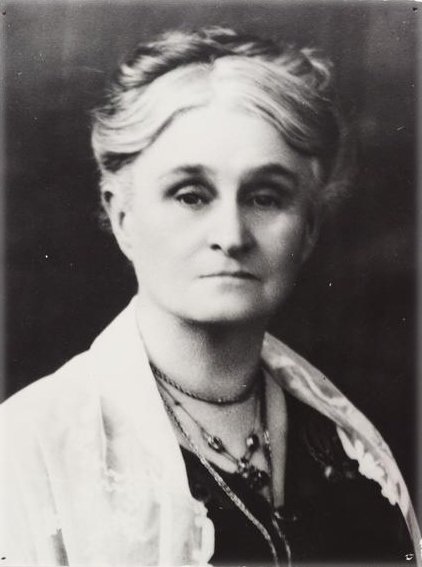
Today, as our choice at the cinema is between a three-part Hobbit and yet another Hunger Games, Dodgy Perth asks: What Would Edith Cowan Do?
For thank goodness the first woman to be elected to an Australia parliament left us her detailed thoughts on the effects of movies.
In 1927, far too many movies contained exciting and thrilling incidents. Mrs Cowan was having none of this. She knew what was good for children. Pictures should be of the “clean, humorous type, devoid of criminals and crimes,” preferably “educational films, depicting industries, sports, travel, and adventure.”
In any case, she continued, going to the movies led to the medical condition known as ‘Fatigue of Brain and Body’ and damaged your eyesight. Worse still, movies could easily “stir into action the sexual side of the child’s outlook”.
“The majority of the people do not want the smutty stuff,” said Mrs Cowan. Instead movies should be such that a “child of eighteen” finds nothing in the film that they did not already know. (Today, I imagine there is little a child of fourteen does not already know!)
Frighteningly, some pictures suggested that married life was not always happy. What if a child saw something that changed their opinion on marriage? What if they started questioning whether mummy was really happy? These things could not be allowed to happen in Perth. Not to our children. Not to our married couples.
But let us not think that Mrs Cowan wasn’t thinking of the poor among us. She certainly was. Children should not be allowed to see movies which contained scenes of wealth and luxury in case it “accentuated the bitter class consciousness already fostered among them”.
Edith Cowan, Dodgy Perth salutes you and your quest to stop Michael Bay from making another frigging film.

In honour of Perth Glory women’s team reaching the W-League grand final this Sunday (I’ll be there), Dodgy Perth decided to seek out the first women’s football game played in WA.
The authoritative history of soccer in this State is Richard Kreider’s Paddocks to Pitches. He says that after WWII there were a few ladies social matches, particularly among the Italian community.
However, the first organised women’s soccer game was not until 1971 when the Vel-Belles played the Beauts as a curtain raiser to WA v Moscow Dynamo.
To find women’s football older than this, we need to turn to the domestic version of the sport.
In the late 19th century, when women in other countries were beginning to play games seriously, most men found the idea either ridiculous, or at the very least unladylike.
The West Australian even found space to mock the idea of women’s sport in a lengthy song, of which this verse is typical:
The goal-keeper looked at the ball—quite amazed at it!
Now, the next time it neared her she’d turned to a friend
To examine the cut of her blouse, and to chat on it,
Said the captain, “Miss Bodgers, I wish you’d attend!”
So she turned to see where the ball was, and she sat on it.
With attitudes like this, it is easy to see why women’s sport was slow to develop in WA.
It was not until 29 September 1917 that the first Australian Rules game was played by ladies. It seems that the number of young men away fighting in Europe probably had an influence on the development of the women’s game.
Taking place at Subiaco Oval, the event was organised as a charity fund raiser by Miss Gell Howlett.

One of the 1917 women’s football teams, these players worked for Foy & Gibson
Taking to the field were a team in maroon and a team in gold. The former won three goals to two.
Even so, this ground-breaking moment in WA sporting history was simply scorned by the media, who referred to it as women in ‘fancy dress’ who showed little talent. Although there was much ‘laughter’, it was said to be a total failure as a game of football.
Seems the women didn’t quite see it that way, since leagues were established both in the metropolitan area and in the Goldfields, and grand finals were keenly fought.
With the centenary of women’s organised sport in WA coming up in a couple of years, Dodgy Perth proposes that the Gell Howlett trophy should be established as an annual competition. Anybody want to organise that?
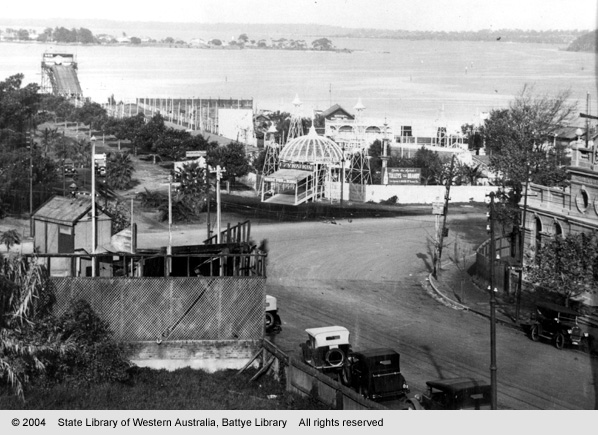
Farewell to White City,
Which was always black;
Farewell to the ‘angels,’
Who will get the sack.
Farewell to housey-housey
And the dreary jazz.
And the spinning jennies
And the razzle-dazz.
Farewell to the rotten
Desire to win
By hooky or crooky
The other chap’s tin.
Farewell to the cancer
On the fair face of Perth.
Farewell to the pervert
Who gave it birth.
Now for disinfectants
To sweeten the spot,
And clean up the microbes
On the blighted blot.

This is the famous English music hall singer, Marie Lloyd. She has nothing to do with this story, but I quite like the picture.
Priscilla Verne: serio-comic singer, with a lusty singing voice, sparkling personality, golden hair and a shapely form
Gus McBride: civil servant, variety show patron, front row seat occupier
Alice Chalmers: Miss Verne’s nom de guerre
George A. Jones: co-manager of the Olde Englishe Fayre, co-conspirator with Miss Verne
George B. Lawrence: co-manager of the Fayre, co-conspirator
Mrs Jones: lady with no first name, wife of George A., co-conspirator
Madge Stackpole: mezzo-soprano singer, apparently talented, co-conspirator
A Malacca cane: pliable weapon, first concealed in a parasol, subsequently in Miss Verne’s dress
PC Bailey: witness to the assault, apparently sympathised with Miss Verne
Chorus: 200 to 300 onlookers, none of whom apparently wished to assist Mr McBride Continue reading →
As your attorney, I advise you…
Miss Priscilla Verne readily consented to be interviewed.
“Let me tell you how the trouble originated,” said the artiste to our reporter. “On Tuesday night I was singing a song called ‘He Sits in the Front Row,’ and, as I usually do, pointed to a person in the front row. Mr. M’Bride was there, and, looking at him, I sang—
He sits in the front row; he is blushing like a maid,“To this,” resumed Miss Verne, “I distinctly heard a reply that made my blood boil, and I determined to do something. I consulted a solicitor, and he advised me to horsewhip the man.
“Very reluctantly I did so, but I considered that I had been grossly insulted, and only wanted to revenge myself.
“Accordingly, on Wednesday I penned a letter to Mr. M’Bride, and signed it ‘Alice Chalmers.’ I wrote that I was enraptured by his charms, and asked him to meet me at 1.45 p.m. on Thursday at the Town Hall corner. I added that he, perhaps, would not remember my name, but, doubtless, when he saw me he would remember me.
“I ascertained that he had received the letter, and, accompanied by several other Fayre artistes, I lay in wait for him at the appointed place. He arrived with a punctuality that did him credit, and forthwith I proceeded to interview him.
“I had a neat little, though strong, cane concealed in the folds of my dress, and as he saw me I called out, ‘Come here; I want to speak to you.’
“He began to run, and I followed, and lashed him as frequently as I could. I said ‘You cad; I’ll teach you not to insult another woman as you did me.’
“He broke away from me, and hastily proceeded across the street. I followed, and with each stroke I took good care to let him know what it was for.
“Soon a crowd collected, and I heard him appeal to a policeman. Messrs. Jones and Lawrence, however, put matters right.”
“Have you ever had any such experience before?” queried our reporter.
“Never,” replied Miss Verne. “It is entirely new for me, and I can assure you I was nervous for the time being. In all my years in the business I have always got on remarkably well with gentlemen. The remark, however, was as venom to me, and I plucked up courage and did it.”
Accept this kiss and give me one.
The reporter’s version of events:
On Tuesday night, November 24, 1896, Miss Verne, as usual, took the leading part in the variety programme presented at the Olde Englishe Fayre.
In the second half she had occasion to sing a song bearing the title ‘He Sits in the Front Row,’ and in which occurs ‘Accept this kiss and give me one, for I love you.’ To emphasise the pleasing declaration the singer, it is stated, indicated one of the audience sitting in the front
Miss Verne it is understood, pointed to Mr. McBride, because he happened to sit in the front row, and because he was, she avers, the first person to attract her attention at the critical moment.
McBride, it is alleged, uttered a response in a tone of voice sufficiently loud to be heard by the singer, although she was several feet away, and by those around. If the words used are truthfully described, they were certainly insulting.
Miss Verne at once paused, and glaring down on the delinquent, she retorted, “You low cad,” and those who knew the circumstances applauded her.
When the show had terminated, Miss Verne reported the circumstances to Mr. George Jones, the manager of the Fayre, and at the same time made up her mind to resent the insult in her own fashion. In this determination she was heartily seconded by the other members of the company.
Her version of events:
She said that in singing the humorous song, ‘He sits in the front row,’ she had to point to some person occupying a front position.
“On Tuesday night I pointed to Mr. Gus. McBride,” Miss Verne continued. “To my great surprise and indignation he made a most insulting remark to me as I stood on the stage. He spoke aloud, and others heard what he said.
“I don’t care to repeat the remark. I paused and called him a low cad, and made up my mind that I would punish him in such a way that he would not insult another woman.”
His version of events:
Mr. McBride states that he was insulted by Miss Verne and held up to ridicule before a crowd of people at the Fayre.
He was sitting in the front row when Miss Verne sang one of her songs. At the end of a verse she pointed to him—singled him out, in fact—calling him by his name of ‘Gussie.’ She even said she would kiss him if he would go on the stage.
He did not care to be made so prominent before so many people, as they could not help knowing that he was pointed out and was being made a laughing stock of.
On the spur of the moment he retorted with the remark complained of. Perhaps it was a rude remark. He would not have said anything if she had not commenced it.
 Dodgy Perth