She’s got Bette Davis eyes

article76445587-3-002

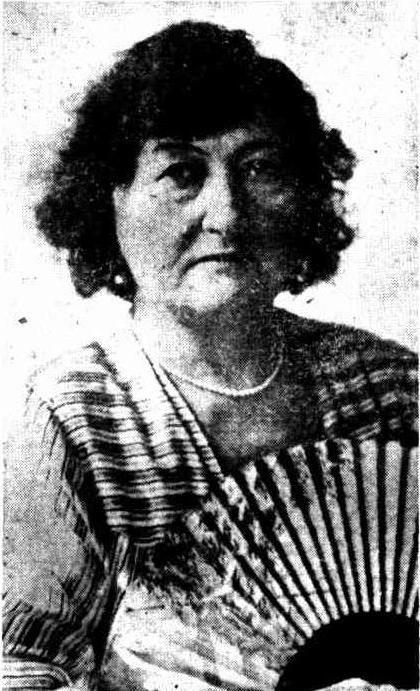
She does not look at you. She looks through you, beyond you.

As a teaser for our next story, I bring you some of the most purple prose ever written about a person on trial:

Among students of human nature the eyes are generally conceded to be indicative of many things that other features or mannerisms can never reveal.

Those who have seen Audrey Campbell Jacob since the tragic death of Cyril Gidley have commented haphazardly on various features of her beauty. But her eyes have been discussed by every observer.

She was in the court for three hours on Thursday. Most of the time her face was downcast. She cried at intervals, and once her whole frame was shaken by sobs that seemed to suggest a coming breakdown.

But by supreme efforts she managed each time to regain control. Whenever she did raise her face it was her eyes that attracted everybody’s gaze. They are eyes that the student of human nature would never forget.

They are not big, nor yet small. Medium sized is a fair description. They are fairly well back under her brows, but not deep set.

They are not the eyes of a coquette or a woman accustomed to using her eyes as women are supposed from times immemorial to have used them. They are the eyes of one whose thoughts are really not with the immediate things around them.

There is about them the mistiness that is not brought by tears, but is associated almost with the dreamer. She does not look at you. She looks through you, beyond you, away somewhere in the distance as it were.

They are of no defined shade. Blue-grey would probably be the nearest description. They are the eyes that suggest artistry and intellect and the habits of one who thinks much. They seem to be forever looking for something that is not in the immediate vision.

At what far-away thing are they looking, of what far-away thing is she dreaming, here in this public place when her thoughts should be so alert? They are remarkable, the eyes of this twenty-year-old girl, the most remarkable I think that I have ever seen in or out of court.

The shootout on the Rue de Roe

The red light area on Roe Street, shortly before the brothels were closed (image 1958).

The red light area on Roe Street, shortly before the brothels were closed (image 1958).

Josie Villa wasn’t always at 222 Roe Street. Just after the Great War, it was located closer to town at number 98 on the same street.

It was at this location that Josie De Bray was wounded in a shooting, possibly carried out by drunk soldiers.

In August 1919, at 3.30am, a car was driven along the red light district, with the occupants demanding admission to the houses there.

At this time of night, the only occupants of Josie Villa were Josie herself and Esther Miller. They had just eaten a late supper, and were preparing to retire to their rooms, when they heard the car pull up outside the house.

Footsteps were heard on the front verandah, and a rap on the door followed. Although Esther said she would answer, Josie was ahead of her. She approached the front door and asked who was outside.

One of the men demanded admission, but Josie replied that no one would be admitted at that time of day. Looked through the peephole in the door she saw some of the visitors were wearing military uniforms.

The men repeated their demand, but Josie again refused them admission. They clearly became agitated and started shouting.

Suddenly two shots rang through the house. A revolver had been placed close to the peephole and fired into the passageway.

At the first shot, Josie felt a stinging pain on her left elbow. The second bullet missed her, sped through the length of the passage, leaving a hole in the wall at the end.

If Josie had not, by sheer chance, stepped aside from the peephole at the right moment, she could easily have been killed.

After firing the shots, the men fled the scene.

Josie managed to get to the rear of the house, leaving a trail of blood along the way. A doctor was summoned, and she was carried to a nearby private hospital on St George’s Terrace.

Dodgy Greenough

Until 1967, when fireworks were banned in WA, a common sight was kids standing beside home-made Guy Fawkes, demanding, “A penny for the Guy!”. This image is from 1931.

Okay, so I’m a day late with this one. Sue me.

Dodgy Perth presents an 1879 story from Greenough to help us “Remember, Remember, The fifth of November”:

I hasten to give you a few particulars of the sad accident, attended with fatal consequences, which occurred near Mr. Maley’s mill on Guy Fawkes Night.

It appears that a party of young men and lads met together for the purpose of commemorating the time-honoured Gunpowder Plot. In order to do this the more effectively they secured two fowling pieces and an old carbine, and a canister of gunpowder.

After amusing themselves by firing in the air, along the ground, etc., one of the young men, by way of adding to the excitement, commenced firing off his gun unexpectedly between the legs of some of his companions.

One of the lads, named John Cook, who had possession of the carbine, unhappily attempted the same dangerous amusement, and, stealing up behind one of the young men, named Isaac Patience, put as he thought the barrel of the carbine between his legs and fired it off.

But instead of the charge going clear of the legs it unfortunately took effect in the young man’s left thigh, tearing away a great piece of flesh and shattering the thigh bone, causing a frightful wound, from which the blood flowed copiously.

The unfortunate youth was immediately carried to his home, which happened to be close by, and a messenger despatched for medical assistance, but before the doctor could reach the scene of the accident the sufferer had ceased to breathe.

Interestingly, although John Cook pleaded guilty to a charge of manslaughter, the jury still found him not guilty. Apparently, this verdict gave rise to some spirited discussion locally.

A fortune on furs

ML Monnier

It is not easy to square the post war picture of Mme Marie-Louise Monnier with the pre-war image of her as a strikingly colourful peroxide blonde princess. But being held in a concentration camp might well make you a different person.

Undoubtedly, she came from a good French family. She had received a good education, and had contacts in France which suggested her family moved in the best circles.

She was pretty in her younger days, but grew very plump with increasing age. Her clothes came from Australia’s most exclusive stores. Her money was good, even if her profession wasn’t. And she spent a small fortune on furs while travelling in a smart car with her own chauffeur.

Her striking blonde hair was said to be a matter of her own taste, not necessarily a preference of gentlemen. In fact she was probably the first peroxide blonde in Perth.

Joel%20137_1

At 137 Joel Terrace, Princess Josie had an exclusive home with a river frontage. Neighbours turned an appraising eye as hundreds of pounds worth of expensive furniture went into the house, gazed with intrigued interest at the blonde, middle-aged, expensively dressed lady who followed it in.

But excitement simmered when whispers carried the name ‘Josie’—whispers that became almost a bellow of protest as some of the girls from Roe Street began to visit the house on social calls.

After Josie went overseas, the house was left in charge of one of her friends, who was tipped off by the police not to allow any of the girls from Roe Street to come there.

It was subsequently leased to a lady with several daughters. She exited hastily as soon as she learned the identity of its owner.

The racecourse whisky scandal

469073-melbourne-cup-day-gallery-portrait-366x488-

A little too much racecourse whiskey perhaps?

Apparently today is something called the Melbourne Cup. Unlike those lazy Victorians, we in the Dodgy Perth office are expected to work all day. Anyway, because we will be sneaking off to the Civic Hotel for a lunchtime flutter and drink, we present the local scandal of ‘racecourse whisky’.

Racecourse Whisky was not a nobbled horse. Nor even a nickname for the lovely lady pictured above. Instead, it was low-grade, adulterated liquor sold to the general admission patrons at Ascot.

Half a public health concern, it was also half a joke. People charged with being drunk and disorderly would sometimes claim, “It wasn’t me, your Honour, it was the racecourse whisky.”

There were regular debates about who should run Ascot’s bars, professional publicans or the Western Australian Turf Club. But very little was done to improve the standards of the alcohol served at the course.

For all those who overindulge today, listen to plea from a Belmont racegoer a century ago:

To the Editor

Sir, May I ask a little space in your paper to protest against the class of liquor dispensed to patrons on our leading course at Ascot?

It is scandalous the class of drink served out to customers there. I think the caterer must make it his business to secure all the oldest and unsaleable stock he can manage to get hold of.

Where are the inspectors? I remember once seeing an inspector make the caterer remove a dozen or more bottles from the shelves as unfit to be sold to the public. Still even then I do not think there was a prosecution.

I think it only a fair thing to patrons of the leger that they be protected by the clubs which they patronise. Clubs should see that only the best liquors are on sale and do away with what is now termed ‘racecourse whisky.’

Yours, etc.,
C. D. Lester, 861 Murray Street, Perth, Nov. 16

Introducing Princess Josie

90X120mm

Wherever men get together, whether in the curse-charged ribaldry of an army camp or in the deep chairs of some of our most exclusive clubs, the topic often switches to Josie.

On All Hallow’s Eve we presented the secret backside of Josie Villa. Today we expose the front of 222 Roe Street, now sadly demolished to make way for tedious commercial buildings.

In our opinion, ‘Princess’ Josie De Bray deserves to be one of the most famous residents Perth has ever had. But her story appears little known.

Her profession was the world’s oldest. But she was the undisputed leader of that profession in Western Australia.

ML Monnier

Josie pictured in 1949

In the boom days on the Goldfields, Josie—real name Mme Marie-Louise Monnier—operated houses of ill repute on Hay Street, Kalgoorlie. Her friends in those days included some of the biggest in the mining world.

In Perth she acquired houses in Roe Street. For years she ran her various establishments herself, with the same efficiency as any modern businesswoman. To her it was simply a (profitable) business.

Josie bought and lived in a big house in Mt. Lawley, 137 Joel Terrace, which fortunately still stands and deserves to be recognised for its history, which was certainly controversial among the neighbours in its day.

Joel%20137_1

About 1937 she went home to her birthplace, St. Nazaire, France, and was trapped there when war started.

For years no one in Perth knew if she was alive or dead. While living in St. Nazaire it was bombed again and again. Josie spent some tough years as a German prisoner of war.

Finally she sold a portion of her inheritance and returned to Perth in 1949, seeking to re-establish her empire.

Josie died in 1953, leaving her Perth properties to a niece back in France.

Her story will be told here over the next few days.

The war on the home front

What is there wicked about a glass of good beer?

Today is the centenary of the AIF’s departure from Albany.

Strangely, for all the media coverage, and expense, it is not often mentioned that this party has little to do with West Australians. Our boys departed through Fremantle, not Albany, and there seems little money to be spent on recognising WA’s role in WWI.

So we thought that Dodgy Perth should get in on the heritage juggernaut and offer up our own slant on the Great War.

West Australians were trained at Blackboy Hill, located a couple of kilometres east of Midland town centre.

The canteen was provided by the YMCA. This proved controversial, with the YMCA accused of operating the mess as a profit-making concern, overpaying its manager, charging rent to the canteen for use of a government erected building, and generally ripping off the enlisted men.

So, on Monday 28 September 1914, the officers opened a ‘wet’ canteen in a tent at Blackboy Hill. They believed that this would be good for morale, keep the men away from the local pubs and at camp, and limit alcohol consumption to beer rather than spirits.

All in all, you would think, an improvement to the training camp to which no one in their right mind could object. However, this was Western Australia.

Continue reading →

Folly, infidelity and unleaded petrol please

82x108mm

The secret entrance to Josie Villa (pictured here around 1930), the most famous residence in Roe Street, or the Rue de Roe as it was known in those days.

What kind of place would be accused of luring married men to folly and infidelity?

And why did it need a secret entrance from James Street, through an otherwise unassuming garage, the Modern Service Station?

And who was the enigmatic Josie?

Hmmm… some kind of mystery here if you ask me. Perhaps this will be worth exploring over the next few days.

On a heritage note, it is entirely possible that this building still exists hidden inside the Wilson Parking building. I’ll try to check it out at some point when I’m in the City.

All of the dramas

Marie-Lloyd-001

This is the famous English music hall singer, Marie Lloyd. She has nothing to do with this story, but I quite like the picture.

Dramatis personae

Priscilla Verne: serio-comic singer, with a lusty singing voice, sparkling personality, golden hair and a shapely form

Gus McBride: civil servant, variety show patron, front row seat occupier

Alice Chalmers: Miss Verne’s nom de guerre

George A. Jones: co-manager of the Olde Englishe Fayre, co-conspirator with Miss Verne

George B. Lawrence: co-manager of the Fayre, co-conspirator

Mrs Jones: lady with no first name, wife of George A., co-conspirator

Madge Stackpole: mezzo-soprano singer, apparently talented, co-conspirator

A Malacca cane: pliable weapon, first concealed in a parasol, subsequently in Miss Verne’s dress

PC Bailey: witness to the assault, apparently sympathised with Miss Verne

Chorus: 200 to 300 onlookers, none of whom apparently wished to assist Mr McBride Continue reading →

Miss Verne knows how to be interviewed

As your attorney, I advise you…

Miss Priscilla Verne readily consented to be interviewed.

“Let me tell you how the trouble originated,” said the artiste to our reporter. “On Tuesday night I was singing a song called ‘He Sits in the Front Row,’ and, as I usually do, pointed to a person in the front row. Mr. M’Bride was there, and, looking at him, I sang—

He sits in the front row; he is blushing like a maid,
I love you, darling; be my hub; now, don’t be afraid.
Don’t turn away in anger, dear; I always will be true,
Accept this kiss, and give me one; for I love you.

“To this,” resumed Miss Verne, “I distinctly heard a reply that made my blood boil, and I determined to do something. I consulted a solicitor, and he advised me to horsewhip the man.

“Very reluctantly I did so, but I considered that I had been grossly insulted, and only wanted to revenge myself.

“Accordingly, on Wednesday I penned a letter to Mr. M’Bride, and signed it ‘Alice Chalmers.’ I wrote that I was enraptured by his charms, and asked him to meet me at 1.45 p.m. on Thursday at the Town Hall corner. I added that he, perhaps, would not remember my name, but, doubtless, when he saw me he would remember me.

“I ascertained that he had received the letter, and, accompanied by several other Fayre artistes, I lay in wait for him at the appointed place. He arrived with a punctuality that did him credit, and forthwith I proceeded to interview him.

“I had a neat little, though strong, cane concealed in the folds of my dress, and as he saw me I called out, ‘Come here; I want to speak to you.’

“He began to run, and I followed, and lashed him as frequently as I could. I said ‘You cad; I’ll teach you not to insult another woman as you did me.’

“He broke away from me, and hastily proceeded across the street. I followed, and with each stroke I took good care to let him know what it was for.

“Soon a crowd collected, and I heard him appeal to a policeman. Messrs. Jones and Lawrence, however, put matters right.”

“Have you ever had any such experience before?” queried our reporter.

“Never,” replied Miss Verne. “It is entirely new for me, and I can assure you I was nervous for the time being. In all my years in the business I have always got on remarkably well with gentlemen. The remark, however, was as venom to me, and I plucked up courage and did it.”