It’ll look good in my kitchen

Looking as attractively arty as ever

Looking as attractively arty as ever

Here at Dodgy Perth we don’t pretend to know much about modern art. Which is okay, because it turns out no one else does either.

In 1953 the first significant exhibition of modern art was held in the Art Gallery, including works by Picasso, Leger, and Le Corbusier.

The public response was predictable. Letters poured into the newspapers decrying the monstrosities hung on the walls, demanding to know why the artists had not been locked up in an asylum. Most visitors regarded the whole show as a bad joke.

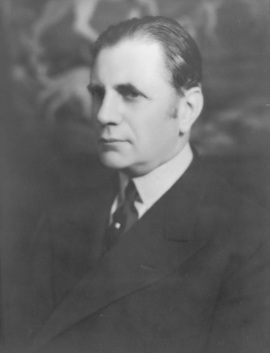
Fortunately, the gallery’s Assistant Art Director, David Lawrance, was on hand to explain why modern art was important. So let’s listen to the wise words of Perth’s leading expert on the subject.

No one knows what modern art is about, but it will have an important influence on the average kitchens of tomorrow.

Sorry? I’m not sure I heard you correctly.

“It is difficult to arrive at what exactly is meant by modern art,” he restated, but it has influenced modern kitchen design.

Okay, moving on. David was asked what one painting next to him was all about. He blushed, turned aside and whispered to an aide: “What is its title?”

As the audience began to snigger, the art expert helpfully added “Your guess is as good as mine,” making everything clear.

He ummed and he ummed some more.

As a picture, it is quite good in its balanced shapes and variation in colour. But the meaning… I’m a bit lost!

Ladies and gentlemen, that concludes today’s lesson on modern art. Thank you for attending.

Up yours!

Definitely a parental advisory image

Definitely a parental advisory image

Are you suffering from nervous tension or constipation? Then you need to visit Perth Zoo. A choice of remedies were on offer, including a chance to bathe in radioactive water.

But if that hasn’t cured you, fear not. A nice lady attendant will happily offer you an enema. Or if you want something stronger, how about a complete intestinal cleansing?

In Perth Zoo. In 1950.

Dodgy Perth wonders what the animals made of all this.

A cycling Lady Godiva

queen-bicycle-race-1978-fat-bottomed-girl

This lady has many more clothes than the star of our story

The scene is Thomas Street, at the Subiaco end. It is midnight on a Wednesday in August 1938. Two young fellows were walking home. We don’t know exactly where they’d been, but is easy to image they’d probably had a pint or two.

This particular Wednesday night was to prove an experience these two lads were never going to forget. They were walking on the right hand side of the road when a bicycle came towards them. So far, not very out of the ordinary.

Although the bike didn’t have any lights, it was, in fact, simply a young lady in a large overcoat pedalling her way home.

Pulling level with our heroes, she suddenly whipped open the fawn-coloured coat and revealed. Well. Everything. Or nothing, take your pick.

She was stark naked underneath and the two fellows could do nothing but stand there, jaws open. Or, in the words of one of them:

You can guess the shock I got when I saw she had nothing under it. We just gaped at her. Well, we couldn’t do anything else. And next minute she was gone. One thing I’m sure of is that she didn’t have anything at all on the front of her body.

She didn’t say a word, or laugh, or even look at the astounded observers. In any case, they don’t think she did. They weren’t paying too much attention to her face, it must be admitted.

After all, if a chap suddenly sees a girl’s nude body in front of him, he can’t remember for sure whether she’s laughing or not.

As she rode off into the distance, they did note her bare legs, but were unable to say for certain if she had shoes on.

By the time our brave Subiaco boys recovered, she was round the corner and lost to sight. Could they describe her? She was a brunette. That’s all they could remember. Definitely a brunette.

The media wondered if this cycling Godiva would encourage more Subiaco men to take midnight strolls. But not our gentlemen informers. No way, sir. They had no intention of spending any nights wandering round the suburb hoping that she would turn up again.

At least, that’s what they told the newspapers.

The scam artist who built London Court

Photographic Negative - Acetate

Looking well shady

If he’s remembered at all, Claude de Bernales is famous for having built the gaudy mock-Tudor shopping arcade, London Court. Described as a “mining promoter and investor”, he is also said to have been “larger than life”.

Those who lost their savings in his fraudulent schemes would have called him a con man.

Flashy and egotistical, de Bernales was the one of the biggest personalities ever to set foot in Perth. But he gambled on gold in a big way—and lost. Lost other people’s money, that is.

In his youth, de Bernales was well-known on the goldfields. Traveling the dusty fields on a push-bike, he would arrive at a mine, and put on a spotless shirt and collar before presenting himself to the manager to sell his machinery.

Before World War I he bought up as many derelict mines as he could. Some were flooded, few were workable. After the war, de Bernales created a labyrinth of interlocking companies, and floated his mines on reports of old workings.

Only one mine, Yellowdine, ever paid dividends, but even that failed to live up to its promise. In a classic Ponzi scheme, interest in his numerous companies was kept alive by dividends drawn from Yellowdine.

At his peak, de Bernales’ office was adorned with Flemish tapestries, African mahogany paneling, and a luxury bathroom lined with marble. Visitors were offered the best cigars and liquors.

However, in 1939 eight of his companies were barred on the London Stock Exchange. He faced many stormy shareholder meetings, where he indignantly denied allegations of fraud. But when Scotland Yard sent two detectives in 1946 to Australia to investigate, the whole rotten scheme came to a sudden end.

A man who built an empire entirely made of smoke and mirrors also built London Court. What a surprise.

Developing bad habits

St-Trinians_2562365k

Typical convent schoolgirls

At a well-known Perth convent school in 1944, one of the nuns noticed her spare habit was missing. She looked for it, and assumed it was accidentally mislaid and would turn up eventually.

And turn up it certainly did. But not in the way she was expecting.

That night, as the girls were preparing for bed, they were surprised to see a nun standing motionless at one end of the dormitory. It was unusual for nuns to be there at that time, so a couple of older girls approached her to find out what she wanted.

Although the light was dim, as they approached they noticed the face under the head dress sported a decent growth of stubble. Being clever students, this led them to conclude the ‘nun’ was probably not a member of staff.

As the girls started screaming, the fake nun gathered her skirts about her, and flew down the corridor at top speed. Despite a thorough search of the area, no trace of the intruder could be found.

Apart from the scare, none of the girls were harmed, and the ‘nun’ was caught too soon to have a chance to be a real Peeping Tom.

Even so, the police announced they would like a little chat with the individual concerned, should he ever show his stubbly face again.

Those ugly Cottesloe beachgoers

FloCO

Liked topless Englishmen

Dame Florence Cardell-Oliver, or FloCO as she probably preferred to be called, certainly knew what she wanted. Beautiful topless men.

In 1935 Cottesloe council ordered men to stop rolling bathing costumes down to their waists. FloCO was fully supportive. As the 59-year-old future parliamentarian explained, Australian men weren’t good looking enough.

“I consider that few of our men possess sufficient physical beauty to allow the sight of their bodies,” she said. “And a girl with shoulder blades which stick out like wings, wearing a backless costume, is inartistic and nude-looking.”

FloCO liked to spend her spare time on the best beaches around the world, and never saw anything as hideous as the two-piece bathers worn by common Cottesloe girls.

“I spent the summer before last at Biarritz, where the smart French and Spanish people go,” she explained artlessly, “and they were certainly not nude-looking in bathing costumes.”

It was not impossible to look good topless, the good lady admitted. At one of her many homes—this one in Cornwall—there were several really fine-looking men with costumes without tops. Apparently British men are better looking than Aussie men. Who would have guessed?

The solution? Like the fashionable French Riviera resorts frequented by Perth’s high society, attendants should be employed to wrap towels around bathers.

That would be lovely, FloCO, just lovely. We look forward to it on our next trip to Scarbs.

The king of vibrators

veedee 2

Are you run down? If so, why remain so?

Your whole system can he revitalised by using the

VEEDEE,

the recognised “King” of Vibrators.

Massage by vibration is used throughout the world by leading medical men.

It has cured thousands of  Rheumatism, Gout, Lumbago, Sciatica, Deafness, Debility, Neuritis, Neurasthenia, Catarrh, Liver and Kidney Troubles, and will cure you.

Priced at a mind-boggling 70 shillings (a family home could be rented for 16 shillings a week), the above advertisement ran in the Sunday Times in October 1915.

The Veedee adjustable mechanical vibrator did not use electricity to power the heads, but was hand cranked instead.

However, the vibrator was the fifth home appliance to be electrified. After the sewing machine paved the way in 1889, the fan, kettle, toaster, and vibrator quickly followed. The vibrator beat the vacuum cleaner and iron by about a decade.

If you want one of the hand cranked type, in 1915 the ‘Veedee Institute’ was located above the Bank of Australasia at 68 St Georges Terrace.

Hurry before they’re all gone.

Atomic alligator water…. seriously

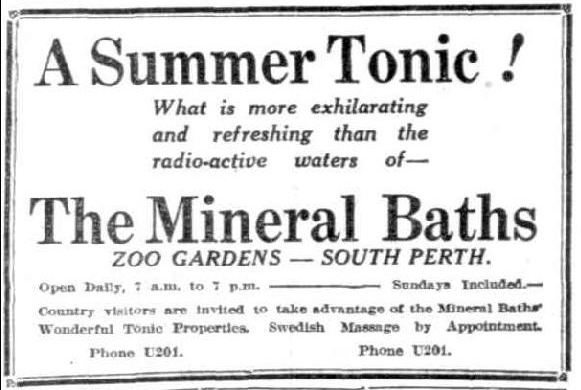
Feeling sore? Do you know what would be good for you? Bathing in radioactive water. That would be just the thing to relieve your aches and pains.

But where, you ask, will I find this modern miracle? Look no further than Perth Zoo.

1928 Zoo Ad

Discovered around 1904 when Colonel Le Souef bathed in the alligator pond to cure his rheumatism, the radioactive baths became one of the main sources of money for the ever-impoverished zoological gardens.

In the 1920s, it cost just one shilling for admittance to the hot waters, although for a little more you could also get a Swedish massage from Madame Asta Idlund.

Along side those suffering from rheumatism, radioactivity was thought to be very good for those athletes who made regular visits.

But what about those radioactive alligators?

Perth’s perverted razor crank

Straight_Razor_cropped

In the winter of 1944, a ‘razor crank’ terrified the working women of Perth.

Over a period of weeks, a number of women fell victim to his extraordinary perversion. The attacks occurred around six o’clock in the evening when the streets were crowded with people hurrying from work.

As the chosen victim walked through the city, he would sneak up behind at slash the back of her coat with a razor.

In each case the targets had expensive clothing ruined. For two unfortunate victims, the pervert struck too hard and wounds required stitching.

In one case the slashing deviant asked the girl if he could accompany her home. When she refused, he put his arm possessively round her back. It was not until she had hurried away from him that she found to her horror that her coat had been slit at the back from top to bottom.