To celebrate Movember, we present Henry Whittall Venn, Commissioner of Railways and Director of Public Works in Forrest’s ministry.
A bald, portly man, with a red face and heavy moustache, pompous, extremely conventional, and very, very longwinded, Venn clashed with Forrest over the purchase of rolling stock.
He accused Forrest in the press of disloyalty. When asked to resign from the ministry, Venn refused three times. On 8 March 1896, Forrest requested Governor Sir Gerard Smith to withdraw Venn’s commission. As Venn famously put it, he was “dismissed in his nightshirt”.
So who would have guessed that the awesome moustache was concealing a veritable Don Juan?
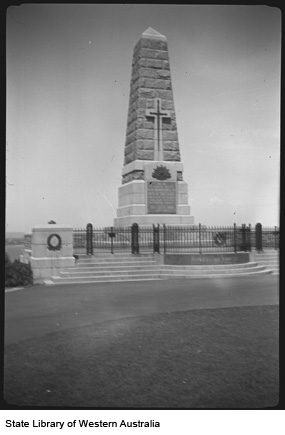
It will be a memorial all right, but it isn’t a design—there is no design in it.
Estate agents will tell you that three things make a property great: location, location, and location. There’s no denying that the WA State War Memorial has all three.
What it lacks, though, is any sense of scale, dignity, or architectural style. Transplant it from its sublime location to your local park and the SWM would look like the council put it up on the cheap.
And cheap is exactly what it was. Victoria’s Shrine of Remembrance? £80,000. South Australia went for a less costly memorial at only £25,000. And WA? We managed to shell out a whole £3,000. And look what we ended up with.
How was it that the brave men who fought, and often died, for their young nation ended up being commemorated with a Red Dot bargain-basement memorial?
Let Dodgy Perth take you through another tour of Western Australian history.
The red light area on Roe Street, shortly before the brothels were closed (image 1958).
Josie Villa wasn’t always at 222 Roe Street. Just after the Great War, it was located closer to town at number 98 on the same street.
It was at this location that Josie De Bray was wounded in a shooting, possibly carried out by drunk soldiers.
In August 1919, at 3.30am, a car was driven along the red light district, with the occupants demanding admission to the houses there.
At this time of night, the only occupants of Josie Villa were Josie herself and Esther Miller. They had just eaten a late supper, and were preparing to retire to their rooms, when they heard the car pull up outside the house.
Footsteps were heard on the front verandah, and a rap on the door followed. Although Esther said she would answer, Josie was ahead of her. She approached the front door and asked who was outside.
One of the men demanded admission, but Josie replied that no one would be admitted at that time of day. Looked through the peephole in the door she saw some of the visitors were wearing military uniforms.
The men repeated their demand, but Josie again refused them admission. They clearly became agitated and started shouting.
Suddenly two shots rang through the house. A revolver had been placed close to the peephole and fired into the passageway.
At the first shot, Josie felt a stinging pain on her left elbow. The second bullet missed her, sped through the length of the passage, leaving a hole in the wall at the end.
If Josie had not, by sheer chance, stepped aside from the peephole at the right moment, she could easily have been killed.
After firing the shots, the men fled the scene.
Josie managed to get to the rear of the house, leaving a trail of blood along the way. A doctor was summoned, and she was carried to a nearby private hospital on St George’s Terrace.
Apparently today is something called the Melbourne Cup. Unlike those lazy Victorians, we in the Dodgy Perth office are expected to work all day. Anyway, because we will be sneaking off to the Civic Hotel for a lunchtime flutter and drink, we present the local scandal of ‘racecourse whisky’.
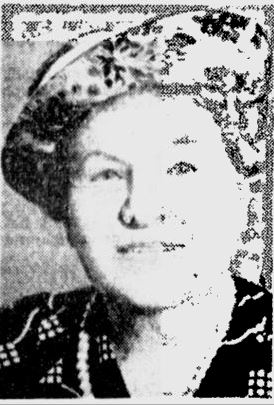
Racecourse Whisky was not a nobbled horse. Nor even a nickname for the lovely lady pictured above. Instead, it was low-grade, adulterated liquor sold to the general admission patrons at Ascot.
Half a public health concern, it was also half a joke. People charged with being drunk and disorderly would sometimes claim, “It wasn’t me, your Honour, it was the racecourse whisky.”
There were regular debates about who should run Ascot’s bars, professional publicans or the Western Australian Turf Club. But very little was done to improve the standards of the alcohol served at the course.
For all those who overindulge today, listen to plea from a Belmont racegoer a century ago:
Sir, May I ask a little space in your paper to protest against the class of liquor dispensed to patrons on our leading course at Ascot?
It is scandalous the class of drink served out to customers there. I think the caterer must make it his business to secure all the oldest and unsaleable stock he can manage to get hold of.
Where are the inspectors? I remember once seeing an inspector make the caterer remove a dozen or more bottles from the shelves as unfit to be sold to the public. Still even then I do not think there was a prosecution.
I think it only a fair thing to patrons of the leger that they be protected by the clubs which they patronise. Clubs should see that only the best liquors are on sale and do away with what is now termed ‘racecourse whisky.’
Yours, etc.,
C. D. Lester, 861 Murray Street, Perth, Nov. 16
The secret entrance to Josie Villa (pictured here around 1930), the most famous residence in Roe Street, or the Rue de Roe as it was known in those days.
What kind of place would be accused of luring married men to folly and infidelity?
And why did it need a secret entrance from James Street, through an otherwise unassuming garage, the Modern Service Station?
And who was the enigmatic Josie?
Hmmm… some kind of mystery here if you ask me. Perhaps this will be worth exploring over the next few days.
On a heritage note, it is entirely possible that this building still exists hidden inside the Wilson Parking building. I’ll try to check it out at some point when I’m in the City.
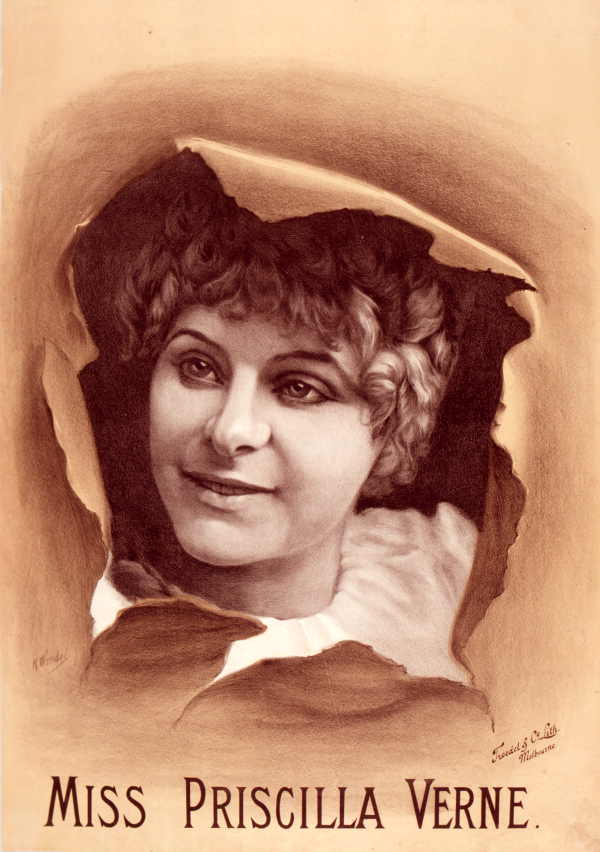
On Tuesday night, November 24, 1896, Miss Verne, as usual, took the leading part in the variety programme presented at the Olde Englishe Fayre.
In the second half she had occasion to sing a song bearing the title ‘He Sits in the Front Row,’ and in which occurs ‘Accept this kiss and give me one, for I love you.’ To emphasise the pleasing declaration the singer, it is stated, indicated one of the audience sitting in the front
Miss Verne it is understood, pointed to Mr. McBride, because he happened to sit in the front row, and because he was, she avers, the first person to attract her attention at the critical moment.
McBride, it is alleged, uttered a response in a tone of voice sufficiently loud to be heard by the singer, although she was several feet away, and by those around. If the words used are truthfully described, they were certainly insulting.
Miss Verne at once paused, and glaring down on the delinquent, she retorted, “You low cad,” and those who knew the circumstances applauded her.
When the show had terminated, Miss Verne reported the circumstances to Mr. George Jones, the manager of the Fayre, and at the same time made up her mind to resent the insult in her own fashion. In this determination she was heartily seconded by the other members of the company.
Her version of events:
She said that in singing the humorous song, ‘He sits in the front row,’ she had to point to some person occupying a front position.
“On Tuesday night I pointed to Mr. Gus. McBride,” Miss Verne continued. “To my great surprise and indignation he made a most insulting remark to me as I stood on the stage. He spoke aloud, and others heard what he said.
“I don’t care to repeat the remark. I paused and called him a low cad, and made up my mind that I would punish him in such a way that he would not insult another woman.”
His version of events:
Mr. McBride states that he was insulted by Miss Verne and held up to ridicule before a crowd of people at the Fayre.
He was sitting in the front row when Miss Verne sang one of her songs. At the end of a verse she pointed to him—singled him out, in fact—calling him by his name of ‘Gussie.’ She even said she would kiss him if he would go on the stage.
He did not care to be made so prominent before so many people, as they could not help knowing that he was pointed out and was being made a laughing stock of.
On the spur of the moment he retorted with the remark complained of. Perhaps it was a rude remark. He would not have said anything if she had not commenced it.
With a lusty singing voice, sparkling personality, golden hair and a shapely form, Priscilla made a captivating Aladdin.
In 1951, the media remembered that Priscilla Verne was still alive:
This Australian stage star made her first theatrical appearance in 1887, but she has her own method of bridging the years, bringing down the curtain on the ‘eighties with this disarming statement:
“I don’t know how old I am. I don’t want to know. I will never be old, only in years.”
Still in love with life, she walk with a buoyant step and many a younger woman could envy her shapely figure. If variety provides the spice of life this stage career has been highly flavored.
Singing saucy verses set to lively rhythms, Priscilla Verne, at the turn of the century had become the pet of the public and “the Darling of the Gods” (a term applied to the patrons of the gallery).
To capture the big money, this variety artist was forced to forsake her own country. Gold and glamor awaited her in the East. In India she dashed into popularity as principal boy in pantomime, and played at Delhi during the Durbar celebrations arranged in honor of King Edward VII. With a lusty singing voice, sparkling personality, golden hair and a shapely form, Priscilla made a captivating Aladdin.
Then she bobbed up again as lively as ever in 1940 with the Tivoli circuit, a group of veterans presenting the singing and dancing numbers which kept them in the limelight in their younger days. The combined ages of these old timers reached 1000, and if Miss Verne had not been so hazy about her first birthday, the total might have been higher.
Young in mind and still vital, this ‘trouper’ is now toying with the idea of making another comeback in a fresh edition of Veterans in Variety.
Miss Priscilla Verne’s serio-comic effusions were as excellent as of yore, this lady being a deservedly popular performer.
Last evening saw another large crowd at the popular open-air entertainment now being given by Messrs. Jones and Lawrence.
The star of the combination, beyond all question, is Ouda, who skywards, high up in the air, performs some of the most marvellous feats of daring. When it is said that Ouda has no superior, the famous Silbons notwithstanding, we say simply what is true. His flight through space must be seen to be believed.
Miss Priscilla Verne, always a big favourite in the Eastern colonies, has already established her claim to be considered one of the features of this show.
The first appearance of Miss Verne, a clever variety artist who has won considerable fame in other colonies, was greeted with enthusiastic applause, which increased as the singer gained grace in the audience.
The gem of the evening was her song ‘Waiting for the Verdict,’ in which she appeared in character, and her rendering of ‘Their Heads Nestle Closer Together,’ was very artistic, the last of a number of recalls being responded to by a speech, in which she expressed heartfelt gratitude for her splendid reception.
The sister of comedians Joe and Alf Verne, Melbourne-born soubrette Priscilla Verne married minstrel showman Charles Hugo (Hugo’s Buffalo Minstrels) in 1882.
After divorcing her husband in 1892 Verne spent much of the next 15 years overseas working as a solo artist and sometimes touring her own company. In 1909 she formed an act with Nat Phillips’ former partner, Tommy Armstrong.
Verne retired from full-time performing in 1912 following her marriage to politician George Black. She appeared in occasional ‘stars of the past’ shows until at least 1943.
Following up the letters that have appeared in your valuable paper during the past few days on the disgraceful and unseemly conduct of one of the principal artistes of the Fayre, as enacted in Howick Street, and subsequent upon the many who have expressed themselves as disgusted with the state of things that nightly take place at this carnival, I beg to enter my strong protest against such being carried on in one of our main thoroughfares, right at the very doors of some of the leading residents of our city.
Last evening, in company with a gentleman friend, I visited this place with the object of entering my protest on substantial evidence. I do not hesitate to affirm on the very strongest assumption that such a state of affairs should not be permitted.
No doubt the programme (or portions of it) would be appreciated in the common music halls in the East End of London. The coarse jests emanating during the progress of the songs, which are so suggestive, confirms my conviction that it is not a proper place for respectable men, much less women and girls to attend.
Surely the moral tone of the community is low enough without a ‘company’ inviting the public to participate in its degenerating and damnable influence. Truly the animal nature so uppermost in many men finds scope to become aroused at this place of amusement (?).
I should, indeed, be sorry to know that any acquaintance of mine should attend such a place for the purpose of entertainment or amusement. Amongst the audience were some whose characters would not bear very minute investigation, and the very fact of so many ‘cabs’ awaiting the close is significant.
What benefit, might I ask, accrues to the city from this place? It may fill the pockets of its promoters with unholy gain, but the city and its inhabitants indirectly pay the price.
Yours, J. T. Kevern.
150 Hay Street, December 1, 1896.