For the love of Money

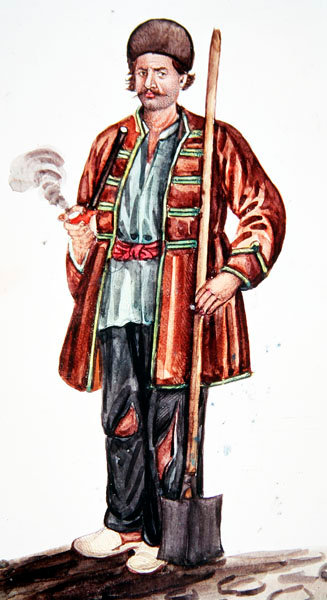
Persian farmerToday’s story concerns Northam resident, Abdallah Mahomet, who was living there in 1849. Abdallah was a Persian (modern day Iranian), who worked as a farm labourer.

But poor Abdallah never had any luck.

He started saving in 1841, only to have all his possessions (and £27 in cash) destroyed in a fire in 1845. A man of stoic character, he resolved to start again.

He built up a small farm, but in 1847 his three cows and heifer calf were stolen.

Did Abdallah give up? No! He cheerily said to himself “He who has not got cannot lose”, and started over once again.

But 1849 turned out to be a particularly bad year. Abdallah was slandered by a man called Hookham John, who claimed that Mr Mahomet was bankrupt and owed him money. The legal fees to set the record straight cost him a fortune.

And now comes the truly pathetic part. A woman (whom he bitterly refers to by the name of ‘Money’) came to his home and promised to be his wife.

Falling instantly in love, Abdallah bought her dresses, shawls, silk handkerchiefs, and the like.

But ‘Money’ was not faithful. Here we’ll let Abdallah tell his own story:

‘Money’ is flashing about with my property, bought with my money, on condition that she became my wife and made me a comfortable home. ‘Money’ has run away with my property, even to my very blankets!

I have spent, besides £29 on other goods, fruits, wines, etc., which she ought to return as they do not belong to her.

I reckon my loss altogether at £74, all through you, which is a great loss for a labouring man, and all is lost by cheating and roguery.

Not only that, but by spending so much time chasing after the floozy, Abdallah lost his job on the farm at Northam.

“I have lost 1849,” he sobbed. “I hope I shall not lose 1850.”

Abdallah relocated to Geraldton, where he ran a small market garden and where he drank himself to death in 1880.

I will allow the reader to draw their own moral from this sad tale. Although becoming disillusioned with love forever would be the most reasonable response.


Ginger pride

Ed Sheeran

One member of the redheaded league

Gentlemen prefer blondes, but they marry brunettes. Quite what they do with redheads is unclear. But in a world exclusive, Dodgy Perth can reveal the upside to dating a bluey. They won’t leave you. Ever.

In keeping with the high standards of journalism of the day, in 1938 The Mirror posed questions of world importance:

Is the colour of a man’s hair any guide to his faithfulness as a husband? Would Perth girls prefer to marry red-headed men rather than dark or fair men? And are red-headed women as faithful as red-haired men?

For answers, they turned to a well-known city divorce lawyer:

I suppose I can say that during the 30-odd years I have been in and out of the divorce court, I only remember one redheaded man being sued for divorce. His trouble was not unfaithfulness, but drink. I can’t recall any others.

And what about the fair sex?

I can’t say the same for them. I’ve seen quite a number of red-haired women in the divorce court. Strangely enough, too, they’re usually fine lookers. But, for the number there are, a good percentage of them seem to find it hard to stick to their husbands.

Oh dear. But please go on, Mr lawyer.

In Kalgoorlie was a barmaid at one of the hotels who was everyone’s sweetheart and nobody’s bride. She was co-re in more divorce cases than anyone else I know.

So there you are. So, before you go out on a second date, make sure his hair is red. And before you marry, make sure her’s isn’t.

Hendricks

Beautiful, but unfaithful. Allegedly.

Park petters and peeping perverts

In 1950, the Mirror undertook a special investigation into the parks frequented by couples, and the perverts who spied on them. (Presumably, the reporter exempted themselves from this latter category!)

At Weld Square, a well lighted area off Beaufort Street, two men sat on nearby seats and later flitted from tree to tree to peep on courting couples.

Russell Square, at West Perth, is not so popular with couples. It is usually frequented by ‘plonk’ drinkers and the type of habitués there is such that it does not induce courting couples to make it a rendezvous.

But Hyde Park is a place where a lot of peering is done. Men wait and watch and when they see a couple engrossed in lovemaking, take up a vantage point and do their best to see, at close quarters, just what is going on.

In some cases, the ‘Peeping Toms’ have been known to creep up and steal the female’s handbag while the couple are too engrossed to be aware of what is going on. And as the couples are, in the majority of cases, too embarrassed to make a complaint, no report reaches the police.

The worst place for the ‘Peeping Toms’ at present is on the grassed area on the river front on Riverside Drive. Numerous cases of men creeping up on recumbent couples are reported from there.

One night this week a man and wife were sitting quietly there when the husband noticed a man crawling up on them. Result was a bout of fisticuffs, with the ‘Peeping Tom’ rushing madly from the locality.

The police are practically powerless to deal with this type of pervert because few couples who have had such experiences feel like facing the resultant publicity if they lay a complaint.

The frogs were having a good time of it

11557161-large

If you’ve not been keeping up, the story so far:

Henry Whittall Venn is a pompous oaf, and WA Commissioner of Railways, who has fallen in love with a young married actress, Eve. She doesn’t seem particularly keen on the old bugger, but who knows what might happen?

Venn has had Eve’s husband arrested on a trumped-up charge, so he can send a love letter, which he is convinced will forever win over his intended. Never mind that Venn also has a wife.

It is getting late in the evening, and Venn is coming towards the end of his letter.

Now read on:

Eve was travelling to Melbourne on the troopship Orient—the Boer War was still raging—and Venn was concerned she might mix with soldiers. He warned her that, as a man of the world, he understood these men, and she should not fall for their fake charms or she would suffer as a consequence.

Although inexperienced at courtship, Venn was no fool. He instructed her that letters were to be sent to the Weld Club, not his home or office. If they were sent to his home, his wife would find them; at the office, his secretary.

The letter repeatedly assured Eve that the stiff, pompous git she had met at the party was dead, and now he was but a man “who looked now and then into a pair of brown eyes and thought the frogs were having a good time of it, because they would sing on, and be near you while I was far away.”

Suddenly, Venn became anxious. Why was Eve keeping her Melbourne address from him? Was she just being careful? Or was she being untrue before their relationship had started?

No… he must not think like that. Instead, he decided to praise her brief note to him, describing it as being like “the fragrance of the roses.” What a charmer the old man was turning out to be.

With a final warning—Please destroy this letter after you have read it—Venn went to bed, ready to post the note in the morning.

To be continued

I think of you as a dear little thing

Mo

If you need a refresher on Mr Venn, it is here.

Henry Whittall Venn spent most of the rest of the evening on the back verandah praying that Eve would return. She did not.

They met on a few subsequent occasions, but each time Eve was surrounded by friends and Venn was unable to get her alone. How he hated those other women. If only she would consent to walk with him, he could kiss her and show her the real man behind the cold, sneering façade. She did not consent.

Yet, almost amazingly, his relentless (if gauche) pursuit of Eve finally brought success. Of a sort.

Eve and Mr Eve—for so it will be useful to call him—were due to set sail from Albany to Melbourne, before heading off to Europe for a long vacation.

From Albany, Eve sent a note to Venn which he took as a sign of her affection. We don’t have a copy of this letter, so it is unclear if it was merely polite, or she had genuinely fallen in love with him.

What we do know is that she invited him to write down his feelings for her.

It is telling, however, that she failed to include any contact details for her trip, and he had to plead for addresses. Could this have been a sign that she wasn’t that in to him?

Continue reading →

What cold hands you have, my dear

A quick refresher.

Henry Whittall Venn was a pompous, portly windbag with a huge moustache. After being sacked by Forrest, he passed his final years at Dardanup where he died of heart disease on 8 March 1908.

End of refresher.

Venn is remembered for two things: trebling the mileage of the government railways, and having been an aging lothario.

Guess which one Dodgy Perth is going to celebrate?

At some point, probably early 1901, Venn was at a party when he met a young, but married, actress. We don’t know her name, which is a pity, so I’m going to call her Eve. She needs to be called something.

Since he was 56 summers old, you would think that Venn would know better than to act like a giddy teenager and believe in love at first sight. But that’s precisely what he did.

However, it had been a long, long time since he had been courting young ladies—in fact, he had been married for nearly three decades.

Continue reading →

It’s only gossip if you repeat it

The Sunday Times used to run a column with all the town’s gossip, but few identifying details.

Anyone who was the subject would know who they were, as would their friends and neighbours, but the newspaper trod carefully to enable maximum humiliation with minimum chance of a libel suit.

So, although I have no idea who the subjects were, Dodgy Perth still presents the gossip from the week ending 20 November 1927:

We hear…

That South Perth is the forcing ground for a scandal that will probably wreck several homes.
That a chance word from a mere baby set a social blaze that will take a lot of extinguishing.
That as the little boy had been allowed to see far too much it was the family’s fault.
That if the rumpus gets to the ears of their farmer relative he will make out a new will.

That a married couple from North Perth caused hearty smiles in a tram leaving the Esplanade for home.
That as it was a hot evening, pa and ma reclined on the grass to await the arrival of a picnic launch.
That when they entered the tram, all hands grew merry over the grass-seeds on the coat of pa.
That by the time they arrived at their destination half a hundred passengers had loud laughs.

That a much advertised wedding-to-be may not be if a certain bundle of letters comes to light.
That the owner of the said epistles has been keeping them for many a long year since his jilt.
That an attempt to steal them resulted in the burglar being caught and made to confess.
That as they have also been well photographed, the denouement may be sudden and sulphurous.

That the practice of a Claremont wife of slandering her decent husband recoiled upon her last week.
That as he devotedly gives her all he can in the way of motors and theatres, a pretty lady visitor heard him libelled.
That she discovered that the wife did it to prevent the visitor from falling in love with him.
That in one case the lady visitor fell in love with hubby out of sheer pity for his misery.

That why White City is being saved from slaughter is a mystery no reasonable citizen can fathom.
That this accursed gambling hell has incited many boys and girls to become hooligans and jazz-flappers.
That the type of brawler it breeds is exemplified by the weedy wasters who nightly enter it.
That as bottled beer and pinky is always planted for the closing hour, the subsequent capers would shock a savage.

That a cheeky swain in a northern township bas been given the key of the street over the piracy of several poems.
That for a long time he has been giving the retired farmer’s daughter verses allegedly composed by him.
That he has laboriously copied them from several volumes of poetry by Lord Byron and Bobbie Burns.
That when the schoolmaster relative came along and exposed the fraud the cavalier called no more.

As the actress said to the Commissioner of Railways

To celebrate Movember, we present Henry Whittall Venn, Commissioner of Railways and Director of Public Works in Forrest’s ministry.

A bald, portly man, with a red face and heavy moustache, pompous, extremely conventional, and very, very longwinded, Venn clashed with Forrest over the purchase of rolling stock.

He accused Forrest in the press of disloyalty. When asked to resign from the ministry, Venn refused three times. On 8 March 1896, Forrest requested Governor Sir Gerard Smith to withdraw Venn’s commission. As Venn famously put it, he was “dismissed in his nightshirt”.

So who would have guessed that the awesome moustache was concealing a veritable Don Juan?

To be continued…

Other men’s wives

Simonetti_-_Rothaarige_Frau_öffnet_gespannt_den_Liebesbrief

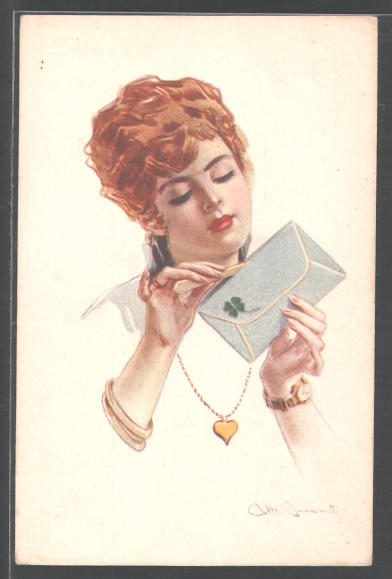
The State of Westralia has been fairly rich in public men who devoted business hours to writing love letters to other men’s wives. Let’s see—there was H. W. Venn, who woke one fine morning to find himself nearly as famous as Abelard or Dean Swift. But that is old history. This is now.
This is the story of W. Bede Christie, a gentleman who occupied a responsible position in the Lands Department up till last year, when a discerning Labor Ministry selected him to go and lecture in New South Wales and try to attract cockies to this great country.
Step up, Mr Bede Christie. How many trustful women’s hearts have you broken, you sly dog? Step up, and you shall be the Paul of this Paul-Virginia idyll.

In 1906 William Bede Christie—surveyor, author, lecturer, business proprietor, land booster for the state, student of astronomy and authority on Egyptology—was 64 and married. Which is definitely time for a song:

He had been touring NSW to promote the quality of farmland here in WA and to attract farmers from over there to over here.

Accompanying him was Mrs Margaret Regan, a matronly woman who was separated from her husband. However, William and Margaret posed as husband and wife while on tour, and when the Wyalong Star reported that W. Bede Christie and his wife were in town, the news filtered back to Perth.

Christie was immediately recalled by the Government, but the most embarrassing aspect of the story—for him at least, and probably for Mrs Regan—was the publication of his letters to both his lover and her married daughter, Pearl Bould.

Continue reading →