Guy, Shannon, Jessica and Power Pinn

PowerPinn

When Guy Sebastian, Shannon Noll and Jessica Mauboy team up with others to record a modern-day patriotic song, you know it’s going to be awful. And boy does it suck. Big time.

We challenge you to get halfway before scrambling for the stop button.

So Dodgy Perth thought it was time to take a look back at Perth’s best known patriotic composer of WWI, who went by the fabulous name of Elizabeth Power Pinn.

Mrs Power Pinn—who lived in Florence Street, West Perth—was utterly convinced of her own talent.

On her delicate shoulders fell the responsibility of churning out poems and songs which would cheer the troops, remind people at home of their duty, and generally assist the war effort.

It is an inviolable rule, though, that there are only two types of poet utterly convinced of their own talent: geniuses and the talentless.

Mrs Power Pinn fell into the second category.

Her biggest hit song was Australia’s Call to Arms, of which the opening verse went:

We’re the worthy sons of Britain,
The Nation of the world!
We’re going to hold the banner,
No matter where it’s hurled.
Of ev’ry page of his’try,
We’re going to paint the red;
And conquer foes as in the past,
When Drake and Nelson led.

Seriously? WTF?

On Friday nights, His Majesty’s Theatre would put on a variety show hosted by The Dandies. One of its stars was Linda Bradford, who was variously reviewed as a ‘gem’ and ‘she sings to the soul’.

Well, in January 1915, Linda made the mistake of singing one of Mrs Power Pinn’s latest jingoistic offerings: Flag of Liberty.

She did the best she could. But nothing could cover up the fact that the thing was god-awful.

The Sunday Times reviewer noted that while the words were bad, the tune was worse.

His sensible advice to The Dandies was to keep a gun handy for the next patriotic songwriter who offered “untuneful hogwash”. And to use it.

He kept a whole armory to stop jingoist writers himself, as well as mining the door to the office.

If only Guy, Shannon and Jessica had been given such advice, we would have been spared their instantly forgettable piece of blandness.

But to cheer up the Dodgy Perth readership convinced that songs can’t support your nation and be good, we offer the only decent jingoistic melody (slightly NSFW) ever written:
Anzac profits

anzac_4_sale

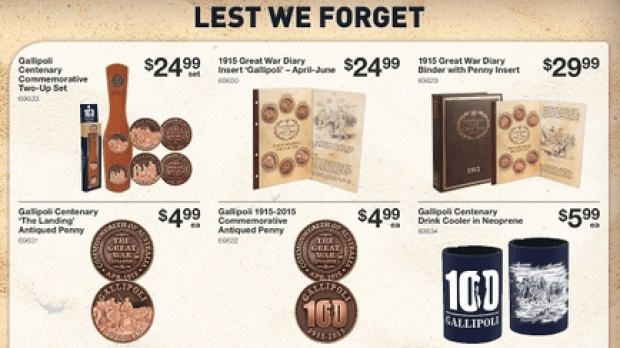
A few Anzac gifts available from the Post Office

As you bite into your Anzac biscuit, preparing to celebrate Anzac Day at Anzac Cottage, or maybe have a pint at the Oxford Hotel on the corner of Anzac Road, or…

You get the point. Anzac is a bit more than a military term. It’s a word full of emotion and value. Value in the ‘give me all of the money’ sense, that is.

The wonderful Ms History Punk has exposed the cashing in immediately—really immediately—after the word Anzac was coined. It wasn’t even an official word at first, just a nickname. It wasn’t even popular with some soldiers. So Ms Punk explores the seedy world of business folk safe back home in Australia who never missed a chance to make a little extra.

Like the Imperial Boot Co on Hay Street who announced an Anzac Sale in 1916. Yep. Apparently all those Anzac heroes going off to war meant they weren’t buying footwear like they should have been. And the poor shop was overstocked. So here was your chance to get some cheap shoes before the soldiers came home and the prices went back up again. That’s what they meant by Anzac Sale!

If you were in Bunbury during WWI and fancied a cool drink, fruit, lollies, or perhaps some beef or ham, we’d recommend the deli quickly renamed The Anzac to catch the current mood. Or if you were in Kalgoorlie, why not eat at the Anzac Grill Rooms?

Didn’t get a residence built for you by the local community? Presumably that’s because you weren’t a wounded serviceman. Never mind, estate agents will still sell you a lovely house as close as possible to Mt Hawthorn’s Anzac Cottage. Really close if you can afford a bit extra.

And finally, not serving overseas? Well you can pretend you are by buying some Anzac badges and Anzac hat pins to wear on Anzac Day. Then you can imagine you’re playing your part. And Boans can make a profit. By coincidence, of course.

It was all getting so out of hand that the WA poet Dryblower (aka Edwin Murphy) imagined a dystopia where:

It’s ‘Anzac Cottage’ and ‘Anzac-street,’
Anzac sox for your tender feet;
Anzac collars and Anzac ties,
Anzac puddings and Anzac pies.
Anzac stockings and Anzac shoes,
Anzac buttons and Anzac booze.
There’s an Anzac hat for an Anzac head,
And an Anzac bridegroom newly wed,
While spoony pairs will be sighing soon
For a sweet little Anzac honeymoon!

We were spared this nightmare when the Government suddenly banned the use of the word on anything commercial.

But you should still go to Anzac Cottage. And eat an Anzac biscuit. And be thankful we were spared Anzac socks. Although a pint of Anzac booze would go down nicely right now.

Halal, is it meat you’re looking for?

Halal-Australia-Logo-JPEG

Halal certification is the new burqa.

Organising boycotts of Aussie companies trying to export their goods is the new opposing a local mosque for ‘parking reasons’.

Few things make our blood boil at Dodgy Perth HQ, but racists pretending not to be racist because “Islam is a religion, not a race” is definitely one of them.

So with all the current fuss over halal certification, you might be forgiven for thinking this is something brand new. Something that Australian exporters have only started doing in the last few years. While they also enjoy funding terrorism. Apparently.

Well, no to all of the above.

WA’s ‘Afghan’ camel drivers must have had sources of approved foods. But it appears they often turned butcher themselves when meat was required.

The first halal certification scheme in Australia seems to have been in Queensland in 1905. Four Muslim butchers were brought over to certify the meat was prepared appropriately, so that exports could begin big time.

You will never guess what happened next.

Protests. And outrage. So much outrage.

Not because halal meat is cruel. Or that we were funding ISIS.

Just because the butchers weren’t white. Oh yes, it was White Australia time.

So, when a canning plant was planned for Wyndham, here in Western Australia, it didn’t take long for the exporters to start drooling at the thought of the tens of millions of Muslims in Malaysia, India, Afghanistan and elsewhere.

All they would need was halal certification and East Kimberley would boom.

In 1909, this was exactly what was proposed.

A Pilbara resident, H. Musa Khan, said that bringing over a couple of ‘educated and religious’ Mohammedans to supervise at Wyndham’s slaughter yards would enable all the canned meat (except pork, obviously) to be sold anywhere in the world.

Mr Khan was keen to stress that only a couple of Muslims would be needed, so White Australia would still be white. And this was not a job which could be filled by a white local anyway.

No one listened. Jobs and exports were not as important as racial purity.

Instead, by the 1920s live exports were thought to be the way to go. (And mainly, still are!)

After the Depression, some bright spark suggested again that perhaps a single Muslim might be brought over to WA. That way, halal certification could start and we could climb out of poverty and misery.

We suppose you can guess that no one listened.

White Australia 1. Beef producers 0.

The battle over Anzac Day

greatWarBear2

So, with Anzac Day coming up and the hundred year thingy being all important, Dodgy Perth asks the question: Won’t somebody think of the children?

More specifically: How should we introduce Anzac Day to the kids?

We have been pondering this since enjoying the savage beating Peter Stanley inflicts on Anzac Ted (an appalling-written book for pre-schoolers).

So Dodgy Perth now looks back to a different war. One between the Government and the RSL.

In the 1920s schools would invite a digger to speak on the subject of Anzac Day. Until 1925 when the Minister for Education banned them.

The RSL was outraged. Seriously, seriously outraged.

Led by the holy trinity of Rabbi David Freedman, Archbishop Riley and Sir Talbot Hobbs, the anger still seems palpable 90 years later.

The peacenik teachers and politicians were more concerned with ‘turning the other cheek’ and the newfangled League of Nations than teaching children to do their duty.

“Whether certain people like it or lump it,” Talbot Hobbs declared to loud applause, “we are going to do our duty by our fellow comrades.”

Anyone who said the RSL wanted to go into schools to teach children to kill people or war was a glorious thing was simply a liar, he thundered.

The Government, though, stuck to its guns.

There was no question of children not being taught about Anzac Day, it insisted. The question was not what should be taught, but who should do the teaching.

In this case, people who are trained to give instruction to young minds (we call them teachers, usually) were ideally placed to deliver lessons on the War.

Returned soldiers had certainly done their duty, but they were not qualified to communicate with the kids. That was best left to teachers.

In any case, there had been complaints after one digger spoke to the assembly for more than two hours the previous year. Which showed exactly how much they understood young minds.

Interestingly, for all their concern over children, the RSL regularly banned kids and women from the Dawn Service in Kings Park. Women and children do not lend an air of dignified respect to the occasion said the RSL, so they had to stay away.

So, nearly a century later, what have we learned about how to teach pupils about the Anzac story?

Given the regular fights between opposing camps of historians, Dodgy Perth suggests the answer is we have learned bugger all since 1925.

She’s got legs, she knows how to use them

legs2

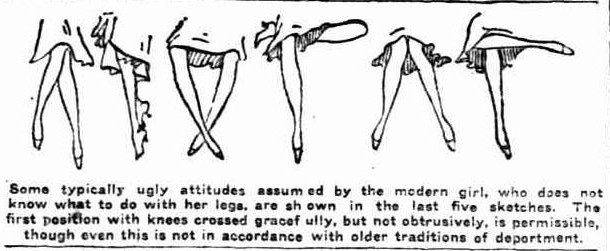
Seriously, somebody needs to teach the modern girl how to sit properly.

In the 1920s, the skirt did not so much creep up from the floor, but jumped from ankle to knee in one amazing fashion moment.

The consequence was that all the old rules on how to arrange your legs were useless in an age where sitting incorrectly could reveal a great deal more than stocking tops.

So, to celebrate International Women’s Day, Dodgy Perth presents advice to the international women of the world, taken from the Sunday Times in 1927.

See the young lady above? That’s good sitting.

See the legs below? That’s bad sitting.

legs

Now you know. So we expect better of you from now on.

Once upon a midnight orgy

001186d

Tell me again, Granny, how kids today don’t have any standards

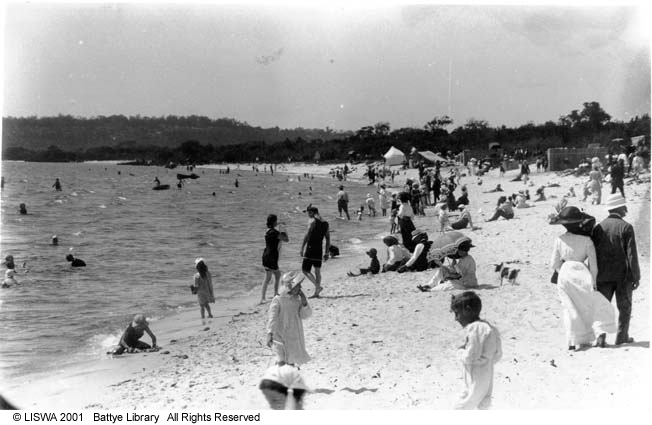
Once Crawley had all the nude parties and wild orgies by the river. Then Scarborough took up the challenge of being the leading place for such antics. But by 1936 Como Beach is where you needed to be for fun disgusting midnight parties.

One Sunday, decent members of society were shocked by what they encountered on a late-night stroll south of the jetty. Four drunken louts were chasing half a dozen tipsy girls along the beach. When they caught them, they dragged them back to a pile of stubbies.

And then—Dodgy Perth does not know if we can go on—they began tearing off their clothes like the wild beasts they were. God alone knows in what state of undress the girls must have arrived home the next day.

This degrading spectacle should not be allowed to happen on a decent beach like Como. Upright members of society need to be protected from having to see young people enjoying themselves. And the disgusting degenerates themselves should be locked up.

What makes it worse, as regular readers will have guessed, is these were not even working class louts. They came from some of Perth’s most respected families.

Four men, six girls. There’s a movie title there somewhere. Not the kind of movie Dodgy Perth would watch. Obviously.

The weed of madness

ReeferMadness-3

In the late 1940s, Reefer Madness once again took hold of Perth’s media.

The dreaded marijuana was running rampant throughout all levels of society.

As is well known, even trying marijuana once leads to murder, suicide, murder-suicide, rape, hallucinations, hallucinations about murder and rape, and eventual but certain descent into insanity.

Worse still, “the weed of madness” was leading to wild out-of-control parties in Perth. We assume that Dodgy Perth’s invite is in the mail.

As usual, Yankee sailors were mostly to blame for corrupting the innocent youth of Western Australia. And—as was the pattern in the States—most especially feared was the drug-pushing American Negro.

These scum would ply girls of a tender age with a single reefer containing the “evil sex drug”. Just one toke would see a previously chaste young lady start to behave in an outrageous fashion and be prepared to sleep with anyone.

Quite often, the poor victim of marijuana would not even remember what she had done the previous night.

It is time that police action was taken to stamp out the drug responsible for the most inhuman crimes in history.

It is a drug which is reducing our decent boys and girls to savages.

It is inconceivable that the media was exaggerating the effects of a single toke of grass. Inconceivable, I tell you.

Won’t somebody think of the children?

Booze, bullets and a body

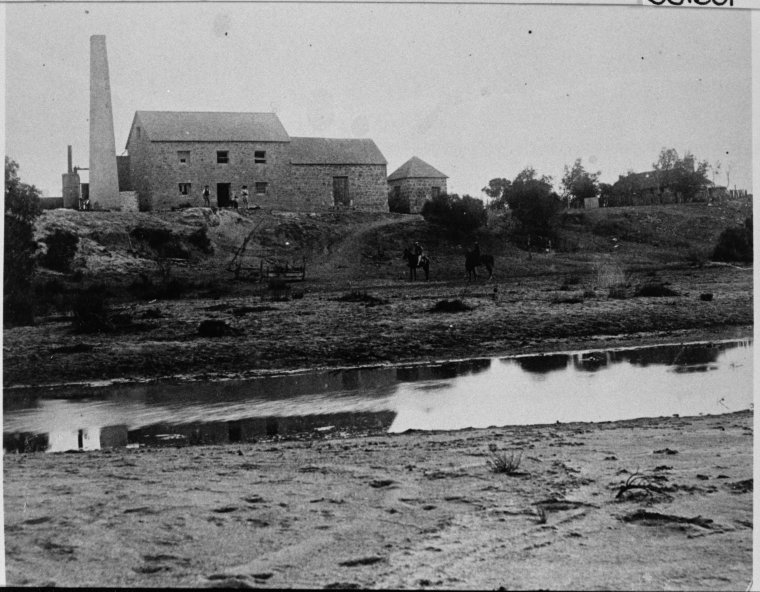
Maley's Mill, 1860

Maley’s Mill, 1860

To prove Perth doesn’t have a monopoly on stupid behaviour, Dodgy Perth temporarily becomes Dodgy Greenough. It was there in 1879 a few young blokes got together to celebrate Guy Fawkes Night.

When they met up near John Maley’s mill (above), it turned out that one of the gang had brought along two shotguns, a rifle and a canister of gunpowder.

What could possibly go wrong when a group of drunk young lads has possession of firearms, you ask?

At first they amused themselves by firing a few shots in the air, but this quickly proved boring. So one youth decided it would add to the evening’s entertainment if he unexpectedly fired his gun between the legs of his companions.

When fourteen year old, John Cook, got hold of the rifle, he decided to copy his mate. Sneaking up behind Isaac Patience, John put the barrel between Isaac’s legs and fired.

But instead of going clean through, the bullet smashed into the young man’s left thigh, tearing away a huge piece of flesh and shattering the thigh bone. Blood flowed everywhere.

The panicking group carried Isaac to his home, and one of them ran to get the doctor. Unfortunately before the doctor could reach the victim, poor Isaac had breathed his last.

John Cook was tried for manslaughter and, presumably overcome with guilt, pled guilty to the charge. The jury, however, had sympathy for the kid and decided that he was not guilty, despite his plea.

This, as you can imagine, divided the local community between those who wished to see Cook punished properly and those who agreed with the jury.

So next time you want a night out, Dodgy Perth suggests bullets and booze don’t mix. Stick to one or the other.

My island (sporting) home

Yagan_Statue

Statue of Yagan on Ma’tagarup

As Heirisson Island looks increasingly likely to become a sculpture park, Dodgy Perth takes a look at the time it almost became a sports complex.

But we at Dodgy Perth have no particular love for François-Antoine Boniface Heirisson, who left us nothing but his name, so prefer a much older designation: Ma’tagarup.

In 1950 the State Government gifted Ma’tagarup to the National Fitness Council, so the island could be turned into a sports complex.

WA180250

Before sculpture parks, there was sport

However, Perth residents were outraged. Not because they didn’t want more sport, but they had always hoped Ma’tagarup would be turned into a nature reserve for Sunday picnics.

There was more controversy when it was announced that Heirisson Island was to be renamed Causeway Island. Just think of the damage to our State’s history, said the Historical Society. Completely forgetting the name Heirisson erased an entire culture’s past.

Ma’tagarup was to become a “playground”, fretted the newspapers, who worried that alcohol would be served during sporting events.

Planning progressed, and various sporting bodies became quite excited about having an island home. The island was levelled and various government announcements told of a wonderful future for sport in Western Australia.

More than two years into the project, the whole scheme was suddenly dropped. No one had given a thought to how traffic would get on and off the island and, in any case, the reclaimed land didn’t even allow for construction. Bulldozers would just sink into the ground.

So that was the end of the redevelopment of the sacred island of Ma’tagarup. Until now. When people want to turn it into a sculpture park for Sunday picnics.

Only the Scouts can save us now

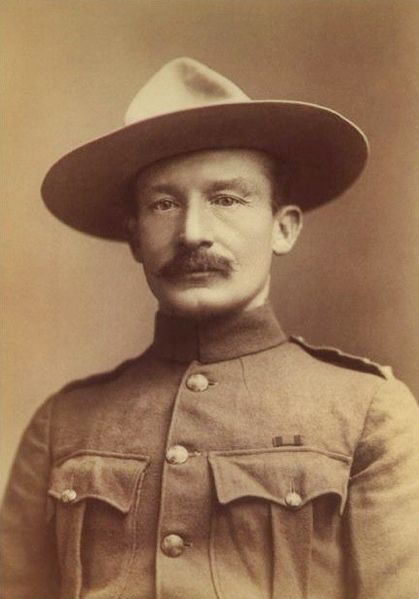
Robert Baden-Powell in 1896

Robert Baden-Powell in 1896

In 1912 Lt Gen Sir Robert Baden-Powell, founder of the Boy Scout movement, was being entertained by the Mayor of Perth, Tommy Molloy, in the Town Hall on Barrack Street.

After his praise had been sung by the assembled dignitaries, BP himself rose to speak.

His message was uncompromising: the Asiatic Menace was at Perth’s shore, and every available hand would be needed to fight them.

BP announced that he knew what he was talking about because he had been to China. While there were a handful of civilised Asians, the vast majority—there were millions of them, he warned—were still savages.

Any day now, these savages would rise up and seek colonies overseas. Especially Western Australia. And with an army of uncivilised men who would stop at nothing, it would be hard to resist.

He was good then, said BP, that Australians were already preparing to defend their homes from the coming invasion.

However, this alone would not be enough.

Here the Boy Scout movement enters the scene.

The whole point of being a Scout, said the founder of the movement, was to give self-discipline to a boy, make him realise his sense of duty, and to make it easier to turn him into a soldier when the Asians came calling.

So next time you see all those innocent-looking Cub Scouts, just remember: they’re a paramilitary force intended to save us from the malevolent Chinese and Japanese.

If they’re our best line of defence, we’re probably stuffed.